











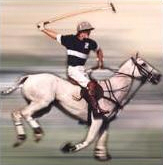
"What is Polo?"
A polo match lasts about one and a half hours and is played in six sets of seven and a half minute periods, called "chukkers". In "high goal polo," which may be equated to the "NBA" or "NFL" of polo, a horse might cover two and a half to three miles during a single chukker. As you may imagine, this drains a considerable amount of energy from the horse, so it's unthinkable to have a single horse play in more than one chukker successively. After resting for three or four periods, some horses can return to the game. In championship polo, a player will almost always come to the field with a minimum of six horses. The horses are usually thoroughbreds and nearly all of them have racetrack experience. Polo "ponies" go through intense training in order to adapt to the sport and to be prepared to obey the swift commands of their rider.
Many quality ponies have very high value, ranging from $30,000 each to
upwards of nearly $1 million in very competitive circles. (They are deceivingly called "ponies" because of the original breeds used to play polo more than 2,500 years ago). As you may imagine, they
often have life insurance policies and special attention is given to them when they travel--either by trailer or by airplane.
The best ponies are constantly flown between the continents to play at
the world's most prestigious tournaments--from Royal Guards Polo Club
in Windsor, England to Palm Beach Polo Club in Wellington, Florida,
and to fields in Argentina and the Middle East. Polo, because of
its great expense, is often referred to as the "Sport of Kings" and
attracts a celebrity following, ranging from Prince Charles and his
sons, Princes William and Harry, to Tommy Lee Jones.
COMPARISON:
One might better understand polo if it were compared to a more common sport. The closest comparison would be hockey. There are four players on a team and each assumes a specific position--either offensive or defensive. However, given the enormous size of the playing field (160 x 300 yards, which is the equivalent of three
American football fields), the momentum of the galloping horses, and the ball's unexpected changes of direction, the game is very fluid; positions are constantly changing. There are few set plays in polo, so good anticipation almost requires a sixth sense.
The four players on each team are assigned positions, designated with numbers from one to four. These numbers can be clearly seen on the team jerseys. Number 1 is the forward offensive player. Number 4 is in the
rear, and his responsibility is defense. Numbers 2 and 3 are usually the highest rated and most experienced. Player number 3 is usually considered the "quarterback," although in polo he would be deemed "field captain." Number 2 is responsible for pushing the play both on the offense and defense at all times. In defense play, each player is assigned an opponent for which he is responsible; number 1 usually covers the opposing number 4 and number 2 usually covers the opposing number 3.
RIGHT OF WAY:
When a sport involves horses (each weighing thousands of pounds) galloping at high speeds (up to 35 m.p.h.), there is a necessity for a right of way rule. The most basic rule of polo is the "line of the ball." This right-of-way is established by the path of the traveling ball. Like the rules of the road, there are dos and don'ts governing access to this right-of-way and in regard to crossing it. Within these limitations, a player can hook an opponent's mallet, push him off the line, bump him with his horse, or steal the ball from him.
It is essential each player follow the rules because failure to do so could cause serious injury or death. If a player misses a shot, he must either wait for his teammate to pass it up to him or he must circle around and follow behind the other players to support his teammates. Naturally, if he wants to turn around, he must turn away from the line of the ball; otherwise the potential of being struck by an oncoming horse is very high.
RULES:
If a player is on the left side of the line, and his opponent is on the right side of the line, the opponent may "hook" him, which means shot may effectively be blocked when his opponent places his mallet into the path of the swing. Another means of offense would be the opponent hitting a
back shot (which would send the ball traveling toward his own goal) before the defensive player could hit it forward.
If an offensive player is on the left side of an opponent and both are on the left side of the line of the ball, the offensive player can "bump" or "ride off" his opponent by steering his steed into his opponent. In other words, a player may actually ride his horse (when the horses are shoulder to shoulder) against his opponent's horse and drive him off the line
causing him to miss his shot.
FOULS:
When a foul is called, penalties are awarded as free hits. The more severe the foul is, the shorter the distance to the goal. The closest hits are almost certain goals because the goals are spaced a full eight yards apart. The ball is three to three and a half inches in diameter. There is no net, of course, because a rider and his horse
sometimes pass through the goal because of the speeds involved.
CHANGES IN DIRECTION:
After every goal is scored, the teams change sides in order to compensate for field and wind conditions. As
in hockey, a typical score would be low, and would usually not be more than something similar to 10-7.
FAIRNESS:
Polo games are played with each team having equal skill for fairness. Every registered player in the USPA (United States Polo Association) is awarded a skill rating from -2 (the lowest) to 10 (the highest). Only a handful of U.S. players are rated above 6, and even less have attained the famed 10. A player's handicap is usually referred to as the number followed by the word "goal." Someone with a handicap of 10 would be referred to as a "ten goal player."
Matches are usually paired evenly, but if one team has more skilled players, the sum total rating of the players' handicaps on the team is subtracted from that of the opposition. Any difference is then awarded to the lower rated side in points on the scoreboard. When matches are paired evenly, the sum of the handicaps of all the players on the team equals the level of the match. "High goal polo" refers to matches where the handicap sums are exceptionally high, meaning the players are exceptionally skilled. Most average teams have four or five goal polo at the most, meaning that the combined handicaps of players on a team equals four or five. However, in famed polo outposts like Oak Brook, Bridgehampton,
Greenwich, or Palm Beach, one will find "high goal polo" where the games might be ranked as ten, twenty, thirty, or even forty goal polo. The latter is extremely rare and would only be seen in championship games, such as the U.S. Open or World Cup, which are played at Palm Beach Polo. "Twenty-goal polo" might mean a team consists of four five-goal players (players with handicaps of five each), or perhaps two four-goal players and two six-goal players.
RULE ENFORCEMENT:
Games are supervised and officiated by two mounted umpires on the field and a referee in the stands.
HISTORY OF THE GAME:
Possibly the oldest team sport, polo's beginnings are speculative. Polo was probably first played on a barren campground by nomadic warriors over two and a half thousand years ago in Asia. It is believed to have began in Persia.
Valuable for training Cavalry, the game was played from Constantinople to Japan during the Middle Ages. Known in the East as the Game of Kings, Tamer lane's polo grounds can still be seen in Samarkand.
British tea planters in India witnessed the game in the early 1800's but it was not until the 1850's that the British Cavalry drew up the earliest rules and by the 1860's the game was well established in England.
James Gordon Bennett, a noted American publisher, balloonist, and adventurer, was captivated by the sport and brought it to New York in 1876 where it caught on immediately. Within ten years, there were major clubs all over the east, including Newport and Long Island.
Over the next 50 years, polo achieved extraordinary popularity in the United States. By the 1930's polo was in the midst of a Golden Age - it was an Olympic sport and crowds in excess of 30,000 regularly attended international matches at Meadow Brook Polo Club on Long Island. The galloping game produced athletes who would doubtless have achieved greatness in any sport: Cecil Smith, the Texas cowboy, who held a perfect 10-goal rating for a still-record 25 years; Devereux Melbourne, instrumental in formulating modern styles of play; and Tommy Hitchcock, war hero, and the best of the best in international competition for two decades.
In the past 20 years, polo in the United States has undergone an unprecedented and remarkable expansion. At present, there are more than 225 USPA member clubs with over 3,000 U.S. players. Check the USPA
web site for the location of a polo club near you.
Polo is an international sport. During the summer season at Hurlingham, England, the fall season at Palermo in Buenos Aires, and the winter season at Palm Beach or Palm Desert, thirty to forty teams will be manned by players from the United States, Argentina, Zimbabwe, Canada, New Zealand, Pakistan, Mexico, France, Australia, South Africa, Great Britain, and a dozen other polo playing countries. For over 30 years, the Argentines have been preeminent in the sport; nevertheless, explosive growth in players and the availability of good horses is honing the competitive abilities of challengers from many countries, including the United States.
*Information made possible in part from the USPA website.
Home •
Members • What is Polo? • Photos • Meetings • Links • Clinics
Schedule • Request Information • Chicago Area Clubs