
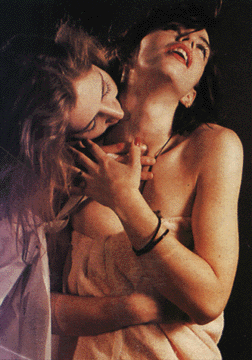
The sudden appeal of the lesbian vampire really grew out of the early 1970s although representations had existed before that as evidenced in novels and literature. This appeal grew along side the greater feminist movement that was going on during this time. Because of this relation, it can be argued that the overt sexuality and �subversive� practices of the lesbian vampire allowed the female audience, or women, in the 1970s a role model of sorts or at the very least the portal in which to safely act out these lesbian fantasies in a time when social and political unrest was going on. As Weiss argues, �the lesbian vampire is at once attractive and threatening to men, in part because she expresses an active sexual desire� (Weiss, 1993: 90).
Despite this relation to the feminist movement and ideologies of the 1970s, the typical representation of the lesbian vampire is for the most part subjugated within a male spectrum and context, with cinematic presence vying more for a male audience than a female one, although this is not to say that the female audience is dismissed outright. In examining several films in which the lesbian vampire has greater onscreen presence than her male counterparts, it is interesting to note that several commonalities exist between these vampire lesbians. One of the representations noted was that of the ultra feminine and exquisitely beautiful vampire. She is never portrayed as butch or mannish, but always as a visually spectacular object that speaks directly for the fantasies of the male mind. Moreover, she uses her seductive charm, rather than any supernatural forces she may possess in order to over come and kill her victims. This is in direct contrast to the male vampire images we see most often, in which he will use his supernatural powers along with or without his seductive charm. This indicates that the relationship between the female lesbian vampire and her victim is mutually desirable and setting it clearly within a sexual context. Another apparent representation that exists within the lesbian vampire is her openness in her nudity. She is often portrayed in film as wearing the most sexualized clothing, either very little of it or she is dressed in such a way as to elicit a sexual response. In addition, she is oftentimes naked, baring breasts as a visual spectacle. Weiss argues that this �breast fetishism� within vampire cinema �helps reduce lesbian desire to an infantile, pre-Oedipal phase of development� that causes a deflection of audience criticism from the contradictions generated by the lesbian vampire (Weiss, 1993: 96). By contradictions, I mean, the lesbian vampire as a dangerous sexual female yet she is viewed within male spectatorship. Furthermore, the vampire lesbian is never without her male counterpart. Either she carries on a heterosexual relationship with a male vampire or she uses her sexuality to overtake male, as well as female, victims.
These representations were clearly seen in the films I examined. Although I had wanted to examine and analysis more (as there are many out there to analyze), time and space constraints only allowed me to examine three: The Hunger, The Vampire Lovers, and Lust for a Vampire. In all three films, there existed a female vampire bound by her desire for lesbian experience, who is visually stunning, sexually captivating and cunning, and placed within either an overtly heterosexual relationship or experience or a covertly one.
Weiss, Andrea. Vampires and Violets: Lesbians in Film. Penguin Books, New York. 1993.
Whatling, Clare. Screen Dreams: Fantasising Lesbians in Film. Manchester University Press. 1997.