|
SPECIAL
ASSISTANCE FOR PROJECT IMPLEMENTATION (SAPI)
Written
by : Rita 'Adek' Artanti
 The
existence of Renun HEPP in Dairi threaded the lack
ness of the water as source of life villagers of
four villages (Pegagan Julu II, IV, V, and
Parbuluan Vi). LSPL have organized and strengthen
the villagers for four years and fortunately the
problem now is getting clear is there is a
dialogue between the villagers, the owner of Renun
HEPP and stake holders. The
existence of Renun HEPP in Dairi threaded the lack
ness of the water as source of life villagers of
four villages (Pegagan Julu II, IV, V, and
Parbuluan Vi). LSPL have organized and strengthen
the villagers for four years and fortunately the
problem now is getting clear is there is a
dialogue between the villagers, the owner of Renun
HEPP and stake holders.
JBIC,
which was regarded as the source of the problem
because JBIC is creditor (grand giver) of the
project, accepted the complaints of the villagers
through LSPL. JBIC considered it rational and
should be solved as soon as possible.
Positive
respond of JBIC is by conducting SAPI study, which
was held by Newjec (SAPI Team). This team worked
in cooperation with the local people accompanied
by LSPL.
SAPI
study was conducted from May to September 2003.
The goal of the study is to recover the trust of
the villager toward Renun HEPP and to anticipate
life survival of local people and sustainability
of Renun HEPP, due to Renun HEPP and the villagers
utilizes the some source of water. That is Renun
River and its 11 tributaries (Mbara, Mbontar
Sibira, Simartaban-taban, Lembara, Sapatonga,
Sigilang, Patuak, Sipaha, Pinagar, and Manalsal
River).
To
reach the goal, SAPI study collected data of the
width area of paddy field, fishpond, and the
number of the population in the area. SAPI also
measured the water unit demand for each part. The
study did not stop there as SAPI also studied the
condition of the forest on the upstream of the
river, as water catchments area for the 11
tributaries.
At
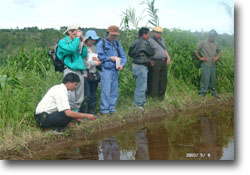
the same time, SAPI conducted social research to
understand the pattern of life of the villagers
applying Participatory Rural Appraisal (PRA)
method in 8 representative villages. These
activities were conducted for about 3 months.
The
villagers respond positively the study and they
supported all activities held in the villages
through their representatives who actively
involved in every activity.
The villagers informed their width area of
paddy field, fishpond, measuring water demand unit
and stated their perspective in very cooperative
way. It was clear as they said that they did not
have any intention to be barriers in whatever
development planned in their area. They just want
that government paid attention and anticipate of
every possible bad impact of the development
toward the villagers.
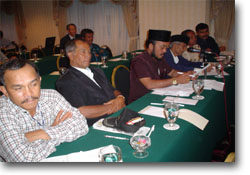
After
same meetings (12 June, 18 June, 13 August, 15
August, and 18 August of 2003) which discussed
about SAPI study and the result of the study, on
last meeting dated 19 August 2003, PT. PLN (Persero)
fulfilled the demand of the villagers in one
Statement signed by head of PT. PLN Pikitring
Sumut-Aceh and Kitlur Sumbagut, witnessed by the
representatives of the 4 villagers, local
government of Dairi, Province government of North
Sumatra and 3 local NGOs (LSPL, DMEM, KPPL).
 The
point is PT. PLN (Persero) acknowledge and receive
SAPI Study result. Based on the data, PT. PLN (Persero)
would put the water demand of the villager as
first priority. The villagers own 2,708 hectares
of paddy field, 28.85 hectares of fishpond and the
population was 9,018 persons as the main part
utilizing the water of 11 tributaries and only the
rest of the water would be utilized by PT. PLN (Persero). The
point is PT. PLN (Persero) acknowledge and receive
SAPI Study result. Based on the data, PT. PLN (Persero)
would put the water demand of the villager as
first priority. The villagers own 2,708 hectares
of paddy field, 28.85 hectares of fishpond and the
population was 9,018 persons as the main part
utilizing the water of 11 tributaries and only the
rest of the water would be utilized by PT. PLN (Persero).
PT.
PLN also agreed to involve on the recovery program
of Lae Pondom forest together with related office.
Lae Pondom forest has been under damage process of
55,5 %for these 10 years.
Dissemination
of the information was not only held in local
level but also in the national level by holding
Feedback Seminar on 21 Augustu 2003 in Jakarta.
One
more step is being prepared of the moment. Stake
Holders (PT. PLN, society, NGO and Government
agencies) demand to be actively participate in
water use management when Renun HEPP starts its
operation in 2005. And last but not less, the
stake holders pay concern to keep the harmonious
relationship between society (local people) and
the Renun HEPP.

|