 |
|
 |
| Some words on the Black-Collared Lovebird , They are shy and do not breed well in captivity. As you can see they are not as coloful as the Lovebird we know. Thier eyes are smaller and they are more slender than a Lovebird. These birds are not easy to tame even from newborns. They have black/grey beaks which is not found on the Peachface Lovebirds. Aviculture: probably not kept outside distribution area; few birds caught died after few days or weeks; no further information available. Habitat: evergreen lowland forest and montane forest to 1,800 m (6,000 ft). Habits: in flocks of up to 20 birds outside breeding season; mostly observed flying; conspicuous during flight because of screeching; otherwise difficult to detect; well camouflaged by plumage; prefers tops of trees and seldom comes down to ground level; shy and unapproachable; flight swift and direct; call sharp and metallic; also subdued twittering. Breeding behaviour: very little known; breeding season probably in July; nests in arboreal termite mounds; no further information available; egg measurements unknown Breeding in aviculture: unknown. Grouping the Lovebird Species There are different ways of grouping these lovebird species. A popular method separates lovebirds in four groups, according to similarities between each species. These groups are: Sexually Dimorphic, Eye-ringed, Intermediate, and Black-cheeked. The Sexually Dimorphic group consists of the Red-faced, Abyssinian and Madagascar lovebirds, because the sex of a lovebird can be determined by its colouring in these species. The Eye-ringed group is made up of the Masked, Fischer's, Nyasa and Black-cheeked species, as they all have an eye ring. The Peach-faced species is known as an Intermediate group, because it shares some traits with both the Eye-ringed and Sexually Dimorphic groups, but Peach-faces are not sexually dimorphic and do not have an eye ring. Black-cheeked Lovebirds, the least known species, are placed into their own group, because they do not fit into any of the other groups. Some experts believe that the Sexually Dimorphic group is the most ancient, and that the other species evolved from that group. Some people think that the lovebird's closest relations are the Hanging Parrots, while others think that lovebirds are more closely related to the African and Indian Ringneck, King parrot and Eclectus group. A short note on Humming Birds...I also like Humming Birds. I have always like watching Humming Birds drink from my bird feeder. They are very tiny birds I invite you to see some good pictures and movie film of them. Please Click here. |
 |
|
|
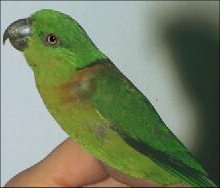
Description: green; head, breast and abdomen slightly paler green; narrow black band to nape; adjoining neck area yellowish to olive-yellow; lower back blue; under wing-coverts green; flight-feathers black with green edging to outer webs; tail green, outer feathers with black and orange-red barring; narrow periophthalmic ring grey; bill greyish-black; iris yellow; feet grey. Diet: figs; softbill insect food; also offer seed mix of various millets, canary grass seed, some niger and hemp; millet spray (also sprouted); regular half-ripened grass and millet; greenfood, fruit and vegetables; eggfood; birds not given figs soon died. |
 |
 |
| y |