| Learn more about both of these excellent air medevac programs and others by ordering your copy of Angels of Mercy -- Just $19.95 in VHS or DVD. (Color - 29:00) |
 |
 |
|
 |
| Lou Angeli: Fire-Rescue Features and Articles |
| by: Lou Angeli editor: John Piege |
| (Dade County, Florida) -- It's dinner time at Miami-Dade's Fire Station-24. As in other North American stations, mealtime is a special time for coming together and sharing good food and fellowship. |
| As the crew gathers for dinner, a TV airing the local Miami news, brings today's events into focus, and tonight's lead story features another serious shooting, one of hundreds that take place in the Miami metro area each year. |
| No one knows better than the crew of Station 24, for they are the Miami area's Angels of Mercy. It's their job to "fly" the most critically injured patients aboard Air-Rescue One to Trauma Centers in and around Dade and Monroe Counties in South Florida. |
| As the crew looks up from their chili to watch the TV report, video of their specially equipped Med-Evac helicopter comes into view. This time it's an undercover "drug-buy" gone bad and the anchorwoman reports that a police informant and DEA agent have been shot. |
| Flashback: 2 hours ago! Lou Angeli |
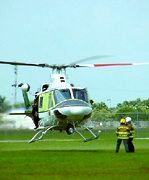
| As we make the Landing Zone, gunfire is still being exchanged, and the pilot determines the situation to be too hairy. He instructs our team to remain on board the ship. As I slouch lower in the cabin, I imagine that Vietnam was a lot like this. |
 |
| As the patients are loaded aboard the chopper, the full extent of their injuries become painfully obvious. Body armor has saved the agent's life, but a 9mm round, delivered point blank, has straight-lined the informant and ended his life. |
| As street violence continues to become increasingly lethal, the difference between life and death often means shaving precious minutes off the trip to the Trauma Center. Unfortunately, In this case, medics will save only the agent's life, as the bullet has ripped away at the informant's chest cavity. |
| Ground crews direct Air-Rescue One onto the LZ or Landing Zone |
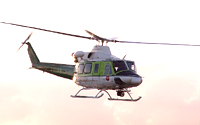 |
| Metro-Dade Fire & Rescue covers a 2500 square mile are with a population of over 2 million. With Air-Rescue-One, the department is able to provide quick response to all South Florida residents, even those in remote areas like the Keys and the Everglades. The cost of operating their Bell-412 chopper is well over $2 million per year, and there will soon be three in the fleet. |
| The Importance of Air MedEvac |
| In more and more communities, MedEvac helicopters are "the" answer to saving lives, by compressing "time" and "space" in the race against the "Golden Hour". |
 |
| Over 1100 nautical miles on Interstate-95 lies North America's largest and most advanced MedEvac system. And like many Mid-Atlantic states it's operated not by fire or rescue, but by law enforcement. |
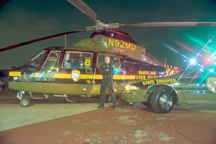
| It's shift change, and Trooper-Pilot John Gainey of the Maryland State Police is making a pre-flight check of his $5.5 million Dauphine II helicopter. It's one of 11 ships in the Maryland State Police Aviation Unit, a system that costs $33 million per year to operate. |
| A Multi-Task Emergency Unit Lou Angeli |
| During our three-day fly-along on Labor Day weekend, we fly to a number of emergency incidents. But the first has nothing to do with stretchers or IV's. It's a police call, so as firefighters, we're a little spooked. We're responding with TrooperOne, the Middle River crew, to assist Baltimore County Police on a report of automatic weapons fire. |
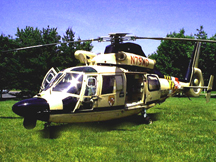
| MSP flies the $2 milion Europcopter Dauphine |
| I ask through the headset, "Could you guys drop us off at the Mall parking lot?" No one answers. I guess not! |
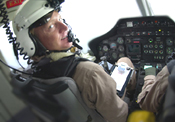
| As we approach the area. Gainey places the Dauphine into a 120mph, � mile diamater orbit. He reminds us that the fuel bladder is just under our butts, so he's exposing a less vulnerable side of the chopper. His partner, Medic Sergeant Doug Dodds keys his mic, |
| "Can you guys see anything through your camera lens?" Centrifugal force has us plastered against the bulkhead, but I manage to bring the camera to my eye. |
| Mutual Aid in the Skies |
| On the Watchman monitor I see three gents, with a cache of automatics laid out on a beach blanket. They're target shooting -- at a small herd of deer. The monitor shows one of the gentlemen extending us warm regards, as the others cover their weapons. Dodd directs Baltimore County Police ground units into the scene, who move in for questioning, and we return to base. |
 |
| Search and Rescue |
| As evening arrives, our camera crew grabs a quick shot of the ship on the tarmac -- nicely framed with the late summer sun setting behind the main rotors. But before we can fold the tripod, Gainey and Dodds come hustling toward us from the hangar. The roar of the turbine means its showtime! |
| Trooper-One is responding to assist volunteer firefighters and marine patrol personnel in North East, Maryland, where a systematic search for a boater in distress has been initiated in the northern Chesapeake Bay. The report is for a boat out of fuel, and its operator, a diabetic, out of insulin. He's said to be shocky. |
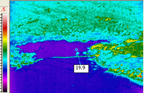 |
| The sun has already set behind the Western Maryland mountains, so the crew of Trooper-One bring out the neat hardware. Dodds remotely operates a Forward Looking Infra Red (FLIR) combing the waters west of Perryville point. During SAR Ops like this one, the FLIR allows the crew to "see" the victim's "heat signature" even in total darkness. |
| Just a few years ago, this mission would have been likened to finding a needle in a haystack. But within 10 minutes, the crew locates the boater/patient, who's hung his 24 foot "party barge on a sandbar near the mouth of the Susquehanna River. Fire and Rescue marine units are directed in, and the patient is moved to a Delaware State Police Bell-407, which was directed to the scene while returning from Baltimore�s Johns Hopkins University Hospital. Mutual aid in outerspace. . .so very, very cool. |
 |
| Medics On Patrol |
| As Gainey swings the ship into a gentle turn toward the southwest, Dodd answers a radio call -- this one for an injured patient near the Pennsylvania State line. A brightly lit football field makes an ideal Landing Zone for the crew of Trooper One. |
| For the spectators, an unexpected half-time show unfolds as the powerful Aerospatiale "touches down" on the field. It's first down at the 20 yard line as the well-rehearsed MedEvac takes place. |
| The only surprise is the patient. She's a cheerleader who fell victim to a sideline stunt gone horribly wrong. The 17 year old fell from the top of a human pyramid and has suffered a ghastly compound fracture to her leg. Not the expected patient in this case, but in this business you quickly learn to expect the unexpected. |
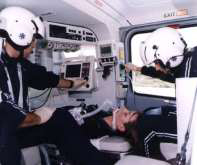 |
| As we lift off toward Baltimore and definitive health care, the cheerleader is screaming at the top of her lungs. Following protocol, Dodds administers what seems to be an extraordinary dose of morphine, but the teen screams even louder. Dodds lowers his head to her face, and his look of concern is quickly replaced by a full-face grin. He keys his mic. |
| Patient care at 180 knots and 500 feet above Earth. |
| "It's not the pain,' he laughs, 'she's afraid of flying." |
| Within 15 minutes were landing at University of Maryland Shock-Trauma, where this frightened cheerleader will receive some of the best hospital care in the country. Just another in the several thousand emergency medical sorties that MSP aviation personnel will attend this year. |
|
 |
 |