| Fire-Rescue-EMS Features and Articles by: Lou Angeli |
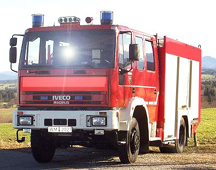 |
| A US Firefighter test drives the EUROFIRE, the world's most popular fire engine, |
 |
| (Pesaro, Italy) -- At fire stations around the World, dinnertime is a special time. A time when the firefighting family comes together to relax and carry on some friendly conversation. And this isolated brigade station in Italy's mountainous Marche' region is no exception. |
| Besides me, there are 7 others at the table, 5 career firefighters, and two military personnel, 18 year olds drafted to serve their mandatory year of military duty. Lou Angeli |
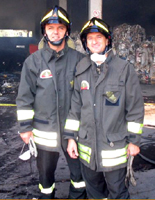
| A mix of career, military and uniformed volunteers, they are all proud members of Italy's Vigili Del Fuoco - the World's very first firefighters. Maurizio, one of those rookies, chose firefighting over the Navy because he says, "my parents' home is next door to the fire station." Not bad duty, I think. |
| The crew from Squadra "B" has just treated me to a meal of "gnocchi con la salsa del piccione" (potato pasta with domestic pigeon), which at first mention doesn't sound too appealing, but is every bit as tasty as FDNY 58 Engine's Chili Mac. I've brought the ice cream, but am eagerly awaiting a special dessert - a treat that the crew's been planning for a week now. |
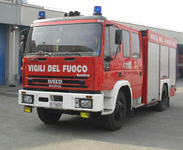 |
| With the permission of the provincial commander, I've been given the OK to test-drive the station's new pumper - an Iveco-Magirus "Eurofire". According to the crew, theirs is one of the prototypes for nearly 200 similar pumpers that are being delivered to stations throughout Italy, a country the size and population of California. In fact the Eurofire is an unlikely success throughout Europe, where there are few firefighting regulations, and very little standardization. |
| Big Change For Firefighters |
| Iveco-Magirus first introduced the concept of a Eurofire "standardized" machine in 1993, about the time the continent became commercially united. Before the 90's, the quality of apparatus varied dramatically from one European country to another. Squad B's going joke is, "Europe's "used" rigs went to the French as their new machines." But when the borders opened several years ago, so did many eyes, and Iveco-Magirus was able to promote a successful program to develop a standardized pumper that would meet both ISO and European Community standards. |
| Walking past the 4x4 Rapid Rescue Unit and duty officer's Range Rover, I notice the old pumper that I rode 5 years prior. With 25 years of service, it now stands in proud reserve. Like many older rigs, it's leaking some strange black fluid onto a pan that's been strategically placed to catch the drippings. Most noticeably, it is dwarfed by the Eurofire in the next bay.. |
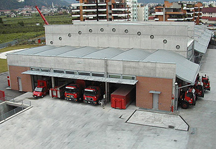
| Since my last visit 5 years ago, these Italian firefighters have made an incredible transformation, with a major emphasis on personal safety. These members have moved from a crumbling station built in 1890 to a brand new gated compound, with more bays than machines. During our "training" exercise, the company will remain in service (a la strada), so everyone but the watchman grabs their gear bags and wanders from the day room to the engine bay, heading toward the pumper. |
 |
| A Firefighting Machine: Not a Parade Piece Lou Angeli |
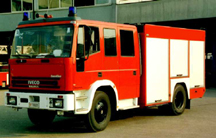
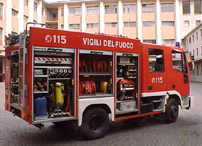
| Italy's version of the Eurofire, like most European firefighting machines, is built for utility -- not looks. There is no chrome, no glitz! With the exception of roof mounted ground ladders, everything is fully enclosed within a tightly fitted aluminum frame and roll-up doors. The shift officer does a quick round robin tour of the rig, explaining to me that the body frame has no welds - but is glued together. The body itself is a mix of aluminum and poly painted in LA County's shade of red with white trim and reflective letters. |
| I'm thrown off by the size of the new machine. It's as large as an American pumper, with more ground clearance and a very high profile - 8 and a half feet. The Eurofire is available on several different chassis, which are usually determined by country. The French prefer a Renault chassis, and German brigades tend to order the Eurofire with the MAN chassis underneath. But these Italian machines are built on the popular Iveco chassis. |
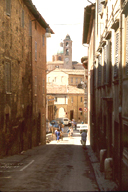
| Overall length is 24 feet and the machine weighs in at 14,000 kilos, or about 28,500 pounds. The previous generation of Italian apparatus were built on much smaller chassis, which I jokingly refer to as 2/3rd modeler's scale. They were designed to maneuver the tight turns and narrow streets of an infrastructure that at its youngest, is 500 years old. Even with this new Eurofire on its roster, this station still operates with a mini-pumper, that responds to all incidents in the old towns where some streets are just 7 feet wide - from building wall to building wall. |
 |
 |
| Long before we introduced enclosed cabs in the USA, the Europeans had already been riding safely INSIDE their rigs for 30 years. In fact, so much room was devoted to keeping personnel safe, that the concept of preconnected hose and hosebeds was never really embraced. "Hosebeds', the Italians claim, 'take up too much room, and valuable storage". |
| Speaking of storage, the Eurofire is jam packed with tools of the trade. In a cabinet on the driver's side of the rig are a dozen or so donut rolls of 70mm Attack Line and 100mm Supply Line, each placed with the Stortz fitting front and center. In addition to Italy's standard brass smooth bore nozzles, there are two American made KK Thunderfog combinations holstered in an adjacent nozzle cabinet. |
 |
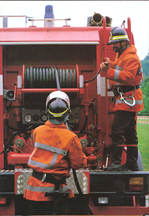 |
| As with all European fire engines, the pump is mounted at the rear and is simple, with a sparse array of controls. This 1000 gpm pump has just two intakes and four discharges fed by a 3200 liter booster tank. Unlike stateside pumpers, there is limited metering and no governor. |
 |
| Mounted above the pump controls is the workhorse hoseline of most European brigades. It's a a 22mm high pressure booster line fed by a separate high pressure 400psi pump, similar to the FMC/John Bean pumps that were popular here in the states in the 1970's. This is their "first-off line" for every type of fire incident, including structural fires. Knowing that second due companies may be 20 minutes out, Italian firefighters prefer the low volume delivery of a high- pressure line because they feel it stretches their water supply. |
 |
| In Part-2 of this feature, Lou Angeli takes us aboard the Eurofire pumper for a demo drive and an emergency incident that is not your run of the mill fire-rescue call. |
| Eurofire on Iveco chassis |
 |
 |
 |
|
 |
 |
 |
| 5th Anniversary Commemorative honoring the 70,000 volunteers, who served at Ground Zero. |
|
|