| Fire-Rescue-EMS Features and Articles by: Lou Angeli |
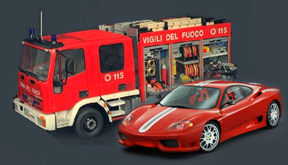 |
| Italy's love affair with things FAST! |
 |
| Part 2 of Lou Angeli's series highlighting the most popular fire engine ever manufactured...anywhere! |
| With the inspection completed, L'Autisto (literally, the chauffer) motions me to the right front seat, which unlike America, carries no special prestige, since the squad officer rides in the rear crew compartment with other firefighters. We belt in as the driver turns over the diesel. He drops it into gear and I drop deep into the bucket seat with the SCBA brackets poking at my ribs. He's just demonstrated this Eurofire's pick-up. |
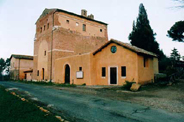
| The Vigili del Fuoco (Fire Watch) station is just a few hundred meters from the Via Flaminia, the ancient road that leads between Rome and port cities on the Adriatic Sea. With the exception of blacktop, road signs and a few new straight-aways, the road is just like it was 2,000 years ago -- tight curves and narrow right-of-way |
 |
| On the road...finally |
 |
| It's important for me to note that all Italian drivers believe that life on the roadway is a Gran Prix. On the "Autostrada" (The Interstate system), there are no maximum speed limits posted - just minimum. The far left lane is there for the brave and/or the crazy. It's not unusual to be traveling at say 80mph, and be passed by someone doing 110mph. And if the car is of German manufacture, make that 125mph. |
| So it should come as no surprise that our first call is to an auto accident |
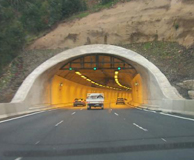 |
| The dispatcher reports an "incidente motore" on the Via Flaminia, "inside the tunnel". Even though the accident is 24 kilometers away, this company is the closest. I understand now why speed is important to the Italian Firefighters. There are very few stations (263 in the entire country) and they're often spaced 60 clicks apart, so response time, and quick intervention, is dictated by their ability to get there pronto. |
| Taking the Eurofire to task |
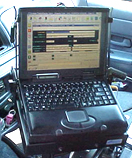
| In the rear view mirror, I can see the volunteer ambulance closing in from a distance. So does the driver, Luciano. He curses in Italian about "the death wagon" as he slips the stick into 6th gear, and adds juice to the 210hp supercharged diesel. I wedge my feet on the dashboard, tighten the belt, and begin snapping pictures. We're booking down a narrow two-lane road, with Bruce Springsteen's "Born To Run" blasting on a portable boom box. Whenever there's a straightway, "Looch" stays put in the opposing lane, passing truckers, farmers' tractors and teens on Vespas. We're doing about 110 kph - you do the math. |
 |
| Three beeps, and an urgent radio report from the station watchman says that the Polizia Stradale (Highway Patrol) are reporting a two car accident, "inside the tunnel, with fire." From the rear, IL Capo immediately radios orders to the watchman -- he and the remaining military firefighter are to respond with the Rescue Squad. A tanker from another station is also toned out. |
| In the rear compartment, two of the pompieri have already donned their Nomex bunkers, hoods and helmets, and ALL have slipped into their SCBA harnesses, including the driver. As we approach the 5-kilometer long tunnel complex. which bores through the famous IL Furlo, "Looch" crosses the divider, and bucks traffic as we travel eastbound into the westbound tube |
| Inside the tunnel, the rig's two tone klaxons reverberate off the walls, and "Looch" blasts the air horn whenever an oncoming car approaches. The drivers flash their lights as if to tell us there's an accident and fire ahead. What are they thinking anyway? As we approach the accident scene, smoke along the tunnel's high, curved roof becomes thicker and darker, and we can barely see the blue twinkling lights of the single police cruiser. Although everyone is reported safe in a connector between the two tunnels, a late model Fiat is already burned beyond recognition. The officer orders everyone on air. |
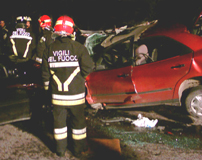 |
| "Looch" drives beyond the blazing auto, and takes an angled blocking position 20 meters upwind. Within moments everyone's off the rig, and the two bunkered firefighters grab the foam preconnect, and race toward the burning vehicle. There are no verbal commands, as each member goes about their pre-assigned tasks. The driver engages the pump, and the officer and other firefighter advance two donuts of 70mm hoseline. They make the quick connects, and attach the Thunderfog as back up to the foam line. |
| While volunteer EMT's and the physician aboard the ambulance attend to the injured, the other firefighters arrive with the Rapid Rescue Unit. They raise the light tower and illuminate the scene while the first-in crew mops up. Using a nearby call box, IL Capo reports that this job us under control. |
| It's my turn |
| "Oh Luigi, siete preparati ora per guidare?"Damned right I am, Cap. So I step aboard and sink into the driver's seat, which automatically adjusts to my 180lb, 5' 10" frame. My right arm rests on comfortable padding, and it takes a simple flick of the wrist to run through the gears. 14 tons of fire truck move without hesitation - no rattles - no strain - just solid response. |
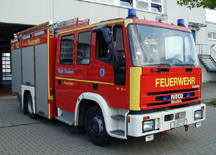 |
| Iveco Eurofire manufactured for a brigade on the Swiss border. |
| This is the crew cab version of Iveco's popular Eurocargo series of chassis, designed for local and regional freight. There are a three basic varieties of transmissions and engines available, and maintenance is a dream since all Italian mechanics have worked on an Iveco. |
| Driving a fire truck is always a thrill. Driving something different, like the Iveco Magirus, is even more fun. But the Eurofire will likely never see an American roadway, because it is designed to fulfill the needs of a system that is foreign to our way of thinking. And the same goes for American manufacturers who hope to stake a claim in Europe. Design and function are based primarily on the tactics and regulations that govern a particular jurisdiction. |
| The fact that the Eurofire that I drove incorporated several major US components --like pumps and rescue tools -- proves that OUR technology does reach the end user overseas. But it's a two way street, and there are many interesting features offered on the Eurofire, that could be incorporated into American design. The other German manufacturer understands that, and Metz is now showing their ladder tower as a "Quint" built on an HME chassis. A very clear cut illustration of how European technology can be adapted to OUR system |
| Suffice it to say, as communication tools like the internet continue to shrink our World, our ability to interact with and influence other firefighters will dictate where, and how quickly, the fire- rescue industry responds. |
| As for me? Well. I really like how quickly the Eurofire responds! |
 |
| Copyright 1998-2006, Lou Angeli, All Rights Reserved |
 |
 |
 |
| 5th Anniversary Commemorative honoring the 70,000 volunteers, who served at Ground Zero. |