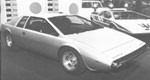
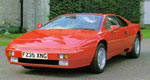
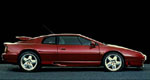
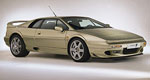
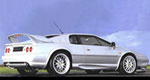
The Esprit story begins at the 1972 Turin Motor Show, where Ital Design presented a striking concept on a stretched Lotus Europa chassis.
So positive was the reaction, that Lotus founder Colin Chapman decided this design should spearhead his new range for the 1970's.
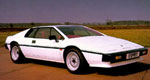
After a long gestation, the first production model appeared at the 1975 Paris Salon.
As ever, Lotus would use a GRP body bolted on to a steel backbone frame.
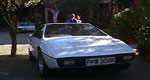
The Summer of 1977 saw the Esprit's big screen debut, with a starring role as 007's company car in The Spy Who Loved Me.
Lotus gained valuable publicity as the white Esprit evaded a number of pursuers both on land and under water with a novel submersible conversion.
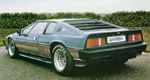
The Series 3 of 1980 proved an important stage for the Esprit.
Refinements consisted of a larger 2.2-litre engine, a strengthened chassis, improved rear suspension, and new bumpers and wheels.
Any questions raised over performance were clearly answered with arrival of the Turbo Esprit.
Fitting a Garrett Turbocharger to the standard 2.2-litre engine resulted in 150mph potential, catapulting the Esprit into the Supercar league.
Modifications between 1980 and 1986 were minor, but there was good reason for this.
The 1987 British Motor Show saw the debut of the second generation Esprit.
Overall quality was improved with new exterior styling and a thoroughly revised interior.
Better aerodynamics saw slight gains in performance with the Turbo capable of 155mph, with a 0-60mph time of 5.0secs, while the top of the range Turbo SE was some 10mph faster than the regular model.
For 1993 there were new smoother bumpers inspired by the new Elan, as well as the fitment of Power Steering for the first time.
The S4 also featured improved switchgear (now sourced from Vauxhall) and a higher mounted rear wing to aid rearward visibility.
The next significant stage in the development of the Esprit was the introduction of a Lotus designed 3.5-litre V8 engine.
At last the supercar from Hethel had an engine worthy of its pedigree.
With 350bhp on offer in basic tune, this was enough to propel the vehicle to 175mph, making it one of the fastest cars around.
For 1997, there was a 2-litre 4 cylinder unit offered in the stripped out GT3, a much cheaper and more driver-oriented derivative.
In 1998, the interior was greatly improved with Peugeot sourced switchgear and the scrapping of the boomerang instrument pod for a more compact and integrated housing.
2002 saw the Esprit reach its 30th Birthday.
To celebrate this, Lotus gave their flagship model a mild revision with new tail lights and wheels the most obvious alterations.
The Esprit finally ceased production in 2003, bringing to an end a significant 31 year chapter in Lotus history. |