I watched a BBC talk show (in English) about the world-wide recession
yesterday. According to IMF, Europe is expected to have growth of 1.4%-1.8% in
the next year, the U.S. (which cycles 40% of the world economy) will grow
.8-1.2%, and Japan about 1%; China’s expected GDP growth is 6.8-7.4%! Is it
because they have no toilets or despite it that theirs is the fastest growing
economy, by far, among the 10 largest nations? You can think of some weird
questions when left alone in a meat-locker-cold hotel room overnight.
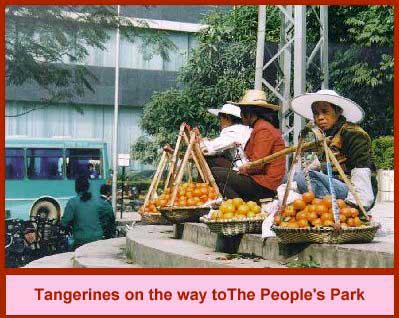 China's dramatic relative growth is probably because of the current low
socioeconomic status. If you start with little, it’s easier to move ahead by
large percentages. Things in Nanning appear desperate for many people, and this
is a somewhat modern city of 1-1/2 million people. In the rural areas, existence is
hard. I don’t know what the average rural income is, but I image it would be
difficult to buy an American priced bicycle on a year’s worth. I notice
everyone locks theirs whenever parked. I also note that damned few U.S. farmers carry
300 lbs. of sugar cane on the back of their bicycle for 10-20 miles to sell his
crop. Their kids have shoes and the daily/weekly trip to town is not a luxury
foregone to save the 1 RMB ($.12 US) cost of transportation. There is definitely
a disparity in quality of life between China and even the poorest American
farmer. The farm work is done mostly by hand and on small patches of land. Even
though vegetables are extremely cheap in China ($2 USD buys enough veggies to
feed a family of 4 for 2-3 days), even the transient boat people plant a
subsistence patch of garden between 10 and 20 square meters to raise fast
growing vegetables and spinach-like greens. These plots are meticulously kept
and orderly. Every morning the plank comes across to shore and the people
follow. After them come the chickens that have roosted aboard for the night.
While the people fish in the muddy water, the chickens eat all the bugs from the
garden and the dog helps fertilize tomorrow’s lunch – everyone has a part
to play in the business of life in China.
China's dramatic relative growth is probably because of the current low
socioeconomic status. If you start with little, it’s easier to move ahead by
large percentages. Things in Nanning appear desperate for many people, and this
is a somewhat modern city of 1-1/2 million people. In the rural areas, existence is
hard. I don’t know what the average rural income is, but I image it would be
difficult to buy an American priced bicycle on a year’s worth. I notice
everyone locks theirs whenever parked. I also note that damned few U.S. farmers carry
300 lbs. of sugar cane on the back of their bicycle for 10-20 miles to sell his
crop. Their kids have shoes and the daily/weekly trip to town is not a luxury
foregone to save the 1 RMB ($.12 US) cost of transportation. There is definitely
a disparity in quality of life between China and even the poorest American
farmer. The farm work is done mostly by hand and on small patches of land. Even
though vegetables are extremely cheap in China ($2 USD buys enough veggies to
feed a family of 4 for 2-3 days), even the transient boat people plant a
subsistence patch of garden between 10 and 20 square meters to raise fast
growing vegetables and spinach-like greens. These plots are meticulously kept
and orderly. Every morning the plank comes across to shore and the people
follow. After them come the chickens that have roosted aboard for the night.
While the people fish in the muddy water, the chickens eat all the bugs from the
garden and the dog helps fertilize tomorrow’s lunch – everyone has a part
to play in the business of life in China.
Small business promotion has become popular in the U.S. in recent years, but
smal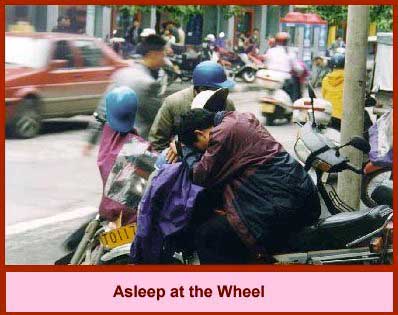 l business is the norm here in China. Many similar-type businesses seem to
cluster along the same part of a street, as in the medieval guild days of
Europe. There is electrical supply street, plumbing street, clothing street,
etc.. This is not a rigid thing, by any means, but is very common. Some other
things are widely dispersed across the city: food stalls, little convenience
stands with cigarettes and candy, barbershops, and so on. Even in this large
city of 1.5 million, the small stand-alone enterprise is much more numerous than
his conglomerate chain-store cousin. When I say small, I mean really small. Many
of the noodle stands are 5’ deep from the sidewalk and, maybe, 10 feet wide
with only two 3’ round tables. The food is cooked on a gas jet out on the
sidewalk. The Chinese equivalent of a 7-11 might be no bigger than a
bedroom closet;
miniscule
l business is the norm here in China. Many similar-type businesses seem to
cluster along the same part of a street, as in the medieval guild days of
Europe. There is electrical supply street, plumbing street, clothing street,
etc.. This is not a rigid thing, by any means, but is very common. Some other
things are widely dispersed across the city: food stalls, little convenience
stands with cigarettes and candy, barbershops, and so on. Even in this large
city of 1.5 million, the small stand-alone enterprise is much more numerous than
his conglomerate chain-store cousin. When I say small, I mean really small. Many
of the noodle stands are 5’ deep from the sidewalk and, maybe, 10 feet wide
with only two 3’ round tables. The food is cooked on a gas jet out on the
sidewalk. The Chinese equivalent of a 7-11 might be no bigger than a
bedroom closet;
miniscule 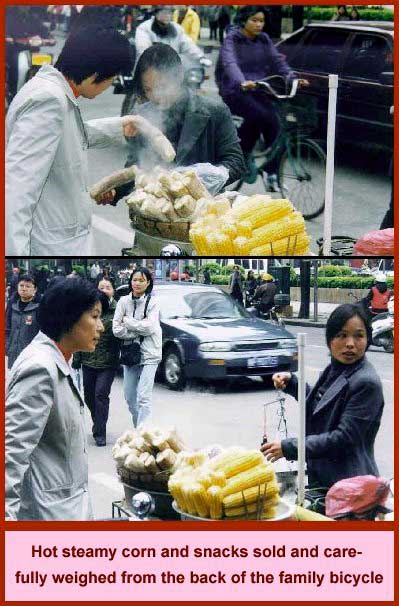 business is more like it. Small Chinese businesses can be as small as
the basket on the back of a bicycle from which bananas and steamed
corn-on-the-cob are weighed and sold as snack food for about 12 cents a pound.
Shoe repair is a sidewalk endeavor with available soles laid out for your
selection. The stitching is done by a hand-turned machine humped to the spot
each morning via a stick over the shoulder. Scooter drivers wait to take you
anywhere in Nanning for about $1 USD.
business is more like it. Small Chinese businesses can be as small as
the basket on the back of a bicycle from which bananas and steamed
corn-on-the-cob are weighed and sold as snack food for about 12 cents a pound.
Shoe repair is a sidewalk endeavor with available soles laid out for your
selection. The stitching is done by a hand-turned machine humped to the spot
each morning via a stick over the shoulder. Scooter drivers wait to take you
anywhere in Nanning for about $1 USD.
Except in the larger Chinese department stores (and even there sometimes),
prices are seldom fixed and haggling is expected. I always do so unless the price
seems extremely reasonable. When I am asked 2 RMB for a light bulb (about 25
cents US), I seldom quibble; when the price is 5 RMB (60 cents US), I hold up 2
fingers and the clerk sighs in resignation to the fact that I know what a light
bulb costs in Nanning. In the U.S., there is a de facto monopolization of
product pricing, despite what the ‘free’ market enthusiasts will tell you.
American retail prices are usually similar across stores and geography, with
minor variations to spark customer interest, because the wholesalers and
manufacturers all sell at an agreed upon price to the retailers. It’s the
"agreed up" part that the antitrust folks need to have a closer look
at. Why are vegetables, even in-season ones, so expensive in the U.S.? Sure,
China has cheap labor, just as we have Mexican agricultural workers that cross
the border by the millions to work for lower-than-minimum-wage in the Southwest
and South. Why is meat about the same price in China as in the U.S.? China has
little grazing land and livestock feed can be more efficiently used to feed
people. It would seem that it should be relatively expensive to gnaw on a burger
in China, when the U.S. has such efficient meat production facilities and more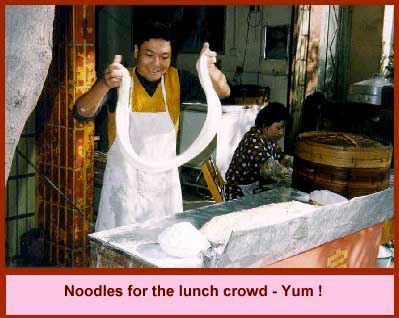 grazing land than you can shake a stick at. Just for parity’s sake, the meat
processing plants and agricultural industries in the U.S. use cheap
south-of-the-border labor and fuel costs about four times as much in China as in
the US. I can think of many potential reasons why this apparent unfairness
exists, they involve over-taxation, restriction and regulation of markets, and
the waste of public resources in the U.S., but this is not the place to posit
these maunderings and gripes. Bottom line is, something smells fishy to me, and
it ain't the Yong Jiang River.
grazing land than you can shake a stick at. Just for parity’s sake, the meat
processing plants and agricultural industries in the U.S. use cheap
south-of-the-border labor and fuel costs about four times as much in China as in
the US. I can think of many potential reasons why this apparent unfairness
exists, they involve over-taxation, restriction and regulation of markets, and
the waste of public resources in the U.S., but this is not the place to posit
these maunderings and gripes. Bottom line is, something smells fishy to me, and
it ain't the Yong Jiang River.