|
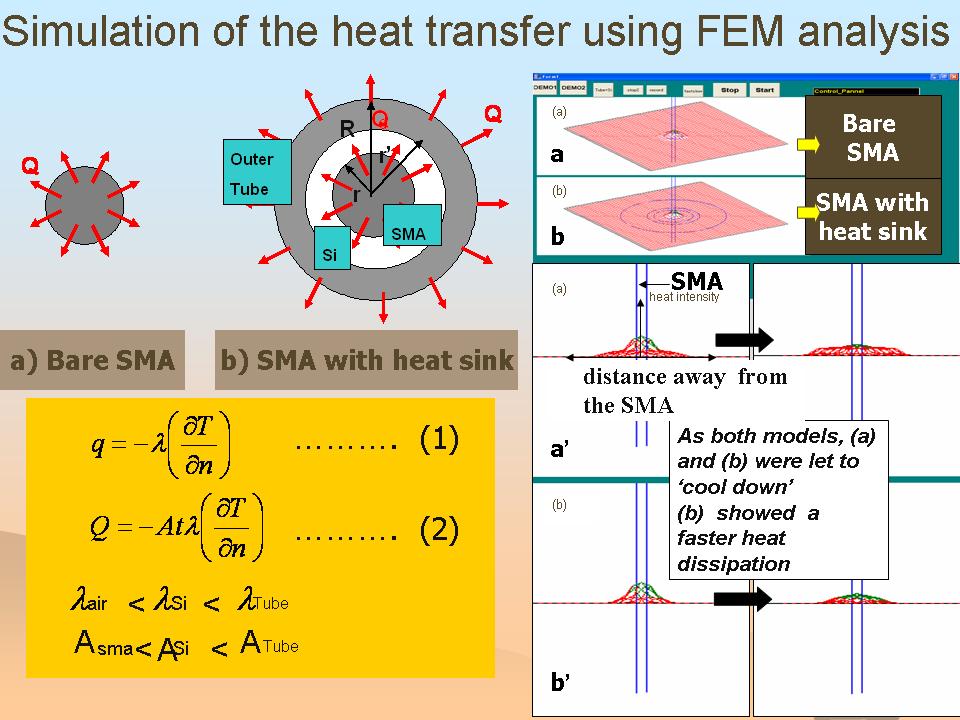
Shown above is one of our early efforts to improve the response speed of the SMA, where heat sinking in ambient environment is conducted. We developed a new heat sink which helps provide a wider surface area and higher thermal conductivity materials for the heat to be transferred from the alloy to the environment. The finite element analysis method (FEM) is used to solve the heat transfer equation.The effect of having the heat sink is compared to when without it. In the case of bare SMA, we can observe that heat builds up around the wire and prevents further diffusion of heat out from the alloy.
Conversely, when heat sink is used, heat from the surface of the alloy is spread to a larger surface area via high thermal conducting material. As a result, heat does not accumulate around the alloy, thus validating the effectiveness of the heat sink.
|
|