| Tremolo |
| When in reference to an LFO, tremolo is the modulation of the volume of an audio signal in so that the amplitude of that signal grows and shrinks. The effect you will get is the volume of the electronic instrument getting louder and then softer and then back again. The rate of this tremolo is dependent on the rate of the LFO. The higher the LFO's frequency (upwards around 20Hz) the faster the tremolo and so on. |
| Interfacing your homemade LFO with an electronic instrument to get the tremolo effect is actually pretty easy. First off, make sure your instrument runs on batteries - no more than 9 volts. Next, find a Phillips screwdriver and carefully take apart the chassis of your instrument. Inside you will find all sorts of intimidating PC boards full of chips and wires and stuff. Let's call this the main circuit. Attached to this main circuit is a speaker. |
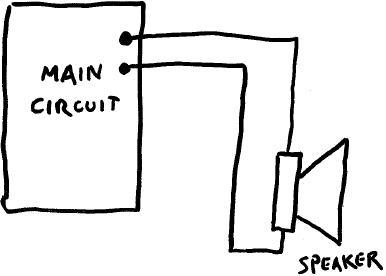 |
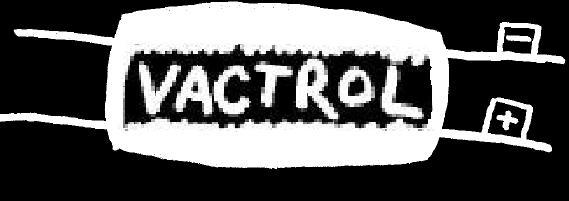
| All you got to do is find the speaker and attach the two ends of the exposed leads from the photo-resistor of your homemade vactrol to either side of the speaker's solder points. That's it! |
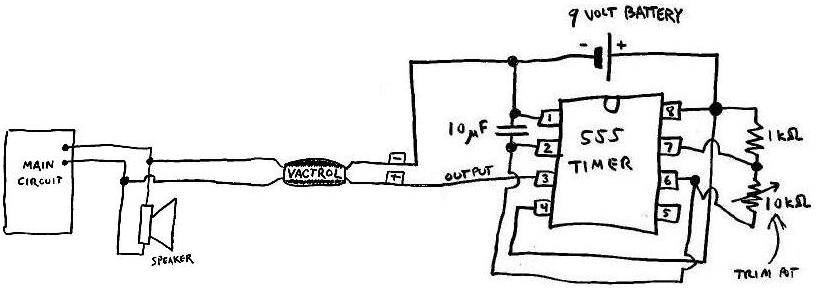 |
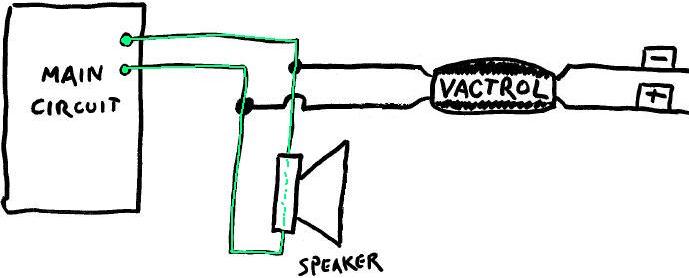
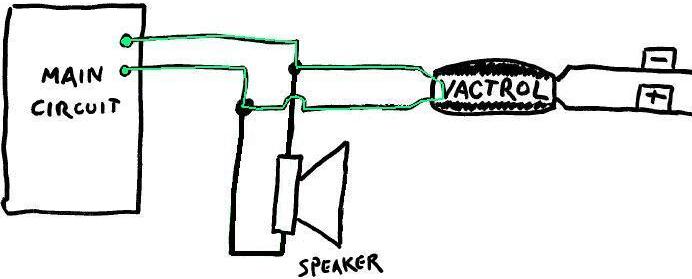
| Why does this work? Electrical current is always looking for a path of least resistance. Before you introduced your LFO into the circuit, all current from the main circuit flowed through the speaker because it had "no other choice". Once the LFO was introduced, the current that was exclusively going through the speaker now has another path introduced to it. But this second path has a varying resistance. When the resistance is relatively high, the current will flow through the speaker as normal. The current flow is represented in green in the schematic below. |
| However when the resistance is low, a good portion of the current (if not all) will flow through the vactrol and bypass the speaker. As a result, the volume of your instrument will decrease to the point where the sound will not be audible. |
| Click on the following links below for having your LFO act as a Vibrato, Stereo panner, or to design your own Vactrol. |
 |
 |
 |
 |
 |
 |
 |