| |
| |
| |
| |
| |
| |
| |
| |
| �
� |
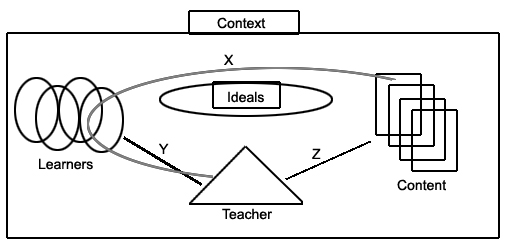
| TEACHING PERSPECTIVES CONSIDERED INTRODUCTION When I entered this course four short months ago, I had no preconceptions about what I would learn or even whether or not it would prove to be worth my time and effort. I certainly was not prepared for the regular "epiphanies" I would experience or the amazingly clear insight I would gain into my job and my goals as an employee in the field of teaching. What appeared at first to be a course revealing methods of presenting information to adult learners proved to be, instead, a course that enabled me to take a deep, probing look at what teaching means to me and how to define my role and beliefs as an educator. I am firmly convinced that I am a better teacher for having participated in the course and will use this opportunity to summarize and evaluate the key elements I have defined from being a student in the class. MY MODEL OF TEACHING In Pratt's text, before detailing and exploring the five perspectives of teaching, he first proposes a general model of teaching, within which he examines the teacher, the learner, the content, the context and the ideals along with the relationships between those. During the course of this class, I have been able to examine my beliefs regarding the roles of each of these same factors and analyze the relationships I believe should exist between them, both in a general sense and in the context of my job. By using the questions Pratt poses in his text, I have been able to summarize my views of each of the players in constructing my own model of teaching. Teacher Until as recently as 1997, I had never been placed in the official role of teacher. I had never given much thought to what sort of teacher I would be or what sort of teacher I would like to become. As a result, much of my feelings on the role of the teacher is defined within the context of where I teach. In my job as an instructor of job seeking/retention skills to people with disabilities and disadvantages, I believe I act as a guide and role model. It is my job to model appropriate and effective methods of seeking and retaining employment and to assist all of my learners in understanding and achieving the same abilities. On my job now, as one of seven instructors, we are, as of this writing, in the process of videotaping and critiquing each other's instruction techniques. As my peers offer suggestions for improvement, I want them to evaluate my teaching based on how effective I am in the role I set forth for myself. Observing other instructors, I have quickly realized that we do not all share the same feelings regarding roles in the classroom. Some instructors have a more authoritative or dictatorial technique, while others are even more nurturing than I. It is a concern to me that my peers understand that I teach with the hope that my learners leave my program with the ability to effectively seek, obtain, and retain employment using the methods I have modeled and demonstrated as an instructor of the class. It is the successful transfer of my training upon which I hope to be evaluated. It is with great hesitation that I submit my methods of instruction to those on the team who do not share my views on instructor role. Until this class, however, I would never have sensed the difference. Learners Again, the differences between my views on my learners and those of my colleagues became more defined throughout my development in this class. I remember when I attended my first "real" interview at my last job at Skills, Incorporated, a sheltered workshop for people with disabilities. I was relatively fresh from college, had virtually no professional work experience, and had certainly never had occasion to work with an individual with a disability. I had never had an interest in special education, and my brief exposure to mental illness in the study of Psychology had not struck any particular chords of motivation in school. But I, even then, I think, had a special insight into how I would view my learners from this special population. In the interview, my future employer asked me "How do you feel about working with people who are mentally retarded?" I remember thinking just a moment and responding, "I feel fine. I believe that the key in working with any group of people, be they mentally retarded, elderly, or whatever, is to remember that they are all people first." It is with pride and even admiration that I look back on that moment of clarity. I still feel the same way in regards to my learner. Whether they come from a "special" population or not, I believe the key to being an effective educator is to remember that all adult learners are, first and foremost, people just like me and to assume a position of authority or elevation because of some particular knowledge or expertise, is to create a barrier to the learning situation. As I stated earlier, not everyone on my current work team feels the same way. I again, find it difficult to establish common ground with those individuals, so passionate is my belief in this area. In my work situation, I have determined that my learners are people who have historically resided in an Industrial world and who are attempting to transfer their lives into a more business-like, or corporate world. They are fortune seekers who bring incredible amounts of information and knowledge to the table in the classroom. My learners are often worldly, yet strangely naieve about the "real" world. They are crusty, but vulnerable, simple, but very complex. Many bring emotional damage to the learning situation. Most bring fear. All of these things present natural barriers to the classroom. It is my fervent belief that I cannot allow other barriers to be established through damaging, inaccurate opinions of my learners. Content During this class, I learned that my belief in this area is that the decision of what to teach must stem from what the learner wants and hopes to learn from the classroom experience. Indeed there are certain topics and ideas that must be explored as dictated by the instructor in order for the material to be effectively taught. But how that information is presented, in what order and within what context, must come from the learner. In my particular work setting, I have been able to frame my instruction in a form that will allow me to bridge my learners' current knowledge to a place they have never been and about which they know nothing. This lack of knowledge and experience makes this topic difficult to grasp and understand, making the content totally dependent on the context. The content, how to find and keep a job, must build on the learner's current knowledge, beginning in the simplest terms. In this case, nearly every learner has at least worked, so we begin there, in a generic work situation and begin to build on that knowledge to reach the special work situation we hope to achieve after training. Context This is the area in which I had the most "epiphanies" I referred to earlier. The structure of my curriculum became the focus of my self-directed project for this class. Building that bridge between current knowledge and future knowledge is the challenge of context. In my work situation, I have listened very carefully to the feedback and frustrations of my learners to create a learning context that allows them to better process the new information I present. In essence, I stand between the learner and their desired outcome and attempt to bring the learner to that point through my instruction. Without the appropriate context, I have found that learning simply is not effective. Ideals There are some basic beliefs and ideals that I hold as an instructor in this setting. As I stated before, first and foremost I believe that all learners are capable, regardless of disability, history, or level of intelligence of successfully learning the material and methods that I teach. I believe it is my job to find a way to help that learner get to that place, to facilitate learning through whatever means necessary. Further, I feel that any input from the learner is valuable; to not believe so is not to value my learner. Finally, though it is my responsibility to guide and facilitate learning, I firmly believe that each and every individual learner bears the responsibility for his/her own success as well. Without effort and commitment on his/her part, my effort is hopeless. Relationships Line X Engaging my learners in the content requires finding common ground. Now that that has been established in my curriculum, the structure and methods of instruction have evolved from it. I typically teach by presenting information first, discussing the information within the context of experience among the learners, followed by practicing the new skills and summarizing the transfer of this skill to the learner's reality. I evaluate my learners by asking them to perform the skill I have modeled or explained earlier. Line Y The social contract or relationship between myself and the learners in my classroom is one of "goal partner." We work together to reach the goals of the learners by supporting, providing feedback, and building on previous knowledge. In class, I provide both written and verbal feedback as the learners begin to incorporate the information taught into their lives. I am only unable to do this when the learner is without motivation. It is with great difficulty that I accept my limitations as an instructor in reaching the "motivation button" in every learner. Line Z Establishing content credibility with my learners is accomplished by showing the results of my own experience and efforts. When I feel I need support or reinforcement in a topic, I seek outside experts, conduct research, or otherwise seek external support for my topic. When, as occasionally happens now, always happened previously, a learner does not believe what I teach is important, it is up to me as an educator to find a new avenue of presenting the information or a new common thread to create relevancy in my instruction.
My General Model of Teaching � APPLICABILITY TO GOODWILL INDUSTRIES It is the mission of Goodwill to provide an environment for people to improve the quality of their lives through employment with a focus on people with disabilities. The President and Vice President of Goodwill both believe strongly in an individual's right to choice and do not subscribe to the "rehab" way of thinking about people with disabilities. My organization believes that people with disabilities are capable of being successful in work through their own choices and efforts. It believes that all individuals deserve a chance to make their own choices and decisions and that we should exercise little control over those choices. I believe that my actions, intentions, and beliefs have been further developed under the influence of my organization. Before this job, I worked in rehabilitation. I was a job developer, meaning I went out and found jobs for people who had disabilities. I worked closely with vocational rehabilitation in developing training plans for my "clients." First hand, I saw the problems associated with making decisions like the choice of which job to take for the individuals we served. I saw the power struggle that took place between the vocational rehabilitation counselor ("he's going to have to ask me for help") and the people we were supposed to be helping. I resented it and now truly appreciate working for an organization that promotes freedom of choice and the idea of helping those who are perfectly capable of helping themselves. I have worked with those who do not share the same beliefs as our organization and they have not remained for long. The fit between my model of teaching and that of Goodwill is a good one. The nature of our business and those we serve helps dictate the way in which I am able to present information. The reality is that I sometimes present before learners with Traumatic Brain Injuries that limit their ability to retain information and learners with IQ's of 60-75. Most of my learners are very concrete thinkers and extremely abstract presentations of information simply do not work with them. The challenge, then, is in presenting abstract concepts in a concrete format. This restriction often dictates which method of instruction I may be able to use in my class. In viewing many of the methods demonstrated in our EAC738 class, I was amazed by the creative and interesting ways in which information can be presented. However, many of the methods were highly complex and abstract and would, therefore, be inappropriate and useless in my training program. For example, Sue's presentation on the Simulation method was fascinating and thought provoking, but I simply would not be able to use it in my class. It has too many steps and the effect would be lost and would, instead, create confusion and havoc in my classroom. There were, however, several methods of instruction both presented and used in class that I can use in my class effectively to promote critical thinking and to look at issues in a more indepth way. I was able to take the debate method back to my class, for example, and use it in debating the qualities sought in employees today. These limitations have forced me as an instructor to create my curriculum within these constraints. The challenge has been finding that common context and presenting the often abstract concepts using methods of instruction that promote concrete thinking and actions. The use of things like the felt board to visibly represent the learner and the goals assist me in bringing abstract concepts to the concrete thinker. ANALYSIS OF PERSPECTIVES AND CONCLUSIONS The first "questionnaire" we took in class regarding the five perspectives placed me squarely in the Apprenticeship or Behaviorist perspective. Throughout the course of the class, however, I passed from perspective to perspective, seeing glimpses of my beliefs and intentions in each one. Upon writing my first paper, I had discovered I held many of the same beliefs as the Social Reform perspective. My method demonstration fit in the Apprenticeship perspective. By the time I handed in my self-directed project, I was decidedly Developmental. Discussions in class lead me to see that my teaching techniques are clearly from the Transmission perspective. At the last survey by Pratt, himself, I was clearly of the Nurturing perspective. Finally, I reach the conclusion at this writing that I possess beliefs and intentions that can be found in each and every perspective. I don't know, at this point, that I am capable of defining a sixth perspective within which I would squarely fall, but I have thoroughly enjoyed the process of discovery that has lead me through each. The complexity of teaching has both confounded and thrilled me at every point of the class. That there are so many different instructors with so many different perspectives is a little scary to me. We as educators possess such a unique ability to enhance or destroy, the power is one which cannot be taken lightly. Again, I work with colleagues who take their power with a grain of salt, and make no effort to analyze their framework, or their beliefs from which they present life-altering information to learners. And that is a frightening thing to me. I appreciate the gift of insight; of education regarding the responsibilities of educators. It is my intention to handle that responsibility with care and to continue the process of developing and defining my beliefs. Without this newly acquired knowledge, I do not believe my current employment situation would be bearable. The challenge of meeting the needs of my learners has been a great one and one I have taken very seriously. I cannot imagine attempting to proceed without this knowledge. I worry about those who do. |
| |
| Last Updated July 17, 2001 |