| Welcome to XM496.com
Bristol 175 Britannia Fleet. |
|
||||||||||||||||||||
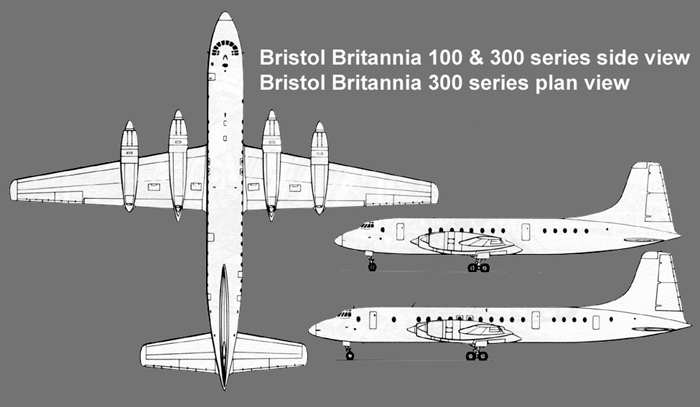
The Bristol Britannia in RAF service The Bristol Britannia in RAF service was operated by two squadrons, numbers 99 and 511. These squadrons previously operated Handley Page Hastings transport aircraft and prior to these the Avro York. Based at RAF Lyneham, Wilts, the Britannia was accepted by both squadrons and were operated by each until central servicing of the aircraft had been established. Following central servicing arrangements the Britannias were pooled, in a similar way to a civilian airline being operated jointly by crews of both squadrons. Pooling of the Britannia squadrons commenced in September 1960, at RAF Lyneham and the system remained until the Britannia fleet was moved to RAF Brize Norton, Oxon, in January 1970. Once the fleet had left RAF Lyneham, the base was then used to house the RAF Hercules transport aircraft, becoming the Hercules main base. RAF Brize Norton had already been accommodating a Britannia derivative in the shape of the Short Belfast, formally known as the Bristol 195. The aircraft was originally ordered to the amount of 12 aircraft but reduced to 10. Operated by 53 Squadron, the Belfast operated alongside the VC1O transport fleet of 10 Squadron, also based at Brize Norton. The central servicing system was retained for the Britannias at RAF Brize Norton and the pooling of both squadrons continued. Following the reduction in the need for a strategic airlift capability, the Britannia fleet was disbanded in the mid 1970s and together with the Comet and Belfast squadrons were removed from the RAF fleet. The Britannias were stored at both RAF Kemble and St Athan, and later either sold or leased to civilian operators, who obtained these aircraft in new paint schemes albeit RAF livery, and extremely low flying hours. In fact they were a good buy for many companies who intended using these aircraft for freight operations and for spares. VARIANT: 252 (Britannia C mark 2 in RAF service). 253 (Britannia C mark 1 in RAF service). Built to Ministry of Supply specification C.176P. Note: Once withdrawn from RAF service and the aircraft had been civilianised, they were designated as 252F and 253F respectively. POWERPLANT: Four Bristol Proteus 765 turbo-props developing 4400ehp (initially in RAF variant 252), driving 16 feet four-bladed Duralumin round tipped propellers. POWERPLANT: Four Bristol Proteus 225 turbo-props (military version of Proteus 765), driving 16 feet four-bladed Duralumin round tipped propellers, developing approximately 4400ehp but with additional water injection to offset reductions in engine performance under certain conditions e.g. high altitude. Aircraft Dimensions: Wingspan 142ft.3.5ins. Overall Length 124ft.3ins. Height 37ft.6ins. Wing Area 2075 sq. ft. PAYLOAD AND PERFORMANCE: Variant 252, Still Air range, maximum payload (33 100lb) over 4628 statute miles at a cruising speed of 355 mph. Still Air range, maximum fuel (including reserves) 5334 statute miles at a cruising speed of 355 mph with 21 724lb payload. Variant 253, Still Air range, maximum payload (37 400lb) over 4628 statute miles at a cruising speed of 360 mph. Still Air range, maximum fuel (including reserves) 5334 statute miles at a cruising speed of 357 mph with 26 024lb payload. CREW: 4-7 PASSENGER ACCOMODATION: Up to 139 passengers in rearward facing seats. 53 stretchers with 6 medical attendants and 2 iron lungs for Aeromedical role. CARGO ACCOMODATION: 5850 cubic feet (252). 6120 cubic feet (253). FUEL CAPACITY: 8580 Imperial gallons. (Avtur, Avgas or Avtag). WEIGHTS: Variant 252 Empty 94 900lb. All up weight (including fuel) 185 000lb. Variant 253 Empty 90 600lb. All up weight (including fuel) 185 000lb. TOTAL BUILT: Variant 252 = 3. Variant 253 = 20 Note: The variant 252 was basically a mixed freight / passenger aircraft. It differs from the series 310 in having a forward freight loading door measuring 74.5inches by 93inches and a strengthened forward fuselage floor. The variant 253 is also fitted with the same door and is essentially a cargo transport, built to RAF requirements but can also be used for troop carrying and Medi-Vac roles. Details of the structural components
of the Bristol Britannia |
|||||||||||||||||||||
|
|||||||||||||||||||||
|
All contents copyright 2005-2008 XM496.com and The Bristol Britannia XM496 Preservation Society. |