|
Cloth diapers are made of 100 percent natural soft, absorbent cotton and are gentle on baby’s skin. Cotton is a breathable material, allowing fresh air to freely circulate, cooling and preventing diaper rash. Cotton is kinder and more comfortable to your baby’s skin than paper or stiff plastic and contains no irritating perfumes or chemicals. Washable stay-dry fleece liners keep moisture away from a baby’s skin.
The interior of single-use disposable diapers don't breathe well and therefore can be a much higher temperature. Because the gel in disposables is so absorbant parents tend to change single-use disposable diapers less often than cloth diapers, increasing the risk of diaper rash, since heat and moisture provide an excellent medium for bacterial growth. (Ever seen one blow up in the pool? The absorbent chemical in disposable diapers, sodium polyacrylate gel, absorbs 100 times its weight in liquid!) Babies diapered in disposable diapers are also exposed to far too many questionable chemicals contained in the disposable diapers. Newborn skin has an underdeveloped outer layer, and chemicals are more readily absorbed through the skin and into the fat cells than in adults. Studies have shown that when these chemicals become wet, they become even more absorbent and pull moisture from the baby’s body, thereby diminishing the normal defenses of the skin.
Consider these numbers: 36 cloth diapers that are used over and over, possibly for more than one child -- or an average 7,349 single-use diapers per child. One-time use, throw-away diapers are the single largest nonrecyclable component of household garbage, creating one ton of garbage per year per child. It takes less than 30 lbs of cotton to manufacture a baby’s cloth diapers.
While growing and harvesting cotton can involve a large number of pesticides and chemicals that are harmful to the environment, organic, or “green” cotton is becoming more and more available. Bleaching cotton for diapers is also taxing on the environment, although unbleached diapers are widely available, quite often at the same price as the bleached variety. Even if you considered the production of non-organic, non-“green” cloth diapers a compromise to the environment, remember that one child only needs a few dozen of them, and these diapers can be used for more than one child.
Wraps and covers used with cloth diapers are made from a variety of materials, both natural and man-made. Some covers are made from wool, some from cotton. Most are made from synthetic fibers, such as nylon, vinyl, fleece, polyester and polyurethane. Fleece is made from recycled soda bottles, which is an environmentally friendly option. But some of the other synthetics are made using processes that produce chemical waste, some of which may be harmful to the environment. A baby will probably need a minimum of 16 wraps and covers over the course of their diapering period (in various sizes), many of which can be used on subsequent children. Again, there is a cost to the environment in producing these diaper covers, but one child needs only a few.
Washing cloth diapers does use a bit of water...roughly 260 loads of wash over a 2 1/2 year period...which is actually less water by volume than would be used by 2 adults each taking a 5 minute shower every day! With the use of nature friendly detergents, the environmental impact is much much less than what goes into producing single-use disposable diapers.
Disposable diapers are made of a waterproof polyethylene outer layer, with an inner layer of wood pulp and synthetic polyacrylate (a super-absorbent crystal), along with a water-repellant liner. Many brands also use fragrances and perfumes in their diapers.
Disposable diapers are not biodegradable and make up a significant amount of municipal waste. A landfill site does not provide the conditions necessary for the single-use diaper to biodegrade. The “Diaper Genie” and its like, effectively mummify single-use disposable diapers into our landfill sites for eternity. Consider the cost to operate additional landfill sites and the depletion of our natural forests.
To acquire the wood pulp for disposable diapers, one billion trees world-wide are cut down per year. Some people stop there and decide the cost of disposables on the environment is too much. But what is done to that wood is even more detrimental to us and our world. Disposables are so beautifully white because the wood pulp is bleached with chlorine gas, producing toxic chemicals known as organochlorines. The most notorious of organochlorines is dioxin, which is one of the most toxic substances ever made by humans. Dioxin is associated with birth defects, miscarriages, cancer, and genetic damage.
Both cloth and disposable diapers have an impact on our environment in the ways they are made, disposed of, and/or laundered. But cloth diapers pose a significantly less threat to the environment in the way they are made, the resources consumed, and most importantly, the small number needed to diaper a baby.
Chinese pre-fold or cpf- a flat diaper that is thicker in the middle.. need pins or snappi (comes
in bleached or unbleached...Premie, infant, regular, premium, toddler...All I've needed were infant and premiums), needs a
cover

A premium cpf and a snappi...The staples of any diaper system.
|
|
|
Diaper Size
|
Number of layers
|
Size Preshrunk
(Shrunk)
|
Serging stitch color
|
Weight Limit
|
Reccomended Uses
|
|
|
|
|
|
About 8 lbs
|
Fits small/preemie babies, use as a doubler later.
|
|
|
|
12inX16in
(11inX13 1/2in)
|
|
Up to 15 lbs
|
Fits babies up to 4 mos., use as a doubler later.
|
|
|
|
14inX21in
(13inX16 1/2in)
|
|
Up to about 25-30lbs
|
Fits all ages, can be used as a doubler for toddlers.
|
|
|
|
14 1/2inX22in
(13 1/2inX19 1/2in)
|
|
Up to about 25-30lbs
|
Fits older babies and toddlers, overnight for babies over 15lbs.
|
|
Toddler
|
4X8X4
|
18inX23in
(16 1/2 inX21in)
|
Light Green
|
Fits from about 25 to 50lbs
|
For extra heavy wetters, overnight, or babies over 30lbs.
|
|
|
|

Diaper Service Quality DSQ- the prefold diapers that diaper services use.. needs
pins or snappi, needs a cover
Flats- single layer dipes made of birdseye or gauze...less absorbant..pins or
stuffed in pocket, not reccomended for snappi, needs a cover
Fitted- a diaper shaped like a disposable...needs a cover can have velcro/ snaps,
or need pinned/snappied
Lay-in---Is basically just the soaker...needs a cover, but not pins or snappi

My bf Rachel's son Liam in an AIO she made.
Bumkin AIO's inside and out. available at

All in one(AIO)- is the diaper and cover in one item needs no pins or snappis
Chumbas AIO's available at

Pocket diapers-There are several types of pocket diapers...These are similar to AIO's, but the soaker part is removable.


How many cloth diapers will I need?
This depends on how often you intend to wash them and your budget. The typical baby uses 8 - 12 diapers per day. With a supply of 24 diapers, 4 diaper covers and 24 washable liners, you would need to do laundry about every other day. The ideal amount of diapers would be 36 - 48. This way you should be able to go 3 - 4 days between washing diapers.
What other supplies will I need?
Washable liners - great for keeping your diapers free from stains and for adding extra absorbency - a must for nighttime! They are also great for making a diaper more snug. I suggest you buy about the same amount of liners as diapers, although some prefer to buy less and use them only for nighttime. You can also make your own by cutting rectangles from simple polar fleece.
Diaper covers - these go over your diaper to keep baby's clothing/bedding dry. I suggest 6 - 8 covers since they should air between uses and this way you'll always have some available, even while doing laundry. For nighttime covers, such as the Aristocrats Wool Soaker, I suggest having at least 2, as these take time to dry. If you are handy with a sewing machine, crochet hook, or knitting needles (or know someone who is) then making your own or having some made is another great option. I actually have the most fun diapering because of the creativity i get to put into new covers. A warning though, crafting for diapers can be addicting!!
 
Washable wipes - great moistened with water for a chemical-free rinse! I suggest at least 2 dozen and more if you go longer than 48 hours between washings. Store in a used wipes/margarine/Tupperware® container. Simply throw used ones into the diaper pail and wash with your diapers.
Waterproof Tote Bag - for the times you're away from home and need something to carry your dirty diapers. These are machine washable.
Snappi-Has for the most part replaced pins. Safer, and easy to use.
Diaper Pins with Secure Safety-Locking Heads - good to have on hand just in case, great with prefolds or diapers that don't Snappi easily.
Diaper Pail - 10 gallons is usually enough. If you plan to use the presoak method in your diaper pail, make sure it has a locking lid, as children have drowned in unsecured diaper pails.
When you first get your new dipes (unless you buy used...but then I'd do this anyway) your dipes
will be flat...not puffy at all...and they are not yet ready to use. Wash on HOT (Turn your water heater up) 3 or 4 times
then dry (this works ok for bleached cpf's/dsq's. For unbleached, I reccomend you boil them on the stove for about
15 mins. before washing to make sure you get all of the natural oils out. After washing and drying your dipes,
test one...take a small amount of water and pour it on a dipe...does it soak in or roll off? If it soaks in quickly,
you are good to go, if it rolls off, you need to wash and dry your dipes again. Test again, and repeat until the water
absorbs into the dipe quickly.
Phosphate free detergent For my old top loader I used X-tra C;assic, baking soda or washing soda, or vinegar as needed....and some
don't...but I also added a scoop of Oxi-clean to the hot wash.....With my new top loasder, I am using 1/2t of Allen's Naturally, and a few drops of Tea Tree oil or Lavender oil as needed.
1...seperate covers/pockets from diapers...I often just toss my fleece or PUL covers right in with the regular baby laundry...make sure the wool covers are not in the wash...they take
special care. Everything else (dipes, wipes, liners, doublers, pockets) goes in the machine.
2...Run a full COLD wash with a very small amount of your chosen detergent. For an idea of what detergent is right for you, check out this chart at 
3...Loosen dipes from side of washer, and run a full HOT wash with a very small amount of your chosen detergent, and any essential oils or additives you may need.
4... Some people run an extra rinse(I don't always). If you notice any bubbles in the last rinse of
the previous cycle, then run another rinse.
5... Dry in the dryer or on the line. May take 2 cycles.
If you are going to use cloth diapers, why not cloth wipes? It's easy! I
used scraps left over from various projects to make mine, which is why there is such an assortment...they are also every color
of the rainbow, lol...I keep my wipes in a warmer. I use about 3, maybe 4
cups water mixed with 2T baby wash and baby oil., and a few drops each of Tea Tree oil and Lavender oil. If you want to make your own wipes, but don't want to use cloth,
you can also use Brawny paper toweling cut in 1/2...just use about 1/2 the amount of solution for 1/2 a roll of paper towels.
">These little 'cakes' are great for absorbing any unpleasant odors!
You'll need:
A mold (a round soap mold works great, carried at most craft stores)
Baking Soda
Essential oils such as Lavender or citrus
water
Mix Baking soda, a few drops of your chosen essential oil and just enough water to make a thick paste. Transfer the paste to your mold. Leave to set in a dry warm place. If you didn't add too much water, a day should be long enough to let the mold stand to dry. You can wrap them in aluminum foil or plastic wrap, and store in an airtight container to keep them ready for use. These are cheap and safe for the environment. and they smell good too!.
|
|
|
So how much does it really cost to diaper a baby?
Single-use disposable diapers range in price from an average of $0.22 each for newborn to $0.45 each for toddler size.
Your baby will use an estimated 7,349 diapers by the time they are toilet trained...(estimating an average of 8 diaper changes per day).
That is an estimated total of $2,694 for 7,349 disposable diapers!
Cloth diapers cost from roughly $2 each for Chinese Pre-folds (the most economic option) to an average of $16 each for the most expensive options (AIO or pockets and insert, AIO's averaging a slightly higher cost) You will need at least 3 dozen CPF or AIO/pockets if you plan to wash twice a week That is an estimated total of $72 for CFP; add the cost of at least 16 covers (for the full diapering period), average cost $5, for a total of $152 for 36 CPF and 16 covers or an estimated $576 for 36 AIO's or pockets and inserts.
Consumer Reports estimates that the most inefficient washer and dryer system costs approximately $0.78 per load, whereas more efficient models cost approximately $0.44 per load. So washing your own twice a week for $0.44-0.78/load, including water, electricity and detergent, for 2.5 years equals 260 loads...for a total of $114.40 to $202.80 for laundering costs...
so...
adding it all up, you will spend a maximum total of $354.80 for the CPF/covers option, and an estimated maximum total of 778.80 for the AIO/pockets option!!
That is a whopping savings of $2,339.20 if you choose to use CPF's and covers, and an average savings of $1,915.20 for the AIO or pockets and inserts option, without even mentioning the savings you will have on gas for the car, and your all too precious time!!!
A pic of a snappied cpf. Links to the snappi site, and a how-to.

Southern Snuggler AIO


These are Cushie Tushie Pockets...My bf Rachel was lucky enough to be one of the testers for these dipes.


Marnie's (owner, The Cushie Tushie) son in a red Cushie Tushie Lay-in...
And a fishy Cushie Tushie Lay-in.
|
|
|
|
|

For my own crocheted
Wool Wrap Pattern, click here
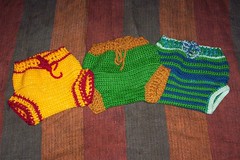
For my own crocheted
Little Fire Wool Soaker Pattern, click here

For my own knitted
Wool Soaker Pattern, click here
Aplix(velcro)---front or side closing...can be made
of fleece, PUL, wool or a combination of fleece/pul.
Snap---front or side closing...can be made of fleece,
PUL, wool or a combination of fleece/pul
Pull-on---no closures...can be made of nylon, fleece, PUL, wool

A Prowrap diaper cover (inside and out)...The cover most diaper services provide. Available
at many online retailers.
Liners---either microfleece, or storebought flushable
Snappi/Pins....I reccomend a couple snappis (you only need 1 at a time) over
pins, but some moms prefer Dritz pins.
Doublers---these are like an extra soaker(the absorbant part) for your dipe.
PUL pail liners(or plastic bags) and a large diaper pail
A diaper duck (diaper dunking tool) or minishower(handheld
sprayer) I have instructions on making your own "minishower" from a kitchen sprayer...I will add them soon!)
A downy ball---for vinegar rinse(used instead of fabric softener as fabric softener
coats your dipes)
A drying rack....I find mine indispensible! Wonderful for airing out covers
between uses, or drying those precious wool covers!
An outside clothesline and clothes pins to 'sun' out stains...yes this
really works(not a must, but nice)!

For years I diapered on the cheap due to financial necessity. My first stash included:
15 Gerber DSQ's , 3 contoured diapers, and 12 (6 layer flannel) lay-in style/pocket stuffers, 1 dozen various doublers (fleece/terry/flannel, velour/terry/flannel, flannel/terry/flannel), 3 mommy-made fleece pockets, 1 mommy made microfleece/PUL pocket, 1 Fuzzi Bunz, and 1 Happy Heiny, 22 covers...9 mommy-made 2 layer fleece, 2 mommy-made fleece/PUL, 3 crocheted wool, 3 mommy-made microfleece/PUL, 1 mommy-made recycled wool, 1 Biobottoms wool cover, 1 Gerber EZ wrap, 2 Cot'nWraps, 24 stay-dry fleece liners, 4 dozen various cloth wipes (infant washcloths, flannel/velour, flannel/flannel).
I now have 66 regular CPF's, (I gifted the Gerbers to a friend, along with quite a few covers, and the contoured to my daughter's dollies), 12 flannel lay-in/stuffers, 1 microfiber insert, 1 Fuzzi Bunz, and 1 Happy Heiny, I have knit wool soakers in various sizes, crochet wool soakers in various sizes, knit wool shories in various sizes, knit wool longies in various sizes, 3 crochet wool wraps, fleece wraps, 5 fleece/PUL covers, 1 mommy-made recycled wool jacket wrap, 1 Biobottoms wool cover, 1 Gerber EZ wrap, 2 Cot'nWraps, 17 Fleece-topped organic hemp/cotton doublers, 24 fleece liners, about 100 cloth wipes (some $Tree infant washcloths, recycled infant towels (pinked edges), and recycled receiving blankets (turned and topstitched), 18 microfiber towels, 1 diaper bag tote, 1 large wet bag, 3 Snappi's, and 3 sets of Dritz pins. Of course, since I am totally addicted, and always making more things, this list is definitely subject to change!!
What is diaper rash?
Diaper rash is a reddening of the skin in the diaper area and is caused by bacteria taking advantage of the warm moist environment inside the diaper. Urine and bacteria mix to create ammonia which burns baby ~ this occurs in disposable diapers as well as cloth. Many perfumes, detergents or ointments may cause diaper rash, as well as tight diaper elastic or spicy/citrus foods.
How is it treated and prevented?
Serious cases can be prevented by following these suggestions.
1. Change baby's diaper each time he/she wets. Disposable diapers should be changed as often as cloth.
2. Wash your baby's bottom with warm water at every diaper change.
3. Pat baby's bottom dry or allow to air dry before diapering.
4. Let baby spend a few hours each day without a diaper. When wearing a diaper, use a breathable diaper cover such as wool or nylon. Apply a thin layer of diaper rash ointment or use a stay-dry liner. Do not use ointment on broken or blistered skin.
5. Avoid scented detergents or fabric softeners in your wash. Adding vinegar to the final rinse removes any soap residue, but if the rash continues, try reducing the amount of vinegar as it may also cause rashes if used in great amounts.
6. Wash your hands after every diaper change to prevent the spread of infection.
7. If the rash persists after 3 days of treatment, see your baby's doctor.
A photo credit and a big thank you to my bf Rachel,,,her digital cam saved the day! :) Cushie Tushie photos courtesy of Marnie Nickelson, owner, The Cushie Tushie.
|
|
|
|
|
|
|
|