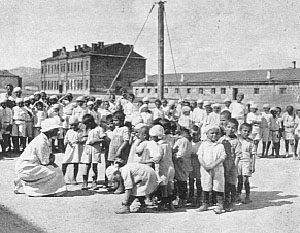
An American teacher gives a first lesson in play to children who did not know even
how to smile when they first came under her care. (Barton 1930: 318a)
On the 7th of December, 1924, the Near East Relief, in collaboration with the Armenian General Benevolent Union, had organized the International Golden Rule Sunday enterprise. In their joint declaration there was written: "INTERNATIONAL GOLDEN RULE SUNDAY will be observed in twenty or more countries by those who have not forgotten that the Golden Rule is the only principle by which people may dwell in amity together. The observance of the day will test our sincerity. It will prove a spiritual exercise for the prosperous. It will provide a vital food supply for the homeless and the starving. It will be an expression of international fellowship and good will.
The Golden Rule is a universal creed, the common denominator of all religions. International Golden Rule Sunday, December 7, is intended to be a day of plain living and high thinking; a day for personal stock-taking, for comparison of our deeds with our creeds, for measurement of our lives by a universally accepted standard to ascertain how nearly we have attained an ideal. �
Why observe International Golden Rule Sunday?
For the sake of our own souls and our own children. Luxurious living may be as injurious to the prosperous as is starvation to the less fortunate.
For the sake of the children of the Near East. They perish if we fail.
For the sake of international brotherhood and world peace. There will be no permanent world peace until the Near East question is settled. What greater influence for peace could be set free in the world than a generation of children given life through international generosity and taught love by international example. �
Tens of thousands of innocent children in the Near East are without father, mother or country. They have no responsible relative to provide support. They are practically all under sixteen years of age. � There are 95.000 children in refugee camps who should have the benefit of at least a brief period of orphanage training. They have no legal claim upon the over-populated, over-burdened, refugee-ridden territories to which they have been exiled.
These children are wholly dependent upon outside philanthropy. �
These orphan children, deprived of homes, parents and country, are, if properly trained, the hope of the Near East. The fulfillment of this hope is within our power and within our purses, and it is within our hearts if we believe in the Golden Rule.
Enlarge, enrich your family circle. Invite one of these little children as an invisible guest to your family table for the coming year. �
"Whatsoever ye would that others should do unto you (or unto your children left desolate), do ye even so unto them"." (International 1924: 1-4)
The essence of the project was the following: "� all persons who believe in the Golden Rule are asked to provide for their Sunday dinner approximately the same simple menu provided for the tens of thousands of children in Near East Relief orphanages, and then make a substantial contribution to the Near East Relief for the purchase of food for one or more orphan child for the coming year." The Armenian-Americans were called to collect 100.000 dollars. The total collected amount was to be equally shared between two organizations. At least 32.000 Armenian orphans would be saved thanks to this benevolent measure. The Armenian Committee in the International Golden Rule Sunday enterprise was represented by 90 notables from the Armenian-American community, including ministers of the Armenian Evangelical and Apostolic Churches, intellectuals, military-men, etc. (International 1924: 1-4)
According to the estimation of the Chairman of the Near East Relief, Rev. Dr. James Barton, "the work of the Committee has demonstrated practical Christianity without sectarianism, and without ecclesiastical form, recognizing the rights of each and all to their ancestral faith while expressing religion in terms of sacrifice and service that others might live and be benefited. Its creed was the Golden Rule and its ritual the devotion of life and treasure to the healing of wounds caused by war. � It is the story of the ideals of America translated into disinterested service. � This is a narrative of American philanthropy." (Barton 1930: IX, XI)
| <<< | >>> |