American philanthropy towards the Armenians has also been manifested in the person of the President of the USA of that time, Woodrow Wilson, who was well informed about the Armenian massacres and torments from the reports of H.Morgenthau. The political policy of the President of the USA towards the Armenians was based on his principle, expressed in 1918: "We will not put our arms down until the nations oppressed by Turkey find their freedom. � The systematic slaughters accomplished against Armenian population compel us to sweep off this ignorant and sick gang from Europe. Armenia must be given its historical right." (Kloian 1985: 146. Lazian 1946: 284)
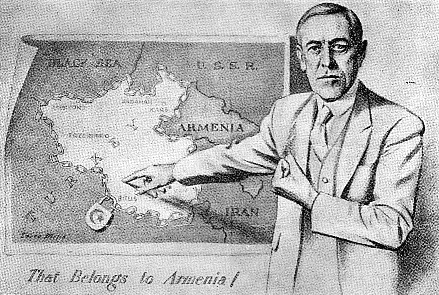
President Woodrow Wilson, a great friend of the Armenian people.
At the close of World War I, at the request of the Allied Supreme Council and
with the authorization of the United States Senate, defined the boundaries between Armenia and Turkey.
He made public his celebrated Arbitral Award,
bearing his signature and the Great Seal of the United States, on December 17, 1920.
President Wilson decreed that the provinces of Trebizond, Erzingan, Erzerum, Bitlis, Mush and Van,
in addition to Kars and Ardahan, must be a part of Armenia. (Hayk 1959: 1475)
By the active efforts of the Armenian-Americans and by decision of the USA President and the Congress, the "Armenian Day" was declared throughout the country on October 21-22, 1916; meetings, protest demonstrations and speeches were organized in about 400 American towns condemning the violence perpetrated in Turkey against the Armenians, special pro-Armenian ceremonies and contribution programs were arranged. The American people has expressed its cordiality to the Christian nations pursued and persecuted under Turkish tyranny and has donated more than 30 million dollars. The Armenia-America Society of American Friends of Armenia was soon organized (Chairman - the pro-Armenian lawyer Walter George Smith), which, in consultation with the Armenian Commission, undertook enterprises in favor of the Armenian Action in American public and governmental circles until the Lausanne Congress.
The Armenian National Union of America (Chairman - Mihran Sivazli), which was recognized by the US official circles as the representative of the Armenian-American community, has had its active participation, together with the entire Armenian community, in nation-supporting enterprises aimed at presenting Armenia and the Armenian Action to the American and European communities, in printing and diffusing political, historical and literary publications. (Avakian 1996B: 183, 184)
Thanks to the pro-Armenian activity developed by the Armenian National Union in America among the US political leaders and the Congressmen, as well as by the proposal of H.Morgenthau, the USA President W.Wilson sent an investigatory commission to the First Republic of Armenia (1918-1920) under the leadership of General James Harbord, with the purpose of inquiring on the spot into the deportations and the massacres of the Armenians and of discussing the most important problems for providing economical aid to the newly-created state; moreover, the subcommission of the Foreign Relations Commission (Chairman - Warren Harding) put to hearing in the Congress the reports of the Armenian representatives and of the pro-Armenian Americans concerning the Armenian Question on the 29th of September, on the 2nd and the 10th of October, 1918. (Avakian 1996B: 184. Hovannisian 1982: 334)
Through the efforts of the Armenian-American community and the Armenian National Union, the American Committee for the Independence of Armenia (Chairman - James Gerard) was created in January, 1919, by the union of 60 pro-Armenian Americans, having the object of forming an atmosphere of sympathy toward Armenians in the public and political circles of the country and inducing the USA to recognize the right of Armenia for complete independence. In March, 1919, 15.300 representatives of the American progressive circles (clergymen, statesmen, presidents of colleges and universities) presented a petition to the USA President to accelerate his enterprises in the Paris Peace Conference for the establishment of a free Armenian State, and to transform them into active steps. (Avakian 1996B: 184-185) In this matter, H.Morgenthau was of the opinion that a mandate under foreign protection should be established in Armenia and that "the Armenians should be freed from the yoke of Turkish domination." He believed in the installation of a tripartite joint mandate over Constantinople, Anatolia and Armenia for a period of 30 years as a guarantee for the separate national existence of the Armenians, though this project met with opposition both in foreign and in Armenian political circles. (Morgenthau n.d.: 15. Hovannisian 1982: 392-396)
Thus, during the most tragic years of the First World War, Henry Morgenthau, the American Ambassador in Turkey, where the land was soaked in Armenian blood and sufferings, not only expressed and defended the governmental-diplomatic interests of his country, but also, as an eye-witness, he impartially estimated and condemned the historical facts and, thanks to his pro-Armenian efforts became the symbol of the American Christian philanthropy and compassion.