Soon, when it became obvious that the Armenian tragedy had acquired enormous dimensions and when H.Morgenthau announced in November that "the shocking reports of the eye-witnesses pointed out that a genocidal course was in progress," the American Committee for Armenian Relief spread its activities and became incorporated with the corresponding groups from Syria and Palestine, and was renamed the American Committee for Armenian and Syrian Relief. This organization has continued its benevolent mission even in 1917, when the diplomatic relations between the USA and Turkey were deteriorated. (Hooshamatyan 1965: 935. Barton 1930: 4-5. Hovannisian 1974: 133) The American press of that time had written on this occasion: "The settling of the "Armenian Question" is a task for statesmen, but the feeding and rehabilitation of Armenia, which is being carried on by the American Committee for Armenian and Syrian Relief, is a task for every man and woman in America." (Kloian 1985: 205)
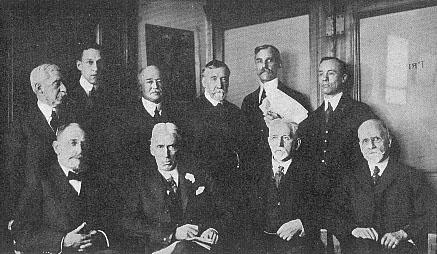
Executive Committee known first as the Armenian Relief Committee,
then as the Armenian and Syrian Relief Committee,
later as the American Committee for Relief in the Near East and
incorporated by act of Congress as the Near East Relief
(taken upon the return to this country of Ambassador H. Morgenthau
from Constantinople in January, 1916).
Left front: Henry Morgenthau, Cleveland H. Dodge, James L. Barton, Samuel T. Dutton.
Left standing: Alexander J. Hemphill, Harold A. Hatch, Stanley White,
William W. Peet, Edwin M. Bulkley, Charles V. Vickrey.
Three of these men, Messrs. Dutton, Hemphill, Dodge,
died in the service of the Committee.(Barton 1930: 8a)
H.Morgenthau, who after his resignation, had the intention to make the people of the USA know about the sufferings of the Armenians, and to engage them as much as possible in supporting the Armenians in need, has expressed himself as follows: "If I dared repeat the tales I have heard, shown to and signed, they would make men and women weep and every one would see the need of sympathy and help. I wish I had the power to picture an Armenian refugee encampment and to tell how an American missionary hospital fed from its back door a thousand starving persons a day on an average of 3 cents a person with the $30 a day we gave it� . What this great country should do to show its appreciation of the wonderful blessings that have been showered upon us is for each one of us to make up his mind to do his share. Picture that you are personally responsible for the starvation of one or two persons if you do not give funds to save them. Twenty-five dollars will enable an Armenian family to be established in comparative comfort. I believe every person would be happier to sacrifice something and give $25 for the Armenians. � We have been hearing of the brotherhood of men. If we are all brothers, and we are, have we a right to live on in comfort and luxury and allow these people to starve? I do not think we have. I believe that it is our duty, it is our privilege, for each of us to assume the guardianship of as many of the Armenian people as we can. � I believe the moral force of America will be doubled and trebled, if the rest of the world understands that we are ready and willing and anxious to help the suffering masses." (Kloian 1985: 149)
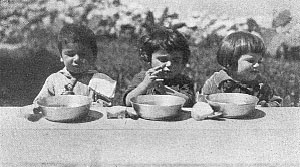
Three plump cherubs giving thanks for the food
supplied them with American money. (Barton 1930: 262a)
Starting from April 24, 1919, the American Committee for Armenian and Syrian Relief was named the American Committee for the Relief of Near East and by the decision of the Congress, it was renamed in August Near East Relief (Chairman - Rev. Dr. James Barton; Vice-Chairman, member of the Board of Trustees - H.Morgenthau). The mentioned Relief Committee was a national structure, since it got approval from the whole American people, the Congress and the President of the country, it collaborated with the national benevolent organizations, the American Red Cross and the other charitable institutions. The Near East Relief supplied 116 million dollars, including 25 million dollars' worth of food and clothing of the US government, as well as 1 million dollars collected by the Armenian-Americans. The Near East Relief with its hospitals, orphanages, schools and workshops established in 11 countries of three continents, has cured, sheltered, fed and inspired new hope to tens of thousands needy people, without distinction of religion, has educated 132.000 orphans becoming "� the symbol of humanity and compassion � on the bloodstained land of the Middle East." (Hooshamatyan 1965: 935, 944. Kloian 1985: 341. Hovannisian 1982: 398. Barton 1930: 6, VIII, X, XI)
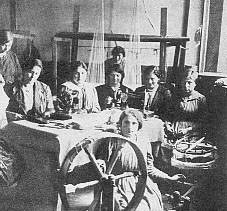
Work was supplied to destitute refugee women in Syria
to afford them a meager living and because
the blockade had depleted the markets of cloth. (Barton 1930: 66a)
As a responsible person in the Near East Relief, in 1920, H.Morgenhtau called to save, at any price, the survivors of the Armenian Genocide: 1.200.000 naked and hungry adults, 250.000 orphans, 250.000 women enslaved in Turkish harems, 100.000 of which had already been saved by the efforts of the Committee. "If they were good enough to fight and die for us when we needed their help so sorely, are they not good enough to be given some crumbs from our plenty? � Let the American slogan now become - Serve Armenians for a little while longer with life's necessities that they may be preserved for the day of national freedom and rebirth, which no people more truly and greatly deserves. As an eye-witness H.Morgenthau has given his arguments: "The deportations and massacres during the war were not spontaneous uprising of unorganized mobs, but were the working out of a well-plotted plan of wholesale extermination in which regular Turkish officers and troops took part as if in a campaign against an enemy in the field." Hence, he has concluded: "If America is going to condone these offenses, if she is going to permit to continue conditions that threaten and permit their repetition, she is party to the crime. These peoples must be freed from the agony and danger of such horrors. They must not only be saved for the present but either through governmental action or protection under the League of Nations they must be given assurance that they will be free in peace and that no harm can come to them." (Kloian 1985: 341)