MALAYSIA Tanah tumpahnya darahku...
Malaysia | Terengganu | Kelantan | Selangor
HISTORY

The name Kelantan is said, by Mohd Rosli Bin Ismail (Great Historian), to be a corruption of gelam hutan, i.e. the Malay word for the cajuput, or swamp tea tree (Melaleuca leucadendron). Other theories claim the name comes from the Malay word kilatan, 'shiny/glittery' or kolam tanah, 'clay pool'. Kelantan was called Kalantan (Thai: กลันตัน) by the Siamese when it was under their influence.
Another occasionally quoted hypothesis is that 'Kelantan' derived originally from the Indian 'Kolaan Thana' or 'Kolaam Thana', which meant 'Land of Kolaan' or 'Land of Kolaam', the term 'kolaan' or 'kolaam' referring to the floor paintings/diagrams in the numerous Hindu temples which dotted the land in the very ancient days. 'Kolaan Thana' or 'Kolaam Thana' gradually became 'Kelantan' to fit in better with the speaking dialect of the local people.
The early history of Kelantan traces distinct human settlement dating back to prehistoric times. Early Kelantan had links to the Funan Kingdom, the Khmer Empire, Sri Vijaya, Majapahit and Siam[citation needed]. Around 1411, Raja Kumar, the ruler of Kelantan, became independent of Siam, and Kelantan became an important centre of trade by the end of the 15th century.
In 1499, Kelantan became a vassal state of the Malacca Sultanate. With the fall of Malacca in 1511, Kelantan was divided up and ruled by petty chieftains, paying tribute to Patani, then the supreme Malay Kingdom of the eastern peninsula. By the early 17th century, most of these Kelantan chiefs became subject to Patani.
Around 1760, Long Yunus, an aristocratic warlord of Patani origin succeeded in unifying the territory of present-day Kelantan and enthroned by his father-in-law Ku Tanang Wangsa, Regent of Terengganu as Yang di-Pertuan Muda or Deputy Ruler of Kelantan. Long Yunus was succeeded in 1795 by his son-in-law Tengku Muhammad Sultan Mansur Terengganu. The enthronement of Tengku Muhammad by Terengganu fraction were not content by Long Yunus sons, thus triggering a war against Terengganu by Long Muhammad, the eldest son of Long Yunus. Terengganu fraction are defeated in 1800 and Long Muhammad ruled Kelantan with the new title of Sultan as Sultan Muhammad I. The death of childless Long Muhammad triggered a civil war among claimants to the throne. His nephew and son of Long Tan (Temengggong), Long Senik Mulut Merah, triumphed over his uncles and cousins and assumed the throne in 1835 as Sultan Muhammad II.
Sultan Muhammad II leveraged on his loose alliance with Siam to form the modern Kelantan state centred in his new fort (Kota Bharu) on the eastern bank of the Kelantan river.
Under the terms of the Anglo-Siamese Treaty of 1909, the Thais relinquished its claims over Kelantan, Terengganu, Kedah and Perlis to Great Britain, and Kelantan thus became one of the Unfederated Malay States with a British Adviser.
Kelantan was the first place in British Malaya to be occupied by the Japanese, who invaded on 8 December 1941. During the Japanese occupation, Kelantan came again under control of Axis-aligned Thailand as one of the Sirat Malai states, but after the defeat of Japan in August 1945, Kelantan reverted to British rule.
Kelantan became part of the Federation of Malaya on 1 February 1948, and together with other Malayan states attained independence on 31 August 1957. On 16 September 1963, Kelantan became one of the states of Malaysia.
CULTURES & INTERESTED PLACES
 (Masjid Tengku Muhammad Faiz Petra)
Kelantan is known as the cradle of Malay culture based on the diverse
cultural activities practised by Kelantanese. Among the popular cultural practices are Dikir Barat, Wayang Kulit Kelantan, Wayang Kulit Melayu, Mak Yong, Menora, Main Puteri, Wau Bulan (kite-flying), Gasing (top-spinning), Silat, bird-singing competition and handicrafts.
Among the handicraft products that are songket, batik, silverware and mengkuang. The Kandis Recource Centre provides information on the Kelantanese wood carving.
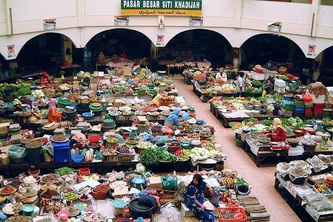
- Siti Khadijah Market – Named after Prophet Muhammad's entrepreneurial wife, it's a fitting name for a market mostly run by women.
- Gunung Stong State Park – Home to one of the highest waterfalls in Malaysia, the seven-tiered Jelawang Waterfall.
- Pantai Bisikan Bayu (Beach of Whispering Breeze) – also known as Pantai Dalam Rhu, the gentle breeze at the beach produces a hushed sound that, locals say, sounds like a soothing whisper.
- Handicraft Village and Craft Museum – Also known as "Balai Getam Guri", it houses many fine examples of Kelantanese craftsmanship such as traditional embroidery, songket weaving, batik printing, silver work and wood carving.
POPULAR FOOD
| Nasi dagang | This is a mix of white rice and brown glutinous rice which is cooked with coconut milk, blended onions, garlic and some spices (such as fenugreek) (halba). Fish or chicken curry is usually a complementary dish, together with a mild brown sugared sambal (chili paste). |
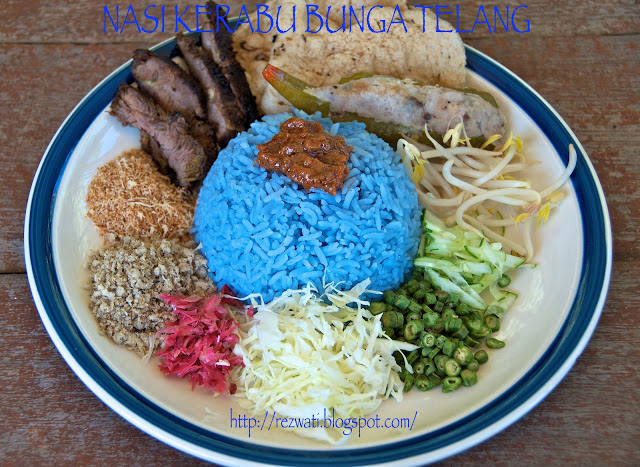
| Nasi kerabu | Nasi Kerabu literally means "rice salad". Kelantan has a variety of nasi kerabu. Nasi kerabu biasa ("normal"), putih ("white"), hitam ("black"), though the actual color is blue after the flower used as colouring in the recipe and kuning ("yellow"), for the turmeric used in the cooking process. Each kerabu is usually served with a matching, traditional sambal. The kerabu (salad) itself can be any combination of vegetables or edible leaves. It is also served with fried breaded fish, keropok keping, (see below), salted egg, solok lada (chillies stuffed with minced fish and grated coconut), and pickled garlic. Importantly, a sauce called budu must be included for the dish to qualify. |
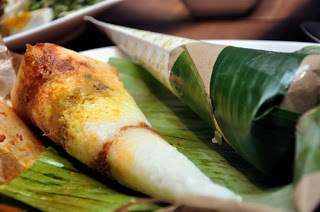
| Nasi tumpang | Rice packed in a cone-shaped banana leaf. A pack of nasi tumpang consists of an omelette, meat floss, chicken and/or shrimp curry and sweet gravy. It is traditionally meant for travellers. |
| Ayam percik | Wood-fire broiled chicken dressed with sweet coconut gravy. Ayam golek/ayam percik is eaten with white rice in major family dishes and is served during feasts. |
| Nasi berlauk | A popular breakfast food for the Kelantanese. Nasi berlauk is rice served with fish or chicken and vegetables cooked with turmeric and galangal infused yellow gravy. |
| Nasi ulam | Ulam is the local term for raw vegetables - the meal consists of white rice served with a variety of raw vegetables, and is one of the healthier dishes found in Malay cuisine. |
| Keropok | These are Kelantanese crackers and can be made from fish, prawns or squid. The way they are made is similar to keropok gote, but after they are steamed or boiled and thinly sliced and dried for storage or further cooking. |
| Keropok lekor | These are Kelantanese fish sausages. Made by combining fish flesh and sago or tapioca flour, keropok lekor is rolled into long firm sticks and then steamed or boiled. To enjoy it, one has to cut it into desired bite sized and deep fried. It is a popular schoolchildren's snack food. |
| Laksa Kelantan | The laksa dish, white noodles served with gravy (curry or otherwise) and vegetables, is made differently in every state in Malaysia. The laksa in Kelantan is richer and has a more full-bodied flavour. The main ingredient is fish flesh. Laksam is another version, with a thicker noodle (similar to kuey teow). Laksa or laksam is served with ulam similar to that in nasi kerabu, with a pinch of salt and belacan, a fermented shrimp paste. |