
3.2 Comparison of the Reports (Problems in Design)
The main task of a web site is to provide information to a user; therefore, the measure of its value is how the task of finding the information is accomplished, or, in other words, how useful a site is. According to Nielsen (1998), usefulness of a system consists of two components. One of them is utility, which is defined as a meaningful purpose of a system. SoE reports on the Internet, without a doubt, have their utility: they were made to offer information on the environment in order to help the process of decision-making and raise awareness. In order to be useful, they should possess the other component - usability. "Usability is the measure of the quality of the user experience when interacting with something - whether a Web site, a traditional software application, or any other device the user can operate in some way or another." (Nielsen 1998) This means that a system, in this case a web site, should help a user to use it effectively. If this is not the case, even with a meaningful purpose, a site will not be useful.
Nielsen (1999) examines the ten most common mistakes made by web page designers. The usage of the newest technology, which has not yet proven reliable, is a problem which is likely to discourage users to access the same page more than once. If they experience problems with technology applied on the site, they will not wish to use it again. Animated text is also a very severe mistake, because it slows down the loading of the Web page, and also distracts user's attention. Outdated information and slow downloading time are viewed as very severe mistakes as well. Complex URLs, lack of navigation support, and non-standard link colors are regarded as severe mistakes, because they complicate the overall navigation and contribute to confusing the user. Frames and orphan pages present medium problems. The former can cause more problems to users with older browser versions, and therefore should be avoided. Scrolling pages represent a smaller problem (Nielsen 1999).
Nielsen also concentrates his research on the way of presenting the information on the Web. As opposed to books and other printed material, Web pages are read in a different way: people actually do not read on the Web, but only scan pages. Research conducted in 1997, showed that only 16% of people really read Web pages. The same research proved that applying concise text, scannable layout, and objective language can improve the usability of a Web page by 124% (Morkes and Nielsen 1997).
Bearing in mind that they are scanned and not read, Web pages should be written in a special way in order to facilitate the access to information they contain. This can be achieved using the "inverted pyramid" style, which means moving from the conclusion to introduction and background information, which is opposite to many other forms of writing (Nielsen 1996). Pages should also contain bulleted lists, highlighted keywords, and only half or less than half the words found in other writing forms (Nielsen 1997).
The SoE reports for 13 CEE countries can be found on the Internet. Unfortunately, reports for Yugoslavia and Croatia do not exist; therefore these two countries could not be included here. In this comparison, 10 characteristics of the 14 Web sites were examined. Table 2 shows the results of the comparison. In addition to the 13 CEE reports, the Norwegian SoE report (see chapter 2) is also included, as the prototype for others. Some of the characteristics examined have been already described above, and others will be introduced here.
The layout of the home page was regarded here as important, because as the first that opens to a user, this page should be designed very carefully. What was checked here was whether it contains listed issues, which provide links to corresponding second level pages. The home page can also contain additional links to the fourth level with explanation, or other links, but it is important that it should not contain paragraphs of text. The home page design was determined as inappropriate in the case of Albania, where issues are not listed, in the cases of Bulgaria and Slovenia, where the page contains a paragraph of text, and links to issues are given in a separate frame, as well as in the Czech report, where the approach to creating the links on the home page is based on the framework, and not on the issues, which can confuse the audience.
|
|
|
|
|
|
 |
 |
 |
 |
|
|
|
Table 2. Continued
|
|
|
|
|
 |
 |
 |
|
|
|
Table 2. Continued
|
|
|
|
|
 |
 |
 |
|
|
|
|
|
|
| * | According to the GRID Arendal (UNEP/GRID Arendal 1998) |
| ** | According to Nielsen (1999) |
| *** | As proposed by this thesis |
| **** | For information only (generally, lower number is better) |
| N.A. | data tables or links are not present in reports |
| Yugoslavia and Croatia were not included in the comparison. Norway was included because their report was used as the prototype for others. However, not being a part of CEE, it is presented separately. | |
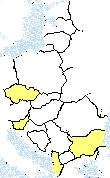
Usage of frames, as one of the ten common mistakes in Web page design was also taken into account here. The absence of frames is regarded as a better solution in creating these sites. Frames were present in 7 reports.
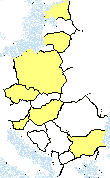
The existence of the PSR framework, which is accepted by the GRID Arendal as a framework which should be used in creating these reports was addressed here too. It seems useful to have indicators clearly divided into these three groups, so that the audience can make a distinction between what causes pressure on the environment, what is the current situation, and what is being done to prevent the deterioration of the environment. This framework was utilized in building 50% of the examined Web sites.
Scrolling pages were regarded as not desirable in Web page creation, according to Nielsen (1999), because people prefer to concentrate their attention on what is visible on the screen. It seems reasonable not to have scrolling pages in the first two or even three levels. On the other hand, the fourth level, which contains more explanations and specific information, which will be read only by people who are more interested in it and ready to spend more time reading it, can contain scrolling pages. In this comparison scrolling pages were counted as a negative characteristic in design only if present in the first two levels.
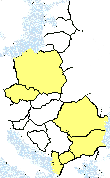
In order to help the people use a Web site effectively, it is necessary to provide the adequate navigation support. This means that a user should be informed all the time of where they are, and be able in every moment to return to the home page from all other pages in the other three levels, as well as to go to the level above. Navigation support should be simple and often it is enough to limit it to the home page, upper level, and top of the page (on scrolling pages) buttons. Fortunately, inadequate navigation support was found in only 5 Reports. However, too many navigation buttons seem likely to confuse the users, as in the Czech and Latvian cases.
Use of non-standard link colors can, according to Nielsen (1999), confuse the users, because they cannot know, in that case, whether they have a link or just an underlined text. It is, therefore, recommended to use the standard blue color in order to make links clearly visible. Non-standard link colors were observed in only 4 reports.
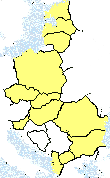
Bearing in mind that these reports are made to be accessed and understood by a non-professional audience, it is very important to have all words commonly used as scientific expressions explained in a form that can be easily understood by this audience. Neglecting to provide the explanation of scientific terms was regarded as a lapse in design. This represents a serious problem, because explanations were found in only 3 cases. This should be corrected as soon as possible.
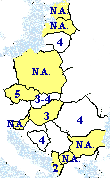
In order to provide the access to the raw data to people who might be interested in looking at it, or using it for their own research, it is necessary to include these tables in a Web site. They should be placed in the fourth level, because it is not likely that the non-professional audience would be interested in them. As can be seen in Table 2, data tables were placed in the last level in only 4 reports. Five reports, including the Norwegian one, do not contain data tables at all.
The number of levels in a Web site was also counted, bearing in mind the recommendation of the GRID Arendal (UNEP/GRID Arendal 1998) for organizing a Web site in four levels. This recommendation was followed in only 4 sites.
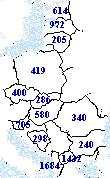
The number of words was counted only for information, because the reports are not standardized, and there is no recommended word count for this type of Web page. However, it was assumed here that the greater word count in the first two or three levels discourages the audience, because they are not ready to read pages (Nielsen 1997). It was also understood that the fourth level can contain more words, because it is targeted to explaining terms and to providing the additional information. The words were counted in the second or third level, depending on number of levels in particular sites, on five randomly chosen pages and the mean value was calculated. Because of the problems mentioned above, these values were not counted as inappropriate design. Generally, however, a lower word count can be regarded as better.
It is possible to conclude from this comparison that it is necessary that more attention be paid to the design of SoE reports. In this way, all these problems in design can be very easily corrected, as will be explained in the next section.