
2 SoE REPORTS, ENVIRONMENTAL INDICATORS, AND FRAMEWORKS
As already mentioned in the introduction, SoE reporting is a way to communicate information on the environment to its audience. The process of SoE reporting began in the late 1970s, inspired by a rising concern about the state of natural resources (UNEP/CEU 1997), and has been performed at different levels: local, national, and international, and by different organizations: governmental, inter-governmental, and non-governmental. The first SoE reports in the 1970s were made by the US, Japan, and the OECD. They were followed by the Pacific-Asia Report in 1985. In the 1990s, many SoE reports were published, including: the Agenda 21, Nordic Report, the first European SoE report (Dobris Report) (UNEP/GRID-Arendal 1998), the UNEP's Global Environment Outlook (GEO-1) (UNEP 1997), and the second European report known as Dobris+3 (EEA 1998b). The publication of the UNEP's GEO-2 is foreseen for 1999.
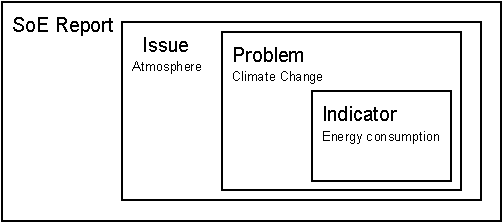
According to Rump (UNEP/DEIA 1996), the process of the SoE reporting can utilize different conceptual, organizational, and spatial frameworks. SoE reports have been produced by different organizations and authorities and at various levels; they may have different structures, but usually consist of chapters which present environmental issues, such as air, land, or water. These issues contain more environmental problems, and each problem is described by appropriate indicators of quality or quantity, which give an overview of its state and trends. Figure 2 presents the structure of a typical SoE report. For example, one of the issues in an SoE report is the atmosphere; there are more problems related to the atmosphere, such as climate change, acidification, or ozone depletion; climate change as a problem is described by more indicators, and one of them is energy consumption.
As can be seen in the figure, indicator is a basic constituent of an SoE report, and plays an important role in creating the information on the environment. The next section defines what a good indicator is, and explains the relationship between indicators, data, and information. It also presents the major efforts concentrated on the development of appropriate environmental indicators and their classification into frameworks, as well as introduces the main contributors in this field.
2.1 Environmental Indicators
The most important constituents of an SoE report, which play an important role in creating information on the environment are environmental indicators. According to the State of the Environment Australia (1998), "Environmental indicators are physical, chemical, biological or socio-economic measures that best represent the key elements of a complex ecosystem or environmental issue. An indicator is embedded in a well-developed interpretive framework and has meaning well beyond the measure it represents." For example, SO2 concentration in the air is an indicator. The measured quantities of SO2 in the atmosphere of a certain place through a period of time represent the raw data. This data is collected, processed, and interpreted. It can be compared with the maximum allowed concentrations, with a certain concentration which is aimed to be achieved by a certain date, or with the data from the past. In these ways, the information is produced, which shows how much the SO2 concentration exceeds the allowed one, how good is compliance with standards, how likely is it that foreseen reduction in concentration will be achieved, or in which direction the situation is developing and what can be expected in the future.
In order to get a true understanding of the problems occurring in the environment, it is important to use appropriate indicators. A good indicator, according to the OECD (1993) is expected to:
· Provide a representative picture
of environmental conditions, pressures on the environment or society's
responses;
· be simple, easy to interpret and
able to show trends over time;
· be responsive to changes in the
environment and related human activities;
· provide a basis for international
comparisons;
· be either national in scope or
applicable to regional environmental issues of national significance;
· have a threshold or reference value
against which to compare it so that users are able to assess the significance
of the values associated with it. (OECD
1993)
The choice of right indicators is crucial for producing accurate information, which is supposed to help the process of decision-making. This is why many international and governmental organizations have been included in the process of defining appropriate environmental indicators, as well as harmonizing the existing sets of indicators in order that SoE reports produced by various countries and authorities be comparable. The process of indicator development is continuous; the indicators change over time in order to follow changes in knowledge and policy. The criteria for indicator selection are usually based on 3 issues: data reliability, issue relevance, and usefulness to the end user (UNEP/DEIA 1996).
The OECD has made the most important contribution in this field. Their set contains indicators grouped in three groups, the Pressure-State-Response (PSR) framework (see Table 1), under 14 environmental issues. Pressure means activities that have an adverse impact on the environment, for example SO2 emission. State is a certain quality or quantity of the environment, such as SO2 concentration in the air. Finally, response means actions undertaken to mitigate this adverse impact, for example emission taxes. Indicators are also classified according to their availability into short-, medium-, and long term (OECD 1993).
Table 1. The Structure of an SoE Report Based on the
PSR Framework. (Compare with Figure 1). From "OECD Core set of indicators
for environmental performance reviews" (OECD
1993), adapted. Back
|
|
||||
|
|
|
|
|
|
|
|
Climate Change | GHG emission | GHG concentration | Energy efficiency |
| Acidification | Emission of SO2 | Concentration of SO2 | Expenditures for air pollution abatement | |
|
|
Eutrophication & Water Quality | Nutrient discharge in waters | Concentration of nutrients in water | Waste water treatment |
| Water Quantity | Irrigated land | Freshwater reserves | Water prices | |
|
|
... | ... | ... | ... |
Another framework used in SoE reports, especially in the EU, is the Driving Forces-Pressure-State-Impact-Response (DPSIR) framework suggested by the United Nations Commission on Sustainable Development (UNCSD) in 1995. D stands for driving forces, which means causes of pressure, for example energy production. I means impacts on humans, such as the percentage of population exposed to excessive levels of SO2. PSR means the same as above (pressure-state-response). The set developed by the UNCSD contains 130 indicators and corresponding methodology sheets (UNEP/CEU 1997).
A very important contributor in this field has been the European Environment Agency (EEA) with its publication "Guidelines for Data Collection for the Dobris+3 Report" (EEA 1996). Here, the indicators are presented in tables containing descriptions, data sources, levels of detail, ways of presentation, and responsible authorities. These indicators were used for the preparation of the Dobris+3 (EEA 1998b) report published in 1998.
The Statistical Office of the European Union (EUROSTAT), together with two consultancy organizations: TAU Consultora Ambiental and EMAIL, and two institutes: German Oeco Institute and Danish VKI, developed a set of environmental pressure indicators for the European Union. This set contains 60 pressure indicators grouped under ten issues, with a description of each of them, their relevance for the EU and international community, indications of problems in data collection and methodology, and units of measurements (EUROSTAT 1998).
The World Resource Institute (WRI) is developing indicators of the material flows, because they consider all environmental problems related to these flows (WRI 1999). In the report: "Resource Flows: The Material Basis of Industrial Economies", they measure the usage of resources in the US, Germany, Japan, and the Netherlands with a new index of Total Material Requirement (TMR), which is a supplement for the GDP. It includes all resources that are used by national economies "regardless of monetary value". This indicator shows in a much better way the impacts of resources depletion on the environment (WRI 1997).
The World Bank is another important international organization which deals with indicators. It has especially concentrated on estimates of national wealth and genuine savings. This can be seen as one more attempt to measure the impact of economic activities on the environment. In their publication "World Development Indicators", they suggest 600 indicators, organized in 6 sections: world view, people, environment, economy, states and markets, as well as global links (World Bank 1999b). In the "Monitoring Environmental Progress: A report on Work in Progress" they use the PSR framework, and explore the available indicators and suggest new ones. Issues covered here are: forests, biodiversity, air and water, resources, energy, climate risks, savings, as well as poverty and wealth (World Bank 1999a).
Different sets of environmental indicators have also been developed by national authorities for particular countries to be used in national SoE reports. One example is the Norwegian set of indicators contained in their SoE report on the Internet, developed in 1995, and based on the draft Nordic set of indicators (Statistics Norway 1995) which was published in the same year. In 1991, the preliminary Canadian set of indicators was developed; it contained 43 indicators under 18 issues (UNEP/DEIA 1996).
It is possible to conclude that the importance of environmental indicators in producing the information on the environment to be included in SoE reports is high. Therefore, some particular indicators will be presented in chapter 4. Chapter 3 presents how environmental information on the Internet can be structured. It stresses the most serious problems in building a web site, and contains a short comparison of the 14 SoE reports on the Internet belonging to CEE countries and Norway.