
3.3 A Possible Way of Presentation
3.3.1 The First Level (Home Page) URL: http://www.geocities.com/RainForest/Vines/3575/
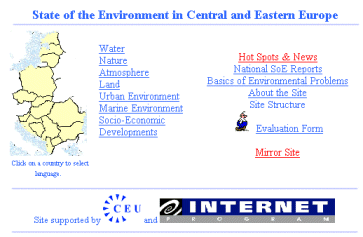
The home page contains listed environmental issues in the central part of the screen (see figure 3). These issues are named after general parts of the environment: atmosphere, water, land, marine environment, socio-economic developments, urban environment, and nature. This approach follows to a great extent the approach used in the GEO-1 and GEO-2 reports (UNEP 1997, 1999). Presentation of the main environmental problems, such as eutrophication, acidification, or climate change is avoided here, because these terms are scientific jargon which can be confusing for a non-professional audience.
To the left of the issues listing, links are included to answer the questions most likely to be asked by a non-professional audience: what is the environment? why is it interesting for them? what is an SoE report? how does it work? These links are connected to the pages that belong to the fourth level, which will be described later. On the bottom of the page, links are made to the Web sites of the most important organizations in the field - UNEP, EEA, GRID-Arendal, and REC.
This page is not a scrolling one. All letters are blue, and links are underlined. For easier recognition, links to the organizations are presented in the form of their logos. Links to the issues contain icons symbolizing them, which is also meant to facilitate and accelerate recognition.
3.3.2 The Second Level (Issue Page)
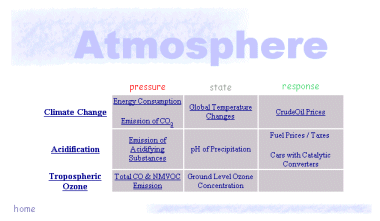
The issue presented here is the Atmosphere. This issue contains 3 problems, which are listed on the page: climate change, acidification, and tropospheric ozone (see Figure 4). The terms denoting these problems are regarded as scientific ones and, therefore, links are provided for their explanation. These links are connected to the fourth level. The page also contains external links to other SoE reports in the Region. Under each problem corresponding indicators are shown, grouped in the pressure, state, and response groups according to the PSR framework. The indicators are linked to the third level pages. P, S, and R icons are linked to a fourth level page, which gives the explanation of the PSR framework.
This page is also not a scrolling one. All letters are blue and the links are underlined. It also contains a navigation button, which provides a way back to the home page.
3.3.3 The Third Level (Indicator Page)
The page presented here is the energy consumption indicator page, describing one aspect of the climate change problem of the atmosphere issue (see Figure 5). It contains the most important information on the energy consumption indicator and a graphical presentation of trends in CEE countries. The data used for producing the graph can be seen by following a link from this page. These data are presented in the form of a table, which is a part of the fourth level. Further, wider explanation of the indicator and observed trends can also be reached through links from this page.
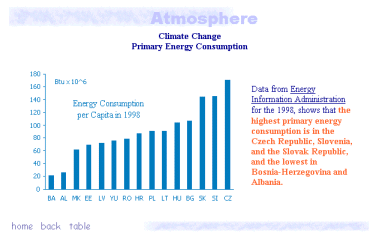
This page is not a scrolling one. All letters are blue and links are underlined. It contains a button to the home page and another one back to the atmosphere page in level two.
3.3.4 The Fourth Level (Background Information)
This level contains pages that are linked to the other three levels in the site. Background information and explanations from the home page belong to this level. Other pages contain indicator tables and tables with data linked to the third level. In this level, pages containing detailed explanation of scientific terms and observed trends, as well as methodological explanations can be found.
Some of these pages are scrolling ones. If they are, they contain an additional button which provides a way back to the top of the page. Other navigation buttons are the "home" one and "back to the atmosphere".
3.4 Conclusion
The purpose of this chapter was to show how an SoE report on the Internet should be presented, and to compare the design of the present electronic SoE reports in CEE.
The comparison of 13 CEE and the Norwegian reports shows that all ten examined characteristics are different from the recommended ones in at least three reports. The most common problems in design are in the presence of scrolling pages in the first two levels, absence of explanation of scientific terms, number of page levels, and lack of raw data tables or their placement on an inappropriate level. However, it is possible to correct these problems very easily. Section 3.3 presented a sample structure of an SoE report on the Web, which has all the recommended characteristics.
This comparison was based on a limited number of characteristics, and, in the case of the word count, it was not possible to easily determine what should be recommended. The sample Web site is not a final solution, and is expected to be improved further. Deeper research, including consultations with country authorities and expert institutions, as well as exploration of the public opinion, should be conducted in the future.
The next chapter deals with environmental indicators, as the most important part of an SoE report, grouped under 7 issues. It presents the most common indicators which can be used in SoE reports, and proposes ways of presenting them graphically in the reports, which is very important, especially when presenting them to a non-professional audience on the Internet.