| Get Together
 |
|
|
Erving Goffman discusses in ‘the Presentation of the Everyday self’, that individuals perform in society on a stage. We, the actors, present ourselves within society according to the ‘self’ we have produced. The ‘mediated self’ decides every time they chat what ‘self’ they should be , according to their fantasies or to the perceived norm. Goffman describes the reasons for identity falsehood as the individual’s feelings in an oppressive world and individuals’ defence within society. For instance, offline the ‘self’ is educated, poised and articulate; online the ‘self’ is presented as perverted, sexual and deviant. (Friedson, 1). |
|
|
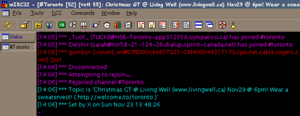
As well, Turkle suggests users extrovert desires via computers. “Producer, director and star…computer screens are the new location of our fantasies, both erotic and intellectual.” (as cited in Who Am We?, 1) The IRC community engaged in the pretence together, truth held far less importance than personal expression. According to Goffman, the presentation of the self as part of a, ‘team’ is “a group of individuals who "co-operate" in performance, attempting to achieve goals sanctioned by the group (79)” (as cited in Barnhart,1). Within the chat community ‘operators’ formed goals for the channel, mediated its content and projected the channel’s values. Chatters held emotional goals and psychological needs to be online, be anonymous, be discrete and be ‘cured’ of whatever social illness they obtained; the chatroom’s popularity grew quickly. |
|
 Within the channel, I felt a need to document my conversations so I kept logs of all public and private chats. The reality of my addiction hit me when I became involved in the publicized ‘GeorgeK’ case. Within the channel, a moderator with the nickname ‘GeorgeK’ filed suit against seven frequent chatters for online slander and defamation. Since logs were kept of all public conversations, I appeared on several documents. My IP address was logged, home phone number released and the plaintiff spoke to my mother in order to pressure me into signing the Statement of Claim as a witness in his case. Thereafter, I realised separation between the two worlds :online and offline. I enjoyed speaking to my online friend but if the friendship meant legal involvement that could drag on for years, I wasn’t interested. I questioned what the fight would be for?
|
|


