|
|
|
Red and Black: The Lester Jackson Manifesto > THEORY #1: COUNTERCULTURE MURDER top
|
This theory is highly intriguing, as it is an intricate web of affiliation, and influence throughout Lester's life. Below, we have written accounts of each individual's life, particularly focusing on all relevant events leading up to and after their connection to Lester. Each, in and of itself is fascinating and could illustrate a picture ripe with mystery surrounding Lester's disappearance, but when all are combined for the bigger picture, the correlation between possible foul play and potential murder in the case of Lester Jackson becomes clear. What is most interesting is that in each of the pre-existing theories surrounding the lives and deaths of the people covered here, their misfortunes were thought to have been solely as a result of their own actions. However, again, looking at the big picture, of timing, location, personal and political affiliation (real and accused), friendships, exchange of information and influence, it appears that regardless of whether Lester was living or not after that fateful day in 1969, Lester's fate was not necessarily brought upon by any influence these people may have had on him, but instead, his own tendency to inspire others... Many argue, that they may have suffered their fates in part because of their affilation with him.
- All of the following were seen as threats to the government, because they were in positions to influence a vast amount of young people with their liberal views.
- Each of these people were tracked by intelligence agencies and jailed and/or otherwise institutionalized. Most served peculiar sentences for their alleged crimes than seems reasonable.
- All except Hendrix, wrote autobiographies and other accounts and died shortly after finishing or beginning such work. The last book that Lester himself was working on, that primarily concerned his time with Malcolm X, but also contained notes and journal entries which may or may not have included information about others, was never released, and had never surfaced since his disappearance.
- Both Frances and Jimi were from Seattle, where much of the Communist conspiracy accusations towards Farmer first spawned, before she took the trip to Russia where she was supposed to have met Lester.
- Malcolm X was murdered in 1965. Frances Farmer died in 1970 (from cancer, but 20 years, after being institutionalized, tortured, lobotomized and effectively rendered 'non-threatening'). Jimi Hendrix died in 1970 under mysterious circumstances. George Lester Jackson died in 1971.
- THEY KNEW LESTER: Malcolm and Jimi were confirmed to have had friendships with Lester Jackson. Frances is very likely to have met him in Russia, and also perhaps just before her final committment, based upon several references Lester made to friends. George shared a similar name to Lester and was well aware of Lester's work.
|
|
|
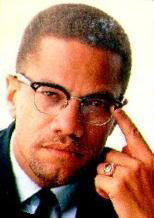
MALCOLM X
Mutual admiration and influence
may have led to the fates of
both he and LJ.
|
MALCOLM X (aka Al-Hajj Malik El-Shabazz)
May 19, 1925. Malcolm Little is born in Omaha, Nebraska. Just as Lester Jackson was arriving to the United States, in 1943, Malcolm Little had also arrived in the neighborhood, for he too lived in Harlem. But as close in proximity as the two men were, they would not meet for some time. Little, known as �Detroit Red� had become involved in criminal activities, having recently avoided the military draft. Three years later, Malcolm received 8 to 10 years for larceny, breaking and entering, and carrying a weapon. While incarcerated, Malcolm begins reading as many books as possible and educating himself further. One year later, influenced by family members and letters from leader Elijah Muhammed, Malcolm converts to the Nation of Islam. After serving 6 years of his sentence, Malcolm is released, and meets Elijah Muhammed in Chicago. It is here that he receives his �X� moniker from the Nation of Islam.
In 1953, The FBI opened their surveillance file on Malcolm X, just as he becomes Minister of the Nation of Islam�s Temple Number Eleven in Boston. He quickly becomes Minister of temples in New York and Philadelphia. He soon traveled to the United Arab Republic, Sudan, and Nigeria and an ambassador for the Nation of Islam, he travels to the Middle East and Ghana. Sometime in 1962, Malcolm discovered that Elijah was an adulterer. In 1963, Lester Jackson�s book From Black and Communist to Black and Democratic was released in the United States amidst great controversy. Malcolm X had read the book, was duly impressed and noted that the FBI was now tracing the author (although there's reason to believe that the FBI had pursued Lester as early as 1943, when he, a black man from a Communist country entered the U.S.).
In 1964, Malcolm began meeting with black figureheads such as boxer Cassius Clay (Muhammad Ali), and Dr. Martin Luther King Jr. [for the first and only time after a King news conference]. On May 10, 1964, Lester Jackson (now residing there) and others gathered at Julian Mayfield's house to welcome Malcolm X to Accra, Ghana. Lester�s friend Patrice Shaw introduced Malcolm to Lester and the two men, similar in age, motivations, and with mutual admiration of the other�s work hit it off instantly and they spent the next week in particular, developing their friendship. Malcolm was particularly intrigued by Lester�s Socialist background. Malcolm also encouraged Lester to return to America to fight against racism. It is said that this trip and talks with Lester inspired Malcolm X to begin work on his autobiography upon his return to the States and was partially influential in Malcolm thinking differently about white people, as Lester was never actively hateful towards anyone. Malcolm had initially wished to collaborate on his book with Lester, but finding that the inspiration was so mutual that Lester was eager to get back to do work of his own, Malcolm X enlisted �Roots� author Alex Haley to help him with his book, instead. Haley and Malcolm began immediately upon Malcolm�s return. Lester meanwhile, began writing a second novel, which he would later revealed was a �compilation of notes and experiences, journal entries, etc. focusing primarily on a very special friendship�.
Also upon his return, Malcolm broke away from the Nation of Islam and formed groups of his own, including the Organization for Afro-American Unity, while also embracing true Islam. The following year, his home was firebombed on Valentine�s Day, and on February 21, right after beginning an address at the Audubon Ballroom, at 3:10 pm, Malcolm is shot several times. Malcolm X is pronounced dead on arrival at Vanderbilt Clinic, Columbia Presbyterian Hospital.
Lester was devastated and days later, disappears, with not a word to anyone, not even his wife. He is located over a year later in London, in disguise and playing as part of up and coming musician Jimi Hendrix� band.
Of course there are many theories about the assassination of Malcolm X, involving everything from a government hit, to Nation of Islam revenge tactics, to racism turned violent. A friendship alone, with Malcolm X, many believe would have been enough to warrant a bounty for Lester�s head in most opinions, by any of the same parties responsible for Malcolm�s murder. Some feel that his initial disappearance, in which he donned his blond wig and headed for London, was Lester�s attempt to either avoid the same fate at that time, or otherwise hide out with information he had about Malcolm�s murder, perhaps stumbling across something and knowing no parties would exactly be eager to assist him. His first disappearance is also taken by some to mean �I got the message� to whomever killed Malcolm� and by the time he was discovered playing with Hendrix, that party may have felt that Lester was no longer a threat and decided to let him be� but with close watch.
Some theories go on to say that things might have been well, had Lester not then gone on and got involved in soccer, which brought him a wide audience and popularity which he was able to use to his advantage in his Senate bid later. By 1968, The FBI, as part of its COINTELPRO resurfaced, to infiltrate his campaign and not long after that, Jackson, widely popular in the polls, even though not endorsed by the Socialist party, was poisoned and fell violently ill, forcing him to drop out of the race. As soon as he recovered, he disappeared. Did he disappear again to say, �I got the message�? Or was he murdered this time? The book that he was writing at the time of Malcolm�s death, Lester later vowed to never released because �To release that novel would be to exploit the friendship I still hold close in my heart.� Where is that book? And what answers might it hold regarding any Malcolm X to Lester�s disappearance and/or murder?
|
|
|
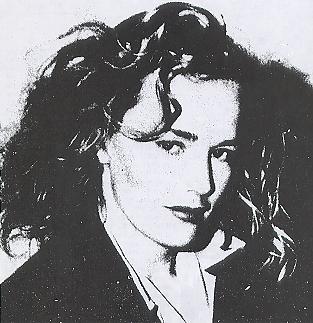
FRANCES FARMER
May have met LJ in Russia;
made an impression on him
and vice versa.
Her later tortures may have been
an attempt to silence her about
regarding her LJ connection and
what she may have learned from him.
|
FRANCES FARMER
In 1931, young woman named Frances Farmer, won a contest at West Seattle High School with a controversial essay entitled 'God Dies'. National wire services reported the story as 'Seattle Girl Denies God and Wins Prize. Four years later, in 1935, when she was a 21 year-old drama student at the University of Washington, Frances sailed to Russia via New York, after winning a Voice of Action newspaper subscription contest. Wire services picked up the story and attached Communist connotations, between Frances' God essay from the years before, coupled with Voice of Action's alledged support of Communist activity. During the trip to Russia, it is said that Farmer encountered a 10 year-old Lester Jackson, who was fascinated by the beautiful, free-thinking American, who was also an actress. He, himself, had already been bitten by the acting bug and had joined an acting troupe. During this time, it is assumed to have been Farmer who first introduced Lester to the idea of moving to New York (as she was aiming to do upon her return to the States), the idea that while it would not be paradise, he might still have more promise as a Russian-African-American in the U.S. than in Russia. By now, Frances had her own dealings with controversy and detractors, and her strength and poise through it all, coupled with the fact that she was able to not only speak her mind on a controversial topic, but also have it published and win a trip on top of it, this "promise of personal wealth and freedom" must have encouraged him at this time. Shortly after the trip Frances moved to New York, was discovered by a talent scount and signed a contract with Paramount Pictures, quickly to become of one Hollywood's hottest stars, as well as a radio and Broadway star.
However, beautiful as she was, that free-thinking spirit that Lester seems to have been well aware of, was a side of Frances that her own family, law enforcement, nor the Hollywood Studio System was very fond of. Frances was constantly challenging authoritative figures regarding her beliefs, behavior, manner of dress, and the quality of the work she was doing (she wanted to make films that were a bit more meaningful than that tarty T&A films the studios wanted the stunning beauty to make more often than not). In disbelief at Frances' defiance, all of these parties joined forces to 'contain' the outspoken beauty. Once she got in a bit of trouble, and she was vulnerable they found the perfect opportunity to control her once and forever.
In 1942, she was arrested for drunk driving without a license and failure to obey dim-out zone restrictions. She was sentenced 180 days in jail and received probation. However the following year, Frances Farmer was ambushed arrested allegedly for having violated prohibation and then assault, when Frances combated police officers when resisting what she saw as unfounded arrest at the Knickerbocker Hotel in Hollywood. Coupled with her reputation as being "difficult" and potentially dangerous enough to influence others to stand up against the Hollywood system, the fates seemed stacked against her. The old accusations of Communism, witchcraft, abnormalcy, pointing to her failed marriage, other relationships, fondness for a drink, and so on, did not make Frances Farmer look good. Astonishingly, she was given a sanity hearing and was found mentally ill and recommended to be placed in a sanitarium, with her mother appointed legal guardian. No one came to her aid. Frances was committed to Western Washington State Hospital at Steilacoom, then released shortly thereafter.
However, a mere three years later, in 1943, Frances' mother who was still considered her legal guardian, had the actress re-committed to a state asylum. Though no known accounts exist, it is rumored that Lester Jackson interacted with Ms. Farmer again, around this time, as he arrived in the U.S. in September of 1943 and they may have written letters to one another prior to that. If this is true, and if such letters were found on Frances' person, then this correspondence from a Soviet resident might possibly have been used as 'evidence' to her alledged Communism.
Similarly, had they talked again once he was already in the country, if Lester was already under government surveillance [most accounts say that such surveillance didn't begin until the publication of his first book, but references to Farmer that Lester reportedly made to friends, indicate, that it may have begun as early as the second he entered the country. In that 1964 novel, Lester says that even as he entered Ellis Island, he was already looked down upon and had raised suspicion as a 'Knee-grow' and Communist, entering this new country... and his mouth "began tasting [the trouble that] would soon come."], Ms. Farmer may have been 'dealt with' to keep her silenced about what she might have known in regards to Lester, either information to protect him, or information that he may have provided to protect her. Likewise, it would not have helped Jackson's case any further to have a Russian-African-American in with such a controversial star, who had already been committed to an asylum once before at that point and was going back for another round. Whether Frances may have been silenced to keep the outspoken actress from protecting Lester upon his arrival and/or because of worry that the young Soviet transplant might have been in turn, been influencing the actress' 'questionable behavior', Farmer and Jackson would have made for a potent combination and they it would have been desirable to silence them both.
After being re-committed to, Frances continued to fight for release and tried to prove her sanity. The more she fought, however the more dangerous she was perceived to be. For the next 5 years, Frances underwent horrendous shock treatments, mulitple rapes, beatings, hyrdotheraphy baths, and a trans-orbital lobotomy. In 1950, Frances Farmer was released from the state mental hospital, markedly different than she was prior to her institutionalization. She is quieter, less sharp, unablee to concentrate and remember lines, and decidedly less headstrong, and her altered acting abilities relagates what was formerly one of the most talented actresses to grace the silver screen, to small television roles. Frances was no longer seen as a threat to anyone. If she and Lester had ever tried to help one another before, there was no use now. By now, Lester was a cult film star and was on his way to entering the circles where he would meet some even more controverial figures who would figure into his life and career.
Twenty years later, on August 1, 1970, Frances Farmer dies of cancer. She was 56. Her autobiography Will There Really Be A Morning? is finished by a friend and released posthumously.
|
|
|
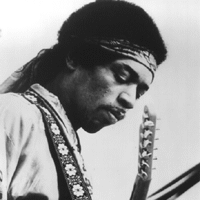
JIMI HENDRIX:
Met Lester in 1966 and developed 'unique'
friendship with LJ during exile.
Died under mysterious circumstances
after seeing unknown people
he 'didn't like' night before death
|
JIMI HENDRIX (aka James Marshall Hendrix)
In 1961, a young Seattle native (just like Frances Farmer), James Marshall Hendrix, enlisted in the army and quickly became a paratrooper at the age of 19. By now, he�d already learned to play guitar, but turning a $5 acoustic upside down so that he could play left-handed, and he�d been in several bands by now. There he met a fellow paratrooper named Billy Cox and became fast friends with him. After breaking his ankle in a parachute jump, Hendrix was discharged from the army, and decided to his the road, touring with his band. For the next few years, James� band supported major acts such as The Marvelettes, Curtis Mayfield and The Impressions, Sam Cooke, Jackie Wilson, Little Richard, Hank Ballard and The Supremes, and he even served as a backing guitar player for the Isley Brothers and Little Richard.
In the mid summer of 1966, James met Chas Chandler (ex-Animals), who was amazed at Hendrix� playing. Chandler sought to manage James� career and thought an excellent move would be to send James to London immediately, where his talents might be better appreciated, than in the U.S. where blacks were still struggling for civil rights. After the assassination of Malcolm X, in February of �65 Lester Jackson had slipped into a deep depression and disappeared without warning a few days later. It is unknown exactly when, but it is now known that Lester Jackson ended up in London. When James Hendrix arrived the two met almost immediately and began to as Lester later recalled develop �a unique friendship with Jimmy�. It was during this time, that James/Jimmy, altered his stage name to �Jimi�, rumored to have been yet another ingenious suggestion by Lester towards someone he saw as unique and special enough to have a unique and special name spelling to match his musical gifts. During this time it is also said that Jimi�s afro influenced Lester to adopt the blond afro wig that Lester was donning when he was discovered by a UPI photojournalist, while playing backing guitar with Hendrix during some of Jimi�s first London gigs, which was to lead to his international fame and reputation as a guitar god�s guitar god. Whatever plans the two musicians had made to work together were ended abruptly on August 14, 1966, when Lester�s cover was blown by UPI. He could no longer hide out and enjoy his new career in London. He was forced to come out of hiding. In later accounts, Lester appears disappointed that the friendship he and Hendrix were developing was interrupted in that manner. As for Hendrix himself, without his new friend, he still needed to carry on with his gigs, and opted to keep local musicians Mitch Mitchell (drums) and Noel Redding (bass) as his band. The Jimi Hendrix Experience would just have to be a three-piece band, instead of having another guitarist in Lester.
Over the next few years, Jimi�s stellar playing, superb writing, and mellow cool earned him many fans. He cut albums and released singles, impressed the likes of the Beatles themselves, opened shows for Tiny Tim, as well as the Monkees (the latter of which he was booed off the stage by teenyboppers waiting for their bubblegum heroes), and weathered some internal problems with Mitchell and Redding. On July 1969, Jimi Hendrix split up the Experience and the following month appeared at the Woodstock music festival where he played his infamous rendition of the Star-Spangled banner, filled with heavy distortion, feedback and dissonant notes, echoing the spirit of America caught up in the Vietnam War. Many young people had seen that moment as a profound statement mirroring their own views.
Between powerful moments such as these, as well as a drug-related arrest earlier in the year, the FBI opened a file on Jimi, along with the likes of other musicians such as Jim Morrison of The Doors, and Janis Joplin, who were seen as potential threats to government power� with the potential to reach and influence a great number of young people. Jimi Hendrix's files are a scant 7 pages, invoking the FBI's investigation of his arrest on May 2 and May 6, 1961 for taking and riding in a car without the owner�s permission in Seattle, WA. His FBI record, for James Marshall Hendrix FBI #829158D also lists an arrest in the Army for unspecified reasons on May 31, 1961 in Seattle, and another arrest completely deleted by FBI censors. But now, he also had a connection with Lester Jackson, who was already being watched like a hawk.
On New Year�s Eve of 1970, Jimi did another thing which caught the interest of intelligence authorities, though like the Lester connection no mention of it exists in FBI files (the ones that weren�t destroyed, as it appears some may have). Jimi Hendrix unveiled a new band, the Band of Gypsys at the Fillmore East. The band�s amazing music got the attention of many, but wat was worthy of the FBI�s attention in this case, was that Hendrix� new band was all-black, with Buddy Miles on drums and Hendrix� old paratrooper friend Billy Cox on bass. They had monitored his music for drug references, and general political statements, but for the most part, they were not making a great number of connections, and besides, all this time Hendrix was playing with British boys; both white. However, Miles and Cox were both black, and the Feds thought the move to be indicative of a �black power� statement, especially when the Band of Gypsys unleashed anti-war songs such as �Machine Gun�, in which Hendrix muffles his guitar in a chug-a-chug sound reflective of a weapon firing, and connecting the war abroad in Vietnam to the war blacks were fighting against at home, struggling for their civil rights. Also, given that Hendrix met Lester Jackson, right after Jackson�s exile, which in itself was a mourning over the death of the slain Malcolm X, and Jackson�s reference to their unique friendship, the FBI may have felt that Lester had influenced Jimi in those months with pro-black philosophies which led to him parting with Noel Redding and Mitch Mitchell. In reality, it seems that Jimi was feeling trapped by what had come to be expected of him musically, and he sought to broaden his horizonds. However, by the end of January 1970, The Band of Gypsys too broke up. In only their second show at a Peace Rally in Madison Square Garden, during the second number Hendrix stopped, announced "I'm sorry but we just can't get it together" and walked off.
By now, Hendrix was exhausted (extremely apparent in the �Isle Of Wight� performance), in deep financial trouble (he was beginning to realize that he was missing millions of dollars), and experiencing legal woes (he was looking to sever his management contract), Jimi was still trying to grow and experiment musically but continued having difficulty gaining that elusive respect as a musician as audiences and media alike still expected ever more outrageous stage actions. On September 17, 1970, Jimi curiously left a message on the answering machine of Chas Chandler, saying �I need help bad, man�. Later that evening, he attended a party at a London flat and was picked up by his West German girlfriend Monika Dannemann. She claims that Jimi showed her a handful of pills given to him by friends at the party: a so-called "black bomber", a capsule containing amphetamine and a sedative and possibly LSD. He told Monika that he had not taken any of them, and threw them out. They went back to Monika�s and stayed there 1:45 am, when Jimi said he had to go to some people's apartment. He did not like them, he said, but he had to go. Alone. So Monika drove him there, and picked him up again at 3am. What happened during the previous hour, and the identity of the people is not known.
Back at Monika�s she and Jimi then talked until 7:00am in a conversation involving numerous people who died fighting for their personal beliefs: he drew the number nine, nine times, and said "nine consciousness was the highest form of consciousness". Then, he drew a Christian cross, and decorated each of the four lines with the faces of famous people from each of the four races: Martin Luther King, Jr and other black faces on the left horizontal, Hitler, JFK and other white faces on the right horizontal. Geronimo and other Indians on the lower vertical, and Genghis Khan, Gandhi and other Asians on the opposite. He then said; "Monika. Remember this. This is the Grand Design. Remember all I say. You are a painter. Put this in your painting. Nine. Remember the number nine. There are nine planets. And remember the number four. Four colors. Remember." and they fell asleep shortly thereafter.
At approximately 11:00am, Monika awoke and noticed Jimi had been sick in his sleep and tried to wake him without success. She saw that Jimi was still breathing and noticed empty sleeping pill packages on the floor. An ambulance was called and arrived at the flat at 11:27am. The attendants told Dannemann that Jimi was just in a deep sleep and that he would be alright before taking him to the hospital. What happened while at the hospital remains unclear, but Dannemann gives some details of the experience in her book. Whatever the case, Jimi entered the St. Mary Abbot Hospital alive and breathing, then at 12:45pm on September 18, 1970, he was pronounced dead.
|
|
|
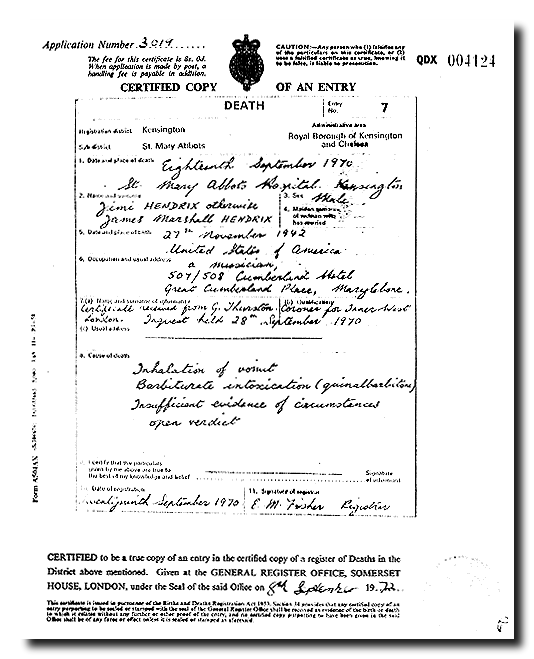
Jimi's death certificate
"Open verdict", no signature
from coroner
|
With the knowledge that the FBI had trailed Hendrix, and his connections to Morrison, Joplin, Lester Jackson (and through him, Malcolm X, and Frances Farmer), the death of Hendrix begins to take on new light. His call to Chas Chandler earlier that day points to the fact that Hendrix seemed to know something was awry. Over a year before, his old friend Lester Jackson vanished for good just after recovering from a poisoning. He also died one month after Frances Farmer�s passing, and nearly a year before George Lester Jackson�s murder in San Quentin prison. Jimi�s cause of death was reported as �Inhalation of vomit Barbiturate intoxication�, but later on Septbember 29, the coroner added �Insufficient evidence of circumstances Open Verdict�, but the final coroner's report then leaves it at "open verdict", meaning no confirmed cause of death. Gavin L. B. Thurston was the coroner, as well as informant for the certificate, but interestingly enough did not sign the death certificate.
Both Noel Redding and Monika Dannemann believe in the "slight possibility" that Hendrix was murdered and both state some interesting arguments and facts to back up these theories in their respective books. Suicide did not seem to be an option for Jimi due to his spirituality. In fact, Hendrix and Dannemann discussed suicide the morning of his death and Jimi relayed his beliefs that suicide causes the soul to never rest (Jimi did have access to over 40 sleeping tablets at the flat, so if he wanted to commit suicide...). As Redding says in his book, "Jimi died from choking on his vomit and that in itself should have been a preventable cause of death". Interestingly enough, in 1991 both Animals/War singer Eric Burdon (who Dannemann called before calling the ambulance the morning of September 18, 1970), and Mitch Mitchell called on Scotland Yard to reopen the investigation into Jimi's death. In 1993, England's Attorney-General agreed and investigated before announcing that it "found no evidence to pursue the case further".
Main questions posed by this theory concerning Jimi�s death and possible connection to Lester Jackson: Did Lester and Jimi share information in 1966, which might have led to both men�s fates? Who were the people that Jimi saw the night before his death that he claimed he didn�t like but had to see anyway? Why was he only there for an hour, and why did he come back and make those drawings for Monika? Since he claimed not to have taken any drugs that night, was Jimi poisioned similarly to Lester, but with deadly consequences? Was the same fate intended for Lester when he was poisoned? And most interestingly, why is it that Gavin L. B. Thurston, the coroner, who was also listed as the informant, didn't sign the death certificate?
|
|

|
GEORGE LESTER JACKSON:
No actual picture of George available
Similar names and beliefs may have made
it convenient for killers to get
two birds with one stone.
|
GEORGE LESTER JACKSON
George Lester Jackson was an author, strategist, and militant revolutionary born September 23, 1941, in Chicago, IL; the son of Lester (a postal worker) and Georgia Jackson. The highest level of education he achieved was 11th grad at Manual Arts High School, Los Angeles, CA. At the age of 18, George was handed a 1-year to life prison sentence for a gas station robbery, during which he allegedly stole $70. During his term, Jackson studied Fanon, Marx, Mao, Lenin, Malcolm X, etc, and with new ways of regarding himself and the struggles of the underclass, he met fellow revolutionaries and began organizing the Black Panthers, which he did from 1961-1969, as Field Marshal. �Black Russian� Lester Jackson disappeared in 1969, and it is thought in some circles that some government officials keeping watch on Black Panther activities might have genuinely mistaken Lester for George, due to their shared outspokenness, influence, mutual respect for the likes of Lenin and Malcolm X, not to mention the similarities in monikers.
Others believe that the �mistaken identity� was not so accidental. Even though George Jackson was in prison at the time, some feel that the government had it out for both men and someone knowledgeable of the difference, used the imprisoned Jackson�s history as further fuel in a secret ambush of the free Jackson, possibly even by going so far as to knowingly falsify a claim that George had escaped from prison, and thus justify �taking care of� Lester. In the climate, Lester could be taken out, without anyone blinking an eye. A. He had a controversial reputation of his own and B. If a murder could be carried out under the guise of killing �another one of those troublemaking Panthers�, it would be perfect to silence this Lester Jackson, while the killer/s could certainly assured to silence the other Jackson in due time.
They may very well have.
Right around the time that Lester Jackson disappeared, George Lester Jackson, still in prison, was charged with killing prison guard, and sent to solitary confinement. It was no accident that this ended his direct Panther involvement. However, he continued to spread his influence by writing two books. One was Soledad Brother, a collection of prison letters and the other was Blood in My Eye, a collection of letters and essays, in which he had predicted that he would be murdered in prison.
Two weeks after he completed the book, it became a self-fulfilling prophecy.
On August 21, 1971, George was shot while allegedly trying to escape from San Quentin Prision. Prison officials claim that his lawyer, Stephen Bingham has smuggled in a gun, which Jackson then concealed under an Afro wig. The story then claims that George shot a guard, released several other prisoners, and headed for the prison wall, before being gunned down by tower guards. Three guards and two other prisoners were also killed. Due to multiple inconsistencies in these accounts, some say that George was set up and murdered by prison authorities because he had become too powerful and posed a major threat to the powers that be. Bingham vanished and remained a fugitive until the mid-1980s, when he was tried for and acquitted of smuggling the gun to Jackson.
Former Los Angeles Police Department (LAPD) agent Louis Tackwood, however, testified in 1976 at the San Quentin 6 tria, that his first assignment was to help plot George's murder. According to him, the state could not afford to allow the Black Panther Field Marshal to continue his successful prison organizing activities. George had quite a reputation, with his books being widely read by both his fellow imates, as well as those out in the free world - books that challenged those opposed to the American penal system to take concrete action to overturn it.
Blood in My Eye was released 2 years after George�s murder.
|
|