|
Magazine articles by LESLIE ROGALSKI
|
||
FABRIC AND FORM: THE FIBER ART OF MICHELLE MARCUSE
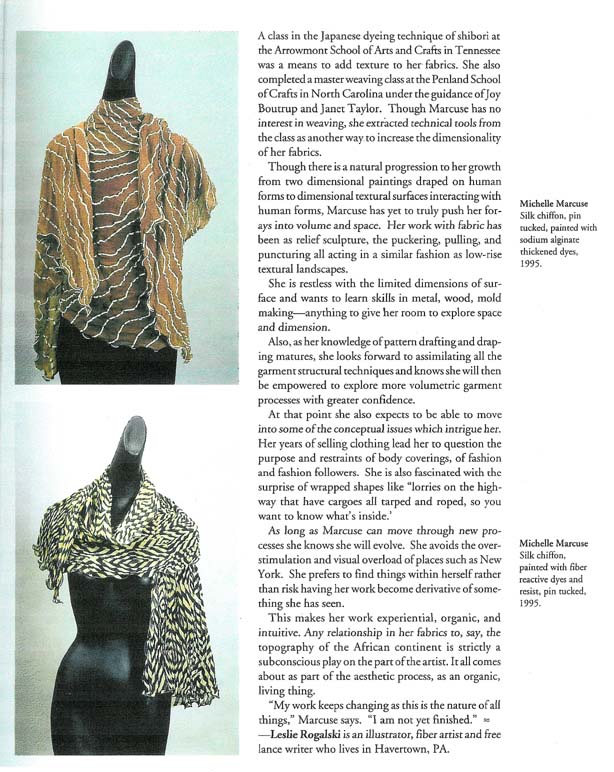
It is the nature of clothing designers to use the human form as armatures for personal expression, but which comes first--the fabric or the fashion? For fiber artist Michelle Marcuse, the fabric inspires the design, but fabrics that she has created, painted, stitched, stretched, pulled, pin-tucked and otherwise gloriously distorted to make her own. Marcuse began her career selling her painted silk scarves but expanded into a complete line of clothing. Lacking formal sewing skills, she used a pattern maker to help make up a line of women's one-of-a-kind clothing, initially the conservative, jewel-neck tops and pajama bottoms that are typical of painted silk clothing. She entered the craft show circuit, and designed looser, more flowing contemporary shapes to accommodate a broader range of body types. This market awareness enabled her to develop a following of galleries and private clients, as well as garner acceptance into quality juried shows. It also locked her into the craft show scene. "It was like an addiction," Marcuse says of her frenzy to make a living. "You feel with each show that this one will be the one to make you money, but it's such an illusion because whether or not you have a good show is such a gamble." For a long time she wondered how she could step away from the money-making motivations that drove her clothing business and feed her artistic Muse instead. She secured help from her parents to invest in two properties, one she rents and one where she lives and works. The modest but regular income from these properties along with continued income from what she calls her "salable collection" of painted silk clothing, enabled her to take drastic measures to get off the fast track. In 1995 she stopped applying to all shows except the Philadelphia Craft Show, and fortunately she was accepted. She was delighted to find that in slowing down her "vital signs" her expenses diminished as well. She realized she could survive economically without working at such a hectic pace. It was her moment of truth. For the first time in years she had no schedule constraints. "Initially I was afraid", she recalled. "Faced with so much free time, I had to calm down, and was at last able to delve into the meaning of process. " It was then she faced the sewing machine on her own for the first time. And there she was stuck, until she realized that the best way to become unstuck was often to return to one's beginnings. She came back to the fabric itself, but no longer merely as a surface for her painting. Now she wanted to make the fabric truly hers. She turned to friends Fernando Mares and Steven Allen, costume designers, trading silk painting tips for sewing pointers. Beginning with the simplicity of white organza, she stitched and crinkled and pierced, playing with buttonholes along the bias. Mares collaborated with her to construct this first garment to make use of her distorted fabric. The result was a white on white jacket that flashes around the body, wafting in voluminous, airy puffs that shift between opacity and sheerness. The play of see-through areas, numerous bound buttonholes scattered everywhere and dense lines of stitching connect to Marcuse's curiosity about how we package our bodies, what we choose to conceal or expose. The buttonholes punctuate the translucence of the stitched organza like little peepholes. With the next fabrics she paid more attention to the human form itself. She selected stretchier fabrics and had them pin -tucked to offer a body hugging texture that responded directly to curves of the body. Sometimes she painted the fabric first, sometimes she stitched first. By utilizing the body this way, her shapes were given a stronger presence, allowing her painting to become more elegant and minimal as her designs became more definitive. She also began to display and manipulate her fabrics on the wall, playing with the medium as an art form and not letting an end dictate her process. It is vital to her to let go of the drive to create a marketable garment, which places too many restrictions on eventual shape and structure. She does not know how a piece of fabric is going to turn out when she begins. "The process is slow," she explains. "By the time it's finished it could be twisting in all manner of ways, so to create the garment then would be to really feel it out when I'm working with it. It's a collaboration between the fabric and the form." The resulting garments are not traditionally marketable. The body-hugging silhouettes are often daring and revealing, not for the timid or modest. The stitching, painting, creasing and other dimensional distortions are also extremely time consuming. Able to produce only a few pieces of fabric like this each year, Marcuse must ask high prices. Still, she has sold a few pieces. She continues to bring them to the craft shows, and they are always attention-getters. In 1995 she won the Turtledove Prize for Wearable Fiber at the Philadelphia Craft Show. But it is the fabrics as they stand alone, as pieces of art, which are drawing attention from the fine art world. After several applications for a grant from the Pennsylvania Council for the Arts with her clothing, Marcuse recently won a grant for her fabrics as fiber art. She was also awarded an honorable mention from the Leeway Foundation which included participation in the Foundation's fiber show at the Philadelphia Art Alliance in October 1997. Marcuse is a second generation South African who has lived in Philadelphia for the past 13 years. She is casual about the influence of her African roots, but recognizes how her background has nurtured her sensibilities. "I am sure the blend of incredible light, color, sun, shadow, drama, black, white, brown, Cape wind, rain and politics entered my being from the beginning." She also believes the torment of her homeland made her sensitive, and it became her nature to try and let things flow rather than impose control. She defers to process as that which truly "switches her on", to the absorption of her artistic and intellectual focus on the physical manipulation of a piece of fabric. Marcuse responds to process as the means for her to travel from here to there and beyond. She is constantly taking courses to add to the toolbox that enables her to evolve intuitively. A class in Tennessee at the Arrowmont School of Arts and Crafts in the Japanese dyeing technique of shibori was a means to add texture to her fabrics. She also completed a master weaving class at the Penland School of Crafts in North Carolina under the guidance of Joy Boutrop and Janet Taylor. Though Marcuse has no interest in weaving, she extracted technical tools from the class as another way to increase the dimensionality of her fabrics. Though there is a natural progression to her growth from two dimensional paintings draped on human forms to dimensional textural surfaces interacting with human forms, Marcuse has yet to truly push her forays into volume and space. Her work with fabric has been as relief sculpture, the puckering, pulling, and puncturing all acting in a similar fashion as low-rise textural landscapes. She is restless with the limited dimensions of surface and wants to learn skills in metal, wood, mold making--anything to give her room to explore space and dimension. Also, as her knowledge of pattern drafting and draping matures, she looks forward to assimilating all the garment structural techniques and knows she will then be empowered to explore more volumetric garment processes with greater confidence. At that point she also expects to be able to move into some of the conceptual issues which intrigue her. Her years of selling clothing lead her to question the purpose and restraints of body coverings, of fashion and fashion followers. She is also fascinated with the surprise of wrapped shapes, "like lorries on the highway that have cargoes all tarped and roped, so you want to know what's inside." As long as Marcuse can move through new processes she knows she will evolve. She avoids the over-stimulation and visual overload of places such as New York. She prefers to find things within herself rather than risk becoming derivative of something she has seen. This makes her work experiential, organic, and intuitive. Any relationship in her fabrics to, say, the topography of the African continent is strictly a subconscious play on the part of the artist. It all comes about as part of the aesthetic process, as an organic, living thing. "My work keeps changing as this is the nature of all things, " Marcuse says. "I am not yet finished." |
||