


Ð, ð


The written form of Old English went through different stages during its several centuries of use. It originally used the runic alphabet, called "futhork" after its first six letters. Later on, monks and scribes from the mainland introduced the Roman alphabet. However, the Roman alphabet was developed for the Latin language, which did not contain all of the same sounds used in Old English. Therefore, scribes introduced the vowel æ "ash" and the two consonants þ "thorn" and ð "eth", which were completely interchangeable regarding sound and spelling.
In fact, much of Old English spelling was subject to change and heavy variation. There was no standardized system in use throughout all of England, which resulted in spelling differences, both between dialects and within them as well. For example, short o and a were often used in the same position, as in monn and mann, "man", which could also be spelled with either a single or double n.
All of the charts on this page use the IPA system to transcribe the sounds of Old English. If you don't know what the symbols mean, check the UCLA Linguistics Page for more information. I have also included individual links to each of the sounds next to each letter in the charts of the pronunciation section.
| Letter | Roman | Sound | Runic | Name | |
|---|---|---|---|---|---|
| A, a | |
[a] | |
āc "oak" | |
| Æ, æ | |
[æ] | |
æsc "ash tree" | |
| B, b | |
[b] | |
beorc "birch" | |
| C, c | |
[k], [t∫] | |
cēn "torch" | |
| D, d | |
[d] | |
dæg "day" | |
| E, e | |
[e], [ε] | |
eh, eoh "horse" | |
| F, f | |
[f], [v] | |
feoh "cattle" | |
| G, g | |
[g], [γ], [j] | |
gifu "gift" | |
| H, h | |
[h], [x] | |
hægel "hail" | |
| I, i | |
[i], [i] | |
īs "ice" | |
| L, l | |
[l] | |
lagu "water, sea" | |
| M, m | |
[m] | |
mann "man" | |
| N, n | |
[n] | |
nīed "need" | |
| O, o | |
[o], [ɔ] | |
ōs "god" | |
| P, p | |
[p] | |
peorþ | |
| R, r | |
[r] | |
rād "route" | |
| S, s | |
[s], [z] | |
sigel "sun" | |
| T, t | |
[t] | |
Tīr, Tī | |
| Þ, þ Ð, ð |
|
[θ], [ð] | |
þorn "thorn" | |
| U, u | |
[u], [ʊ] | |
ūr "wild ox" | |
| W, w | |
[v], [w] | |
wynn "joy" | |
| X, x | |
[ks] | |||
| Y, y | |
[y], [i], [u] | |
ýr | |
| ēa | |
ēar "ground" | |
||
| ēo | |
ē, īw "yew" | |
The letters j, k, q, v, and z also make occasional appearances in Old English manuscripts, but they are comparatively very rare. They are mostly found in later texts, and sometimes with borrowed vocabulary.
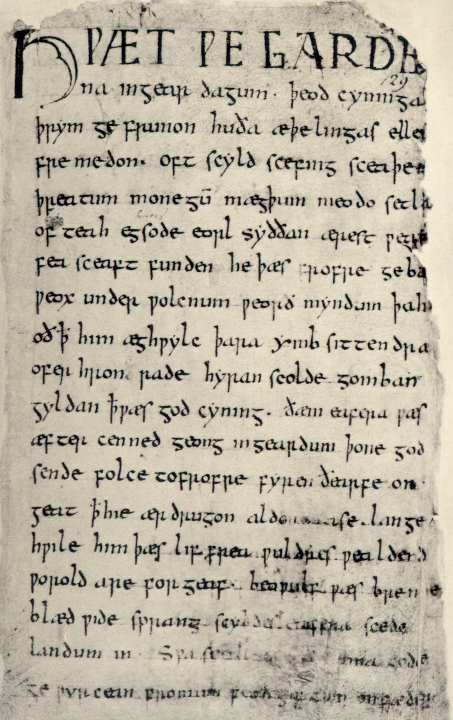
Here is an example of an Old English manuscript, taken from the prologue of Beowulf. To become more familiar with reading the actual Old English script, compare it with the typed version beside it and follow along with the recordings provided below.
My own reading of the selection
Readings from the University of Virginia
|
Hwæt! We Gardena |
| in geardagum, þeodcyninga, | |
| þrym gefrunon, hu ða æþelingas ellen | |
| fremedon. Oft Scyld Scefing sceaþena | |
| þreatum, monegum mægþum, meodosetla | |
| ofteah, egsode eorlas. Syððan ærest wearð | |
| feasceaft funden, he þæs frofre gebad, | |
| weox under wolcnum, weorðmyndum þah, | |
| oðþæt him æghwylc þara ymbsittendra | |
| ofer hronrade hyran scolde, gomban | |
| gyldan. Þæt wæs god cyning! ðæm eafera wæs | |
| æfter cenned, geong in geardum, þone god | |
| sende folce to frofre; fyrenðearfe on | |
| geat þe hie ær drugon aldorlease lange | |
| hwile. Him þæs liffrea, wuldres wealdend, | |
| worold are forgeaf; Beowulf wæs breme | |
| blæd wide sprang, Scyldes eafera Scede | |
| landum in. Swa sceal geong guma gode | |
| gewyrcean, fromum feohgiftum on fæder [bearme]... |