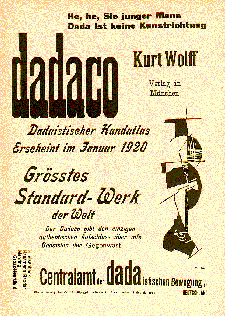
In 1917 Richard Huelsenbeck moved from Zürich to Berlin and
met there Franz Jung, Wieland Herzfelde and his brother John Heartfield.
Additional 'Club Dada' members were Johannes Baader, George Grosz, Hannah Hoech,
Walter Mehring and Raoul Hausmann. Dada Berlin was, dependent on the actual
situation in this city, more political than the other Dada-groups. The Berlin
group provoked the society with magazines as 'Club Dada', 'Der Dada' and 'Dada
Almanach' containing photomontages, manifestos and Grosz's anti-bourgeois
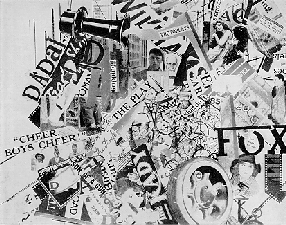
caricatures. The montage-technique became the main-instrument for the works of
the Berlin dadaists. The expert of photomontages was John Heartfield, also
called 'dada-monteur'! This special style has been copied years later by the
lettrists and also by the punk-protagonists for their fanzines and
record-covers! URL: http://www.geocities.com/lein3_2000/germany.htm
Table of Contents 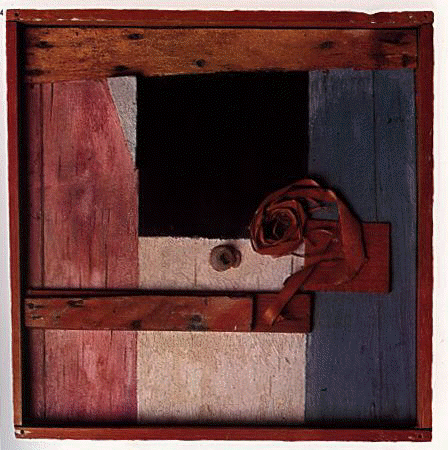
Hannover - Merz 1919 - 1923
Dada Hannover was one person: Kurt Schwitters ! He was an
artist, graphic-designer, typographer and poet who moved to Hannover after
completing his studies at the Berlin Akademie. Schwitters started his own
specific dada-character, which he called 'Merz'. He searched for a name for his
work and found it in one of his glued pictures. It was a part of an
advertisement of the 'ComMERZ- & Privat- Bank Hannover'. Schwitters had
contact to dadaists in Berlin (Hoech, Hausmann) and Zürich (Arp, Tzara). He
published the magazine MERZ and the poem-book 'Anna Blume' with love-hymns and a
print-run of 13'000 ! Schwitters erected the 'Merz-build', a three-dimensional
constructivist room in his house. A copy (the original was destroyed in World
War II) of it can be entered in the Sprengel-Museum in Hannover. Through his
attention for the abstraction he got in contact to the constructivists,
especially to El Lissitzky and Theo van Doesburg. With him Schwitters organized
various dadaist actions in the Netherlands. Theo van Doesburg, the founder of De
Stijl wrote under two pseudonyms (I.K. Bonset, Aldo Camini) also dada-poems.
© mital-U
Table of Contents/
France / Switzerland
DADA/GERMANY
created by Thomas Kleinherne, send mail
Portland Community College
last modified: May 10, 2000
This is not a commercial site. For educational purposes only.