Paris - SubDada 1919 - 1922
Since 1917 Tristan Tzara had contact from Zürich to writers in Paris. Andre
Breton, Louis Aragon a.o. wrote for Dada 4/5. In January 1920 Tzara moved to
Paris and met Picabia and Breton, publisher of the magazine 'Littérature',
there. In the same year Hans Arp and 1921 Max Ernst from Köln as well as Man
Ray from New York arrived. Paris became the last important dada-centre. Other
members of Paris-Dada were Marcel Duchamp, Jean Croti, Suzanne Duchamp, Jaques
Rigaut, Paul Eluard, Georges Ribemont-Dessaignes, Benjamin Péret and Théodore
Fraenkel. The literary character of the Paris dadaism was formed by Breton's 'Littérature',
Tzara's 'Dada', Picabia's '391' and 'Cannibale', Eluard's 'Proverbe' and all
together 'Le coeur à barbe'! The magazines showed also the various interests.
Picabia and Tzara dissolved the typography into its linguistical and optical
relations as the constructivists. Breton and Soupault worked for a new art-form
based on the subconscious, called surrealism. The disputes about the right way
and Breton's try to built a new mouvement broke off their collaborations. The
last dada- season was at the end.
© mital-U
Duchamp, Marcel (1887-1968)
 Born on 28 July 1887, in
Blainville, near Rouen, France. French painter, poet, experimentator in films
and chess player. He is the brother of Raymond Duchamp-Villon, the sculptor, and
of Suzanne Duchamp, the poetess and a half brother of Jacques Villon. In 1911 he
was a member in the painters' circle known as the "Golden Section",
together with La Fresnaye, Léger, Metzinger, Picabia, and others. Influenced by
cubism he painted the picture "The Chess Players" and the first
studies for his "Nudes descending a Staircase". In the same year he
created "The Coffee-Mill", important as regards to form and the part
it played in the general development. Many problems of dadaism (mechanical
drawings by Picabia, Max Ernst, etc.) and of surrealism were anticipated in it.
In 1912 he painted one of his main works, "Nudes descending a
Staircase", shown for the first time in October of that year at the
exhibition of the "Golden Section". In 1913 it was the hit of the New
York "Armory Show". In 1914—15 he confused the public with a series
of works which he called center
Born on 28 July 1887, in
Blainville, near Rouen, France. French painter, poet, experimentator in films
and chess player. He is the brother of Raymond Duchamp-Villon, the sculptor, and
of Suzanne Duchamp, the poetess and a half brother of Jacques Villon. In 1911 he
was a member in the painters' circle known as the "Golden Section",
together with La Fresnaye, Léger, Metzinger, Picabia, and others. Influenced by
cubism he painted the picture "The Chess Players" and the first
studies for his "Nudes descending a Staircase". In the same year he
created "The Coffee-Mill", important as regards to form and the part
it played in the general development. Many problems of dadaism (mechanical
drawings by Picabia, Max Ernst, etc.) and of surrealism were anticipated in it.
In 1912 he painted one of his main works, "Nudes descending a
Staircase", shown for the first time in October of that year at the
exhibition of the "Golden Section". In 1913 it was the hit of the New
York "Armory Show". In 1914—15 he confused the public with a series
of works which he called center
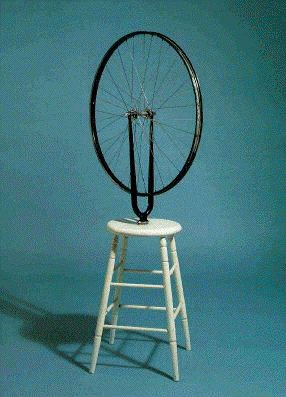
© Duchamp, Marcel Bicycle Wheel 1913 Readymade:
bicycle wheel, diameter 64.8 cm, mounted on a stool, 60.2 cm high Original lost
Collection Arturo Schwarz, Milan © 1999 Artists Rights Society (ARS), New York
/ ADAGP, Paris
In 1914 he put his signature to a second-rate landscape reproduction by an
unknown artist after adding a green and a red patch, calling the whole work
"Pharmacy". "Ready-Mades" were banal objects of every-day
use such as a bottle holder, a snow-shovel, etc., which he signed with his name
after giving them titles totally unconnected with their functional use. In 1915
he went to the United States for the first time and soon became the center of
the circle of painters round the "Stieglitz" gallery. That group had
adopted an "anti-art" attitude and was thus a movement parallel to
Zurich dadaism. In 1917 Duchamp sent a "work" called
"Fountain" to the New York "Independent Show", signed with
the name "R. Mutt", it was nothing but a common urinal. The
"Ready-Mades" demonstrated his profound contempt for the bourgeois
conception of art. Their descendants were in later years the "surrealist
objects". In 1917 Duchamp edited the periodicals, "The
Blind Man" and "Rongwrong",
which had an unmistakably dadaist character. "La vierge", "Mariée",
"Passage de la vierge à la mariée", etc., pictures painted in 1912 -
some on glass and others on canvas - were the points of departure for his
monumental work; (painted on glass): "La mariée mise à nu par ses
cèlibataires" ("The married woman stripped nude by her
bachelors"), at which he worked from 1915 to 1923 and finally left
unfinished, to devote himself to chess-playing and to mechanical and optical
experiments (films) etc. In 1934 he published 93 facsimile drawings etc.
preparatory studies to his unfinished monumental work, a fascinating insight
into the structure and evolution of this unique creation. In 1920 he published,
under the pen name of Rrose Sélavy (arroser, c'est la vie), puns in No. 5 of
the periodical "Littérature". With the same pseudonym he still signed
lesser works. Together with Katherina Dreier he founded the "Société
anonyme" for the propagation of modern art in America. Preference was given
to anti-traditional, cubist, futurist and dadaist works. From 1942 to 1944,
together with Max Ernst and André Breton, he edited the surrealist periodical
"VVV", in New York. Through the charm of his personality and his works
Duchamp has exerted great influence on young American artists.
© English/Graphics
Table of Contents/
Germany
DADA/FRANCE
created by Thomas Kleinherne, send mail
Portland Community College
last modified: May 10, 2000
This is not a commercial site. For educational purposes only.
URL: http://www.geocities.com/lein3_2000/france.htm