 In the very beginning of this century, a nihilistic movement began in Europe
that reinvented every possible aspect of art. This movement produced works of
‘art’ such as the L.H.O.O.Q, a reproduction of the Mona Lisa with a mustache
painted on, as well as seemingly randomly cut pieces of wood glued together.
This and more was displayed as art. This movement, which called itself Dada, was
only the beginning of the rebellion that has been experienced for the entirety
of the twentieth century. Dada died out in the early 1920s and was succeeded by
a very different movement called Surrealism. The Surrealists strove for a
complete understanding of the unconscious human mind, and was not initially an
art movement. However, art found Surrealism and they worked together beautifully
(Nadeau 80). Since Surrealism chronologically immediately succeeded Dada, quite
a few of the Dadaists became Surrealists. But what did the two movements have in
common other than a few people? Although Dada claimed many times to have no
rhyme or reason, it was formed with a definite ideal and set of principles. The
Dadaists’ "revolt against standards was based on a profound belief,
stemming from the romantic tradition, in the essential goodness of humanity when
uncorrupted by society" (Dada 1998). Despite the fact that Dada was ruled
by principle rather than a goal, the movement did attain an end that would have
been its goal: they changed societal ideals and perceptions of what art should
be, and this was proven by the actions of the ensuing Surrealist movement. Dada
was a comprised of a very complex set of people and their beliefs. An
"artistic and literary movement reflecting a widespread nihilistic protest
against all aspects of Western culture, especially against militarism during and
after World War I" (Dada 1998), Dada still escapes definition. In
Surrealist Art, Sarane Alexandrian claims that Dada was more of an
"anti-movement" that opposed even avant-garde schools, attempting to
break away not only from social standards, but all aesthetics. Although Dada
contained elements of nihilism, anarchism, Bolshevism, irrationalism,
primitivism, and mysticism, the nihilism aspect has been over-emphasized (Chaucha
38). Indeed, there was so much more to Dada than could ever be summed up in a
few words. While the art historians try to boil Dada down into a formula, the
artists who experienced it have much more abstract definitions. "‘What we
call Dada is foolery, foolery extracted from the emptiness in which all the
higher problems are wrapped, a gladiator’s gesture, a game played with shabby
remnants… a public execution of false morality.’ (Ball)" (Richter 32).
"Defying rational assimilation" (Chaucha 38) the Dadaists lived in and
for the moment, not caring how long their movement would last (Richter 10).
However, Dada is best explained through its own timeline and the circumstances
under which it came into existence. At the beginning of World War I, many people
moved to Switzerland because of its political neutrality. It was at the height
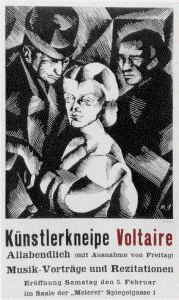
of the war that Dada began with the opening of the Cabaret Voltaire in Zurich
(Alexandrian 29). On February 1, 1916, a German writer named Hugo Ball founded
the Cabaret. Ball came to an arrangement with a man named Herr Ephriam, who was
the owner of a bar called the Meierei in Neiderdorf, a quarter in Zurich. Ball
promised Herr Ephriam that he would increase his sales of beer, sausage and
rolls by means of forming a literary and artistic club (Richter 13). So, on
February 2, 1916, a press release was issued advertising the Cabaret:
"Cabaret Voltaire. Under this name a group of young artists and writers has
formed with the object of becoming a centre for artistic entertainment"
(Richter 16). And people came. Among them were Tristan Tzara, Marcel Janco, Hans
Arp, Richard Huelsenbeck, and Emmy Hennings. "The Cabaret Voltaire was a
six-piece band. Each played his instrument, i.e., himself, passionately and with
all his soul" (Richter 27). Hugo Ball, the one responsible for all this
greatness, was born in Germany and inspired by abstract artist Wassily Kadinsky.
Unfortunately, Ball broke from the group less than a year after its formation
(Dada Almanach 61). However, he was still as much a part of the Cabaret as any
of the members. He was a thoughtful, profound, and restrained man who later went
on to become a Catholic. All of Ball’s qualities were perfectly complemented
by the "fiery vivacity, the pugnacity, and the incredible intellectual
mobility of the Rumanian poet Tristan Tzara" (Richter 18). Hans Richter,
who was also a member of the Cabaret and knew the man, claims that Tzara was
"a small man, but this made him all the more uninhibited. He was a David
who knew how to hit every Goliath in exactly the right spot… with or without
the accompaniment of witty bon-mots, back answers, and sharp splinters of
linguistic granite" (19). Although eventually Tzara’s pretentiousness and
lack of discipline lost him friends, it suited him perfectly for the job of
promoter for early Dada. In fact, it is Tzara who is responsible for making an
international movement out of Dada (Dada Almanach 16). Marcel Janco was another
of the initial members of the Cabaret Voltaire. He came to Zurich as an
architecture student, where he met Tzara and other soon-to-be Dadaists. An adept
painter, architect, graphic arts and object maker, Janco designed and made
posters for the Cabaret. But more importantly, he designed and made Negro masks
for the Cabaret Voltaire performances (Dada Almanach 171). Hans (sometimes
called Jean) Arp was an Alsatian poet, painter and sculptor who worked with
other groups that were, in fact, predecessors to Dada, before striving for
abstraction in 1914. Then, on the declaration of war, he moved to Zurich where
he became a co-founder of Dada. (Dada Almanach 119). Richard Huelsenbeck, a
German physician, arrived in Zurich "only about 10 seconds too late to
become a co-founder of Dada" and his Fantastic Prayers gave Dada its first
poetic voice (Dada Almanach 9). Huelsenbeck clashed terribly with Tzara although
he "was hardly inferior to him [Tzara] in lung-power of in pugnacity"
(Richter 20). Finally, Emmy Hennings sang chansons, accompanied by Ball at the
piano. "The only female member of the Cabaret Voltaire, Emmy Hennings had,
as may be imagined, a hard time holding her own against an otherwise all-male
cast. Emmy had a thin, anti-diva-ish voice, but she had a strong
personality" says Richter, who continues that during her youth, she had met
and inspired some of Germany’s best poets as well as having lived most of her
life exclusively in a bohemian world of writers and artists. It was the
combination of all of these personalities, plus many others, both regulars and
transients, that combined to make Dada what it was. That is the origin of the
concept of Dada, but what about the origin of the name Dada? "To this day,
it is impossible to be sure who discovered the word Dada, or what it means"
is the sentiment of Hans Richter (31). However, "dada" is the French
term for "hobby-horse," and is said to have been selected at random
from a dictionary by Tristan Tzara (Dada 1998). "Dada" was actually
the name selected for the periodical which was meant to present Dada to the
public (Richter 34), and was then applied to the movement itself. The movement
"had no programme, wanted nothing, and created only with the intention of
proving that creation was nothing" (Alexandrian 30). In an effort to
express their rejection of all aesthetic and social values, the Dada artists
often used artistic and literary techniques that were deliberately
incomprehensible. They used novel materials like discarded objects found in the
streets, and tried methods like allowing chance to determine the outcome of
their work. Their theatrical performances were intended to shock the spectators
into re-evaluating their current aesthetic values. (Dada 1998) According to
Alexandrian, Dada filled its statements with incoherence because they believed
that life itself is incoherent, and played havoc with art because so-called art
lovers had lost the concept of art as a game (31). Tzara, as editor of Dada the
periodical, wrote: "Order = disorder; self = not-self; affirmation =
negation; ultimate emanations of absolute art. Absoluteness and purity of chaos
cosmically ordered, eternal in the globule second without duration without
breath without light without control. - I love an old work for its novelty. It
is only contrast that attaches us to the past" (qtd. in Richter 34).
Richter also wrote, "Dada not only had no programme, it was against all
programmes. Dada’s only program was to have no programme… and at that moment
in history, it was just this that gave the movement its explosive power to
unfold in all directions, free of aesthetic or social constraint" (34). And
explode and unfold it did, all over Europe and across the Atlantic.
In the very beginning of this century, a nihilistic movement began in Europe
that reinvented every possible aspect of art. This movement produced works of
‘art’ such as the L.H.O.O.Q, a reproduction of the Mona Lisa with a mustache
painted on, as well as seemingly randomly cut pieces of wood glued together.
This and more was displayed as art. This movement, which called itself Dada, was
only the beginning of the rebellion that has been experienced for the entirety
of the twentieth century. Dada died out in the early 1920s and was succeeded by
a very different movement called Surrealism. The Surrealists strove for a
complete understanding of the unconscious human mind, and was not initially an
art movement. However, art found Surrealism and they worked together beautifully
(Nadeau 80). Since Surrealism chronologically immediately succeeded Dada, quite
a few of the Dadaists became Surrealists. But what did the two movements have in
common other than a few people? Although Dada claimed many times to have no
rhyme or reason, it was formed with a definite ideal and set of principles. The
Dadaists’ "revolt against standards was based on a profound belief,
stemming from the romantic tradition, in the essential goodness of humanity when
uncorrupted by society" (Dada 1998). Despite the fact that Dada was ruled
by principle rather than a goal, the movement did attain an end that would have
been its goal: they changed societal ideals and perceptions of what art should
be, and this was proven by the actions of the ensuing Surrealist movement. Dada
was a comprised of a very complex set of people and their beliefs. An
"artistic and literary movement reflecting a widespread nihilistic protest
against all aspects of Western culture, especially against militarism during and
after World War I" (Dada 1998), Dada still escapes definition. In
Surrealist Art, Sarane Alexandrian claims that Dada was more of an
"anti-movement" that opposed even avant-garde schools, attempting to
break away not only from social standards, but all aesthetics. Although Dada
contained elements of nihilism, anarchism, Bolshevism, irrationalism,
primitivism, and mysticism, the nihilism aspect has been over-emphasized (Chaucha
38). Indeed, there was so much more to Dada than could ever be summed up in a
few words. While the art historians try to boil Dada down into a formula, the
artists who experienced it have much more abstract definitions. "‘What we
call Dada is foolery, foolery extracted from the emptiness in which all the
higher problems are wrapped, a gladiator’s gesture, a game played with shabby
remnants… a public execution of false morality.’ (Ball)" (Richter 32).
"Defying rational assimilation" (Chaucha 38) the Dadaists lived in and
for the moment, not caring how long their movement would last (Richter 10).
However, Dada is best explained through its own timeline and the circumstances
under which it came into existence. At the beginning of World War I, many people
moved to Switzerland because of its political neutrality. It was at the height
of the war that Dada began with the opening of the Cabaret Voltaire in Zurich
(Alexandrian 29). On February 1, 1916, a German writer named Hugo Ball founded
the Cabaret. Ball came to an arrangement with a man named Herr Ephriam, who was
the owner of a bar called the Meierei in Neiderdorf, a quarter in Zurich. Ball
promised Herr Ephriam that he would increase his sales of beer, sausage and
rolls by means of forming a literary and artistic club (Richter 13). So, on
February 2, 1916, a press release was issued advertising the Cabaret:
"Cabaret Voltaire. Under this name a group of young artists and writers has
formed with the object of becoming a centre for artistic entertainment"
(Richter 16). And people came. Among them were Tristan Tzara, Marcel Janco, Hans
Arp, Richard Huelsenbeck, and Emmy Hennings. "The Cabaret Voltaire was a
six-piece band. Each played his instrument, i.e., himself, passionately and with
all his soul" (Richter 27). Hugo Ball, the one responsible for all this
greatness, was born in Germany and inspired by abstract artist Wassily Kadinsky.
Unfortunately, Ball broke from the group less than a year after its formation
(Dada Almanach 61). However, he was still as much a part of the Cabaret as any
of the members. He was a thoughtful, profound, and restrained man who later went
on to become a Catholic. All of Ball’s qualities were perfectly complemented
by the "fiery vivacity, the pugnacity, and the incredible intellectual
mobility of the Rumanian poet Tristan Tzara" (Richter 18). Hans Richter,
who was also a member of the Cabaret and knew the man, claims that Tzara was
"a small man, but this made him all the more uninhibited. He was a David
who knew how to hit every Goliath in exactly the right spot… with or without
the accompaniment of witty bon-mots, back answers, and sharp splinters of
linguistic granite" (19). Although eventually Tzara’s pretentiousness and
lack of discipline lost him friends, it suited him perfectly for the job of
promoter for early Dada. In fact, it is Tzara who is responsible for making an
international movement out of Dada (Dada Almanach 16). Marcel Janco was another
of the initial members of the Cabaret Voltaire. He came to Zurich as an
architecture student, where he met Tzara and other soon-to-be Dadaists. An adept
painter, architect, graphic arts and object maker, Janco designed and made
posters for the Cabaret. But more importantly, he designed and made Negro masks
for the Cabaret Voltaire performances (Dada Almanach 171). Hans (sometimes
called Jean) Arp was an Alsatian poet, painter and sculptor who worked with
other groups that were, in fact, predecessors to Dada, before striving for
abstraction in 1914. Then, on the declaration of war, he moved to Zurich where
he became a co-founder of Dada. (Dada Almanach 119). Richard Huelsenbeck, a
German physician, arrived in Zurich "only about 10 seconds too late to
become a co-founder of Dada" and his Fantastic Prayers gave Dada its first
poetic voice (Dada Almanach 9). Huelsenbeck clashed terribly with Tzara although
he "was hardly inferior to him [Tzara] in lung-power of in pugnacity"
(Richter 20). Finally, Emmy Hennings sang chansons, accompanied by Ball at the
piano. "The only female member of the Cabaret Voltaire, Emmy Hennings had,
as may be imagined, a hard time holding her own against an otherwise all-male
cast. Emmy had a thin, anti-diva-ish voice, but she had a strong
personality" says Richter, who continues that during her youth, she had met
and inspired some of Germany’s best poets as well as having lived most of her
life exclusively in a bohemian world of writers and artists. It was the
combination of all of these personalities, plus many others, both regulars and
transients, that combined to make Dada what it was. That is the origin of the
concept of Dada, but what about the origin of the name Dada? "To this day,
it is impossible to be sure who discovered the word Dada, or what it means"
is the sentiment of Hans Richter (31). However, "dada" is the French
term for "hobby-horse," and is said to have been selected at random
from a dictionary by Tristan Tzara (Dada 1998). "Dada" was actually
the name selected for the periodical which was meant to present Dada to the
public (Richter 34), and was then applied to the movement itself. The movement
"had no programme, wanted nothing, and created only with the intention of
proving that creation was nothing" (Alexandrian 30). In an effort to
express their rejection of all aesthetic and social values, the Dada artists
often used artistic and literary techniques that were deliberately
incomprehensible. They used novel materials like discarded objects found in the
streets, and tried methods like allowing chance to determine the outcome of
their work. Their theatrical performances were intended to shock the spectators
into re-evaluating their current aesthetic values. (Dada 1998) According to
Alexandrian, Dada filled its statements with incoherence because they believed
that life itself is incoherent, and played havoc with art because so-called art
lovers had lost the concept of art as a game (31). Tzara, as editor of Dada the
periodical, wrote: "Order = disorder; self = not-self; affirmation =
negation; ultimate emanations of absolute art. Absoluteness and purity of chaos
cosmically ordered, eternal in the globule second without duration without
breath without light without control. - I love an old work for its novelty. It
is only contrast that attaches us to the past" (qtd. in Richter 34).
Richter also wrote, "Dada not only had no programme, it was against all
programmes. Dada’s only program was to have no programme… and at that moment
in history, it was just this that gave the movement its explosive power to
unfold in all directions, free of aesthetic or social constraint" (34). And
explode and unfold it did, all over Europe and across the Atlantic.
Table of Contents/ Germany / New York
URL: http://www.geocities.com/lein3_2000/switzerland.htm