 |
|
|
|
|
|
|
|
|
|
|
|
|
|
|
|
|
|
|
|
|
|
|
|
|
|
|
|
|
|
|
|
|
|
|
|
|
|
|
|
|
|
|
|
|
|
"CLONE" DOLLS |
|
|
1970's |
|
|
1970's |
|
Return to Home Page |
|
|
|
|
|
|
|
|
|
"Clone" is a term used to describe any miniature fashion doll that was manufactured by a relatively unknown company capitalizing on the popularity of other, more well-known dolls, such as Topper Dawn or Mattel RockFlowers. Typically the body styles made in the 1970's were cheaply made, of hollow plastic construction. Dolls were seldom articulated, except at necks, shoulders and hips. Sometimes wires were used in the legs to make them more bendable, but this often led to them poking through the vinyl or plastic used in construction, particularly if the material was more rubbery, as in the RockFlower body style.
Clone dolls may or may not have had a line of fashions made for them. More often than not, they had only the outfit they came in. As the object in selling clones was to manufacture them as inexpensively as possible, corners were often cut. A clone doll might not have had rooted eyelashes (see the Debbie doll, below). Or the hair may only have been rooted at the part, and very little anywhere else on the rest of the head. Seamlines, where body parts were molded, were often not smoothed out, and are more noticeable.
Some of the clone dolls are very pretty, and have their own character. They don't always look the same, unless they're made by the same manufacturer. A sampling of clone dolls I've identified are shown below: |
|
|
|
 |
|
|
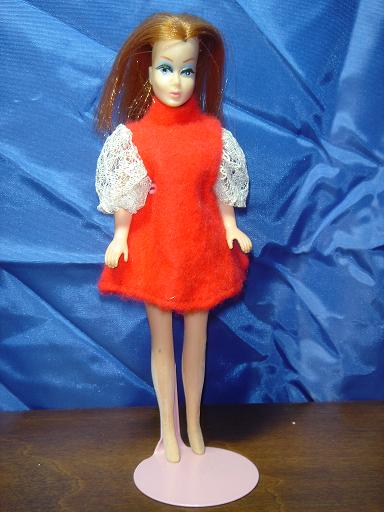
DEBBIE DOLL
by ACTION-LOBECO INDUSTRIES |
|
|
|
|
|
Manufactured in the early 1970's, this "Debbie" doll is marked simply "Hong Kong" on her back. She has rooted hair, but not rooted eyelashes, and her body is hollow plastic construction. She has wire inside her legs to articulate them. She's wearing her original red felt and white lace dress.
Debbie is very similar to the first issue Cindi Joy doll made by MortToys, or Mort Alexander Co.
On a personal note, this Debbie doll is very similar to the one I had as a child. I never had a Topper Glori doll, and my sister didn't like the face on this doll. I loved the red hair, however, and claimed her as my own. My original Debbie doll, however, was stolen along with the rest of my childhood Dawn dolls soon after I married. |
|
|
|
|
|
|
DIANA DOLLS by Unknown or by DAYFRAN COMPANY |
|
|
|
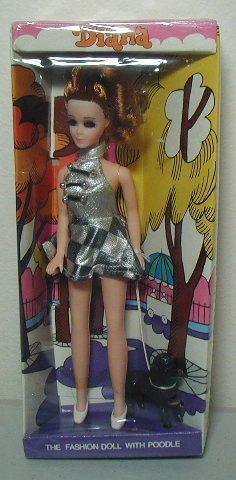
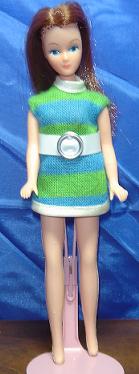
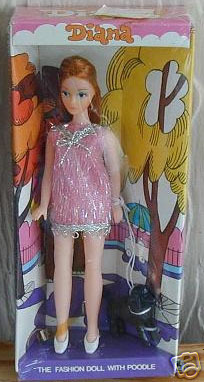
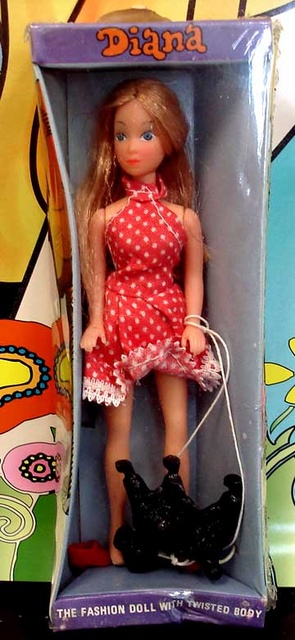
Diana dolls were produced shortly after Topper Toys went bankrupt in 1973, and they were forced to liquidate all their assets. Diana dolls were boxed similarly to Dawn dolls, with cello wrap around the open-face box, and usually a poodle like Dawn's was included. The dolls are similar to Dawn in body construction, and sometimes a left-over Dawn doll was packaged and sold as a Diana doll. Many of the fashions initially sold with Diana are original Topper fashions, and it's here one can sometimes find prototype Topper fashions that were ready to be sold, but never made it to the shelves before Topper went belly-up.
Diana dolls are also similar to Dawn having rooted hair, but painted-on lashes. They were made as blondes, brunettes and redheads.
It should also be noted here that Diana dolls appear to have been made by at least a couple different manufacturers. No identifying marks are found on the dolls in the cello-wrapped boxes. Later, however, Diana dolls were sold in blister packs and marked "Dayfran Co." |
|
|
|
 |
|
|
 |
|
|
|
 |
|
|
|
|
|
 |
|
 |
|
|
|
|
|
|
|
 |
|
|
|
|
|
|
|
|
|
|
|
|
|
|
|
|
|
|
|
|
|
|
|
|
|
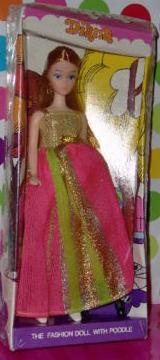
Diana dolls were often sold with left-over Topper fashions, such as the "Cloak & Swagger" gown, and the "Raincheck" mini.
The one on the right is a left-over Topper Daphne doll. |
|
|
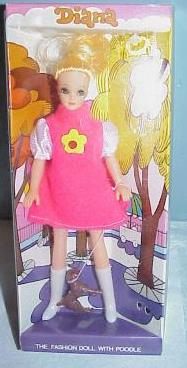
Blonde, brunette and redhead.
Note the different face of the blonde; she appears to be a second-issue Diana doll. |
|
A different redhead, both in face and packaging. She appears to be a third-issue Diana doll. |
|
|
|
|
|
|
More clone dolls can be seen |
|
|
|
Now Playing:
"What's Your Name?"
by Lynyrd Skynyrd |
|
|
|
|
HERE |
|
|
|
|