
| Home | Classes | Calendar | About Taiwan | About Us |
|
|

|
|

Taiwan In-Depth 1 Taiwan In-Depth 2
History | Geo&Climate | People | Languages | Cultures | Food | Gov.&Politics | Economy
History
Aborigines speaking Austronesian languages have occupied Taiwan since pre-historic times.
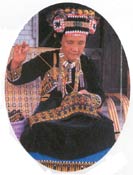 |
A Taiwanese Aborigine |
Immigrants from China began to settle on the island in the 17th Century. Chinese immigrants continued to move in during the following centuries.
Taiwan was temporarily controlled by the Spanish and Dutch for several decades in the 17th century.
China�s Ching Dynasty officially established Taiwan as a province in 1886
Taiwan was ceded to Japan in 1895 after China�s Ching Dynasty was defeated by Japan in the Sino-Japanese War. Japan ruled Taiwan for fifty years.
Japan gave up Taiwan after World War II ended in 1945. The Republic of China, founded in 1911 to succeed the Ching Dynasty, began to rule Taiwan.
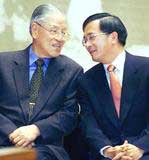 |
Former Pres. Lee & Current Pres. Chen |
The government of the Republic of China was defeated by China�s Communist party in 1949. The Government of the Republic of China then retreated to Taiwan. The waves of Chinese immigrants to Taiwan ended.
The Nationalist party, or Kuomingtang, (the ruling party of the Republic of China) established the world�s longest martial law rule, 40 years, on this island.
The martial law was lifted in 1986 under the pressure of movements for democracy and social reformation.
Taiwan amended its old constitution in the early 1990s, opening a new era of democracy.
Taiwan elected its first president, Lee Teng-Hui, by a direct popular vote in 1996. A true democratic Taiwan began.

History | Geo&Climate | People | Languages | Cultures | Food | Gov.&Politics | Economy
Geography and Climate
Taiwan sits 100 miles off the southeast coast of China, 500 miles south of Japan, and 200 miles north of Philippines.
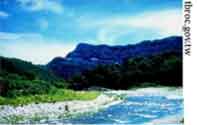 |
Miaoli's Lion Head Mountain |
Its area is slightly larger than Massachusetts and Connecticut combined
High mountains cover much of Taiwan. The western part of the island is flat and fertile and is the most populated area, including cities Taipei and Kaoshiung.
The subtropical climate in Taiwan is much like Hawaii.
History | Geo&Climate | People | Languages | Cultures | Food | Gov.&Politics | Economy
People
Aboriginal Taiwanese: In the 17th Century, the western plain of Taiwan island was occupied by �Pinpu� aborigines. But through intermarriage with immigrants from China who came in after the 17th Century, they had been assimilated into the Chinese immigrants� society and lost their languages and cultures. The descendants of Pinpu aborigines and early Chinese immigrants represent a large portion of the population in Taiwan today. There are eight aboriginal tribes (representing about 2% of the population), mostly living in mountainous areas, still keeping their own languages and customs.
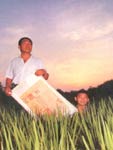 |
Proud Taiwanese |
Hoklo and Hakka Taiwanese: Immigrants speaking Hoklo or Hakka came from China�s Fukien and Kantung areas to Taiwan in waves beginning in the 17th Century and continued in the following centuries. A large proportion of these early settlers came as single males. They married �Pinpu� aborigines who lived in the western plain. The descendants of these early immigrants consists of 83% of the population now in Taiwan.
Mainlander Taiwanese: The last wave of Chinese immigrants came to Taiwan in 1949, accompanying the retreat of the government of the Republic of China. These Taiwanese were from every area of China. They represent about 15% of the population.
History | Geo&Climate | People | Languages | Cultures | Food | Gov.&Politics | Economy
Languages
Mandarin is spoken by 99% of the population.
Hoklo Taiwanese is spoken by 80% of the population
Hakka Taiwanese is spoken by 10 % of the population.
Austronesian languages are spoken by aborigines.
History | Geo&Climate | People | Languages | Cultures | Food | Gov.&Politics | Economy
Best Viewed At 1024x768 With Internet Explorer 4+ |
� 2002 LCS-Taiwan All Rights Reserved |
Lexington Chinese School of Taiwan |
| Home | Classes | Calendar | About Taiwan | About Us | Email | |