 |
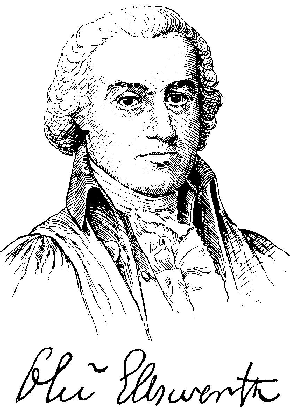
| Chief Justice Oliver Ellsworth |
|
| Major Cases: no major court cases |
| Rutledge Court: |
| Biography: |
 |
|
|
 |
 |
 |
| 3rd Chief Justice of the United States Supreme Court |
| Born: April 29, 1745 in Windsor, Conneticut Died: November 26, 1807 in Windsor, Conneticut Education: 1762 entered Yale 1766 graduated Princeton University 1771 graduated Read law Employment: 1771-1775 practiced law at a private practice in Windsor, Connecticut 1773-1775 member of the Connecticut General Assembly 1775-1784 practiced law at a private practice in Hartford, Connecticut 1777-1785 State's attorney, Hartford, Connecticut 1778-1783 delegatre of the Continental Congress 1779 member fo the Connecticut Counsil of Safety 1784-1785 member of the Connecticut Governor's Council 1784-1789 appointed Judge of Connecticut Superior Court 1787 delegate to the United States Constitutional Convention 1789-1796 elected United States Senator from Connecticut 1796-1800 appointed Chief Justice of the United States Supreme Court 1799-1800 United States Minister Plenipotentiary to France 1800-1807 Member of the Connecticut Governor's Council (Virtualology, 2002) |
| How do you decide which competent justice should be appointed as chief justice of the U.S. Supreme Court? President Washington had to face that problem so he didn�t, instead he appointed Oliver Ellsworth the drafter of the Judiciary Act.(Warren, 1926) Oliver Ellsworth was the last of the three Justices whose court was in the Developmental Period. Oliver Ellsworth in his time as chief justice wasn�t apart of any major court cases but he did participate in four cases that did have some impact or dent on history. His first court case was United States v. La Vengeance. The case involved a boat traveling on the Great Lakes and was transporting illegal arms from New Jersey to the French dominion. In this case the Court�s decision stated the federal government did have jurisdiction on the rivers and lakes. (1926) His second case was Moodie v. Ship Phoebe Anne, in this case the court had to decide whether or not a French vessel was in breach of an U.S. Article. The French vessel has to make an emergency stop on United States soil to do some repairs. Ellsworth made the decision that the French vessel had the right because according to Article 19 it states: �it is declared that French vessels�may, on any urgent necessity, enter our ports, and be supplied with all things needful for repairs.� (1926) Even though the government wasn�t happy, because at that time Americans and French weren�t the best of friends, it continued and tweaked the Article. His third cases was Hunter v. Fairfax�s Devisee, this case is in debate whether or not it should be listed under Ellsworth or Marshall because it was first heard with Ellsworth but it wasn�t decided until Marshall. In this case their had been an alien who took land in Virginia and the question that faced the Court was if that alien had the right to take the land and if Virginia had the right to take the land away from the alien. Hunter had asked Alexander Hamilton to represent him and Hamilton replied �it not being my general plan to practice in the Supreme Court of the United States.� (1926) Then later that year Hunter�s counsel in Virginia died. This case was postponed for twenty years because no one wanted take it on. His last case was New York v. Connecticut; this was the first Supreme Court case where one state was suing another state.(1926) Connecticut and New York were at odds on their boundary lines. With this court case the Supreme Court now had jurisdiction with state-to-state disputes. Due to Chief Justice Ellsworth poor health he was only able to be in the Supreme Court for four years but after a short absence to Bath, England to try to cure him of his aliments, he returned to the Supreme Court and then died in office a few months later. |