 |
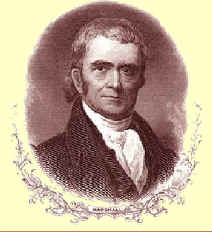
| Chief Justice John Marshall |
|
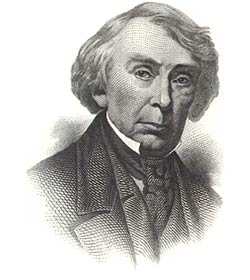
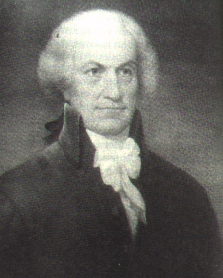
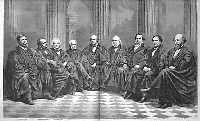
| Marshall Court: |
| Biography: |
| Major Cases: Marbury v. Madison 1803 Fletcher v. Peck 1810 Dartmouth College v. Woodward 1819 McCulloch v. Maryland 1819 Cohens v. Virginia 1821 Gibbons v. Ogden 1824 (Epstein, 2001) |
 |
|
|
 |
 |
 |
| 4th Chief Justice of the United States Supreme Court |
| Born: September 24, 1755 in Prince William County, Virginia Died: July 6, 1835 in Philadelphia, Pennsylvania Education: 1779 attended the college of William and Mary 1780 admitted to the bar Employment: 1775-1776 Lieutenant of the Culpeper Minute Men 1776-1780 Lieutenant of the 11th Virginia Continental Regiment 1780-1783 private practice in Fauquier County, Virginia 1782-1788 delegate for the Virginia House of Delegates 1782-1795 member of the Virginia Executive Council 1783-1797 private practice in Richmond, Virginia 1785-1788 Recorder for Richmond City Hustings Court 1797-1798 United States Minister to France 1799-1800 United States Representative from Virginia 1800-1801 United States Secretary of State 1801-1835 appointed Chief Justice of the United States Supreme Court by President Adams 1835 died in office (Virtualology, 2002) |
| John Marshall was able to create his own era that he was the only member of, the Marshall Era. Marshall was a loyal federalist and said the Constitution was a tool that would unite the United States government so that individuals would always be secure. (Encyclopedia, 2002) �He viewed the Constitution on the one hand as a precise document setting forth specific powers and on the other hand as a living instrument effectively within its limited sphere.� (2002) Chief Justice Marshall and President Jefferson didn�t see eye-to-eye often it was most profusely noted in the case Marbury v. Madison. This case helped establish the Court as a system to be recognized and their decisions to be respected. In the last days of the Adams administration, President Adams made �midnight appointments�, one of the appointments belonged to Marbury but Jefferson told Madison not to deliver the Congressional confirmed appointments. Marbury then wanted a writ a mandamus; this writ would make Madison turn over the appointments. The Supreme Court and mainly Marshall had to write this decision very carefully. If he caved to the Jeffersonian administration the Court could lose all credibility but if he came the decision in favor of Marbury then the Jeffersonian administration would just ignore it and continue to go on their merry way. Marshall only had one option and that was to rule in favor of neither party. Marshall told Marbury that he should have started at the lower courts and should not have started at the Supreme Court and with the Jeffersonian administration he said that they should have delivered the appointments. Because of this case judicial review was founded. (Epstein, 2001) Marshall didn�t like to cite legal authority, in fact there was really not legal authority cited in Marbury v. Madison but what he was known for was his logical deductions from �self-evident propostions� that he used in his opinions. (Encyclopedia, 2002) |
| The people of Philadelphia accorded him [Marshall] a hero�s farewell, and as his body was borne along the streets to the dock for transmittal to his beloved Virginia, the Liberty Bell tolled from the belfry of Independence Hall. Then a strange thing happened. A great cleft appeared in the side of the bell and, like Marshall�s voice, it too became still forever. It was taken down and placed in the Hall. It remains there today fro all to see � the symbol of our liberty � while the memory of John Marshall abides with all of us as that of �The great Chief Justice�, and �The expounder of our Constitution�. (Choper, 1987) |
| Judicial Review: The Authority of a court to determine the constitutionality of acts committed by the legislative and executive branches and to strike down acts judged to be in violation of the Constitution (Definition from Epstein, 2001) |