|
|||||||||||||||||||||||||||||
CONTENTS
The Rajputs who till the 10th century were
mostly local feudal lords holding the status of revenue collectors for
their Gurjara-Pratihara overlords, asserted themselves as independent rulers,
after the Ghaznavid storm had blown over, and took over the earlier
kingdoms of the Gurjara-Pratiharas. The main Rajput kingdoms in the 11th
and 12th centuries were that of the Cahamanas (Chouhans) in East Punjab,
Northern Rajasthan and Delhi. The Gahadwalas (Rathods ) ruled the Ganges
valley today's UP. The Paramaras ruled Malwa in Central India and the Tomaras
ruled from Gwaliar. The most powerful kingdoms were those of the Chouhans
and the Rathods - both of which unfortunatley were incessantly at war with
each other when the Muslim raiders appeared again in the 1191 C.E. The
Rajputs, (from Raj-Putra i.e. prince or literally "king's son") who were
a brave and chivalrous race, held the stage of feudal rulers before the
coming of the Muslims. The Gahadwalas (Rathods) In the 11th century i.e.
in the post-Mahmud Ghazni era, the most powerful Hindu Kingdom in North
India was that of the Gahadwalas or Rathods who were a Rajput clan.
The founder of the Gahadwala line was Govindchandra Gahadwala. He was an astute ruler and ruled from Kannauj. Most of North India, including the university town of Nalanda was a part of his kingdom. He stoutly defended his kingdom from further Muslims incursions. He instituted a tax for this purpose which was called Turushka Danda (i.e. tax to fight the Turushkas or Turks). His grandson was Jaichandra Gahadwala (Rathod) who played a tragic role in Indian History. The Story of Prithviraj Chouhan and Mahmud Ghori In Jaichand's days, a rival Rajput clan had established itself in Delhi (Pithoragarh). The ruler there was Prithviraj Chouhan. Pritiviraj was a romantic, chivalrous and an extremely fearless person. After ceaseless military campaigns, Pritiviraj extended his original kingdom of Sambhar (Shakambara) to Rajasthan, Gujarat, and Eastern Punjab. He ruled from his twin capitals at Delhi and Ajmer. His fast rise caught the envy of the then powerful ruler Jaichandra Gahadwala and there was a lot of ill-feeling between the two. Prithiviraj's Love for Sanyogita - Jaichandra's Daughter The story of Prithviraj's bold exploits spread far and wide in the country and he was the center of much discussion in the circle of the nobility. Sanyogita, the daughter of Jaichandra Gahadwala fell secretly in love with Prithiviraj and she started a secret poetic correspondence with him. Her father the haughty Jaichandra got wind of this and he decided to teach his daughter and her upstart lover a lesson. So he arranged a Swayamwara (a ceremony where a bride can select her husband from the assembled princes. She had the right to garland any prince and she became his queen. This is an ancient Hindu custom among Royalty). Jaichandra invited all the big and small princes of the country to Kannauj for the royal Swayamwara. But he deliberately ignored Prithiviraj. To add insult to injury, he even made a statue of Prithiviraj and kept him as a dwarpala (doorman). The Elopement of Sanyogita with Prithviraj
Prithviraj
got to know of this and he confided his plans to his lover.
Chouhan-Rathod Warfare Leads to Weakening
of both Rajput Kingdoms Jaichandra and his army gave earnest chase and
in the resultant string of battles between the two kingdoms fought between
1189 and 1190, both of them sufferred heavily. While this drama was being
enacted, another ruler also named Mahmud who was from Ghori in Afghanistan
had grown powerful and had captured Ghazni and subsequently attacked the
Ghaznavid Governor of Punjab and defeated him. The kingdom of Mahmud Ghori
now stretched up to the domains of Prithiviraj Chouhan. A clash was inevitable.
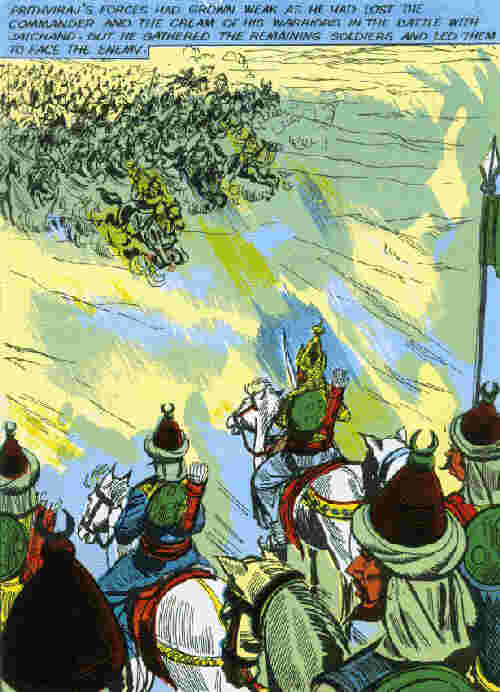
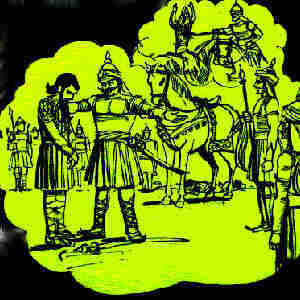
Mahmud Ghori threw the gauntlet by laying siege to the fortress of Bhatinda in East Punjab which was on the frontier of Prithiviraj's domains. Prithviraj's appeal for help from his father-in-law was scornfully rejected by the haughty Jaichandra. But undaunted Prithviraj marched on to Bhatinda and met his enemy at a place called Tarain (also called Taraori) near the ancient town of Thanesar. In face of the persistent Rajput attacks, the battle was won as the Muslim army broke ranks and fled leaving their general Mahmud Ghori as a prisoner in Pritiviraj's hands. Mahmud Ghori was brought in chains to Pithoragarh - Prithviraj's capital and he begged his victor for mercy and release. Prithviraj's ministers advised against pardoning the aggressor. But the chivalrous and valiant Prithviraj thought otherwise and respectfully released the vanquished Ghori. The 1st Battle of Tarain 1191 C.E. - Victory of Prithiviraj Chouhan Mahmud Ghori threw the gauntlet by laying siege to the fortress of Bhatinda in East Punjab which was on the frontier of Prithiviraj's domains. Prithviraj's appeal for help from his father-in-law was scornfully rejected by the haughty Jaichandra. But undaunted Prithviraj marched on to Bhatinda and met his enemy at a place called Tarain (also called Taraori) near the ancient town of Thanesar. In face of the persistent Rajput attacks, the battle was won as the Muslim army broke ranks and fled leaving their general Mahmud Ghori as a prisoner in Pritiviraj's hands.Mahmud Ghori was brought in chains to Pithoragarh - Prithviraj's capital and he begged his victor for mercy and release. Prithviraj's ministers advised against pardoning the aggressor. But the chivalrous and valiant Prithviraj thought otherwise and respectfully released the vanquished Ghori. The 2nd Battle of Tarain 1192
C.E. - Defeat of Prithiviraj Chouhan The very next year Prithiviraj's
gesture was repaid by Ghori who re-attacked Prithiviraj with a stronger
army and guilfully defeated him by attacking the Rajput army before daybreak.
(The Hindus incidentally followed a hoary practice of battling only from
sunrise up to sunset. Before Sunrise and after Sunset there was to be no
fighting- as per a time honoured battle code).The defeated Prithiviraj
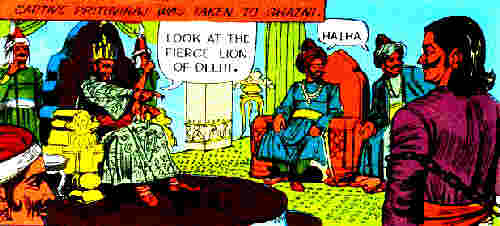
was pursued up to his capital and in chains he was taken as a captive to
Ghor in Afghanistan.The Blinding of Prithviraj The story of Prithiviraj
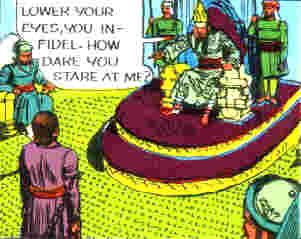
does not end here. As a prisoner in Ghor he was presented before Mahmud,
where he looked Ghori straight into the eye.
Ghori ordered him to lower his eyes, whereupon
a defiant Prithiviraj scornfully told him how he had treated Ghori as a
prisoner and said that the eyelids of a Rajputs eyes are lowered
only in death.
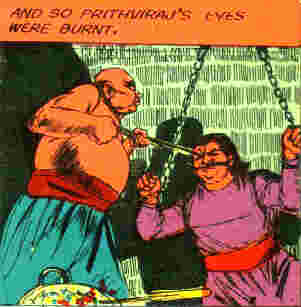
On hearing this, Ghori flew into a rage
and ordered that Prithviraj's eyes be burnt with red hot iron rods.
This heinous deed being done, Prithiviraj
was regularly brought to the court to be taunted by Ghori and his courtiers.
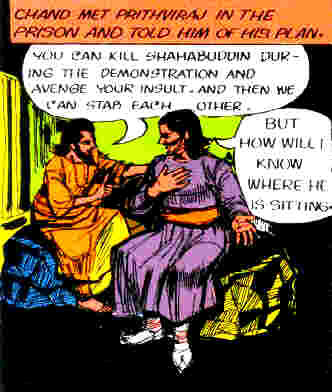
In those days Prithiviraj was joined by his former biographer Chand Bardai,
who had composed a ballad-biography on Pritiviraj in the name of Prithviraj
Raso (Songs of Prithviraj). Chand Bardai told Prithiviraj, that he should
avenge Ghori's betrayal and daily insults.
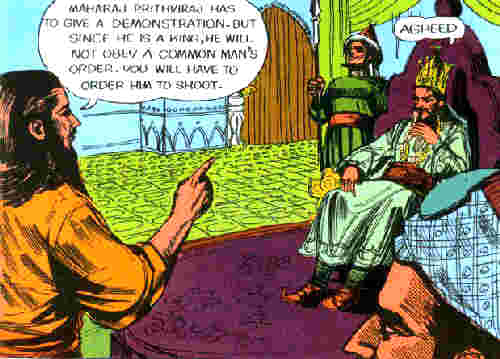
The Blind Prithviraj Avenges the Injustice done to him The two got an opportunity when Ghori announced a game of Archery. On the advice of Chand Bardai, Prithviraj, who was then at court said he would also like to participate. On hearing his suggestion, the courtiers guffawed at him and he was taunted by Ghori as to how he could participate when he could not see. Whereupon, Prithiviraj told Mahmud Ghori to order him to shoot, and he would reach his target. Ghori became suspicious and asked Prithviraj
why he wanted Ghori himself to order and not anyone else. On behlaf of
Prithiviraj, Chand Bardai told Ghori that he as a king would not accept
orders from anyone other than a king. His ego satisfied, Mahmud Ghori agreed.
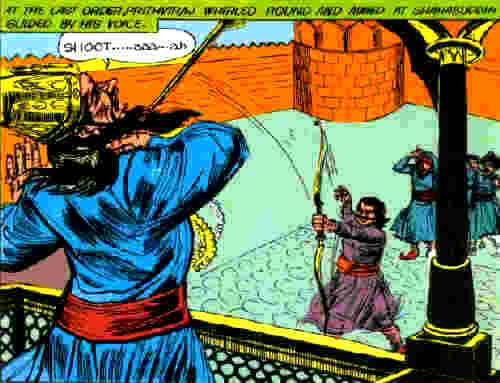
On the said day, Ghori sitting in his royal enclosure had Prithiviraj brought to the ground and had him unchained for the event. On Ghori's ordering Prithviraj to shoot, we are told Prithiviraj turned in the direction from where he heard Ghori speak and struck Ghori dead with his arrow. This event is described by Chand Bardai in the couplet, "Dus kadam aggey, bees kadam daey, baitha hai Sultan. Ab mat chuko Chouhan, chala do apna baan." (Ten feet ahead of you and twenty feet to your right, is seated the Sultan, do not now miss him Chouhan, release your baan - arrow)
Thus ended the story of the brave but unrealistic Prithviraj Chouhan - the last Hindu ruler of Delhi. Delhi was to remain under Muslim rule for the next 700 years till 1857 and under British rule till 1947. Those few Hindus who came close to liberating Delhi during the seven centuries of Muslim rule were Rana Sanga in 1527, Raja (Hemu) Vikramaditya in around 1565 (2nd battle of Panipat), and Shrimant Vishwas Rao who was the Peshwa's son and was co-commander of the Maratha forces in the 3rd battle of Panipat in 1761. Metaphorically speaking, the next Hindu ruler to actually preside over Delhi was to be Dr. Rajendra Prasad, the first President of Independent India (and Jawarharlal Nehru - who was the President's first Minister). Establishment of Muslim Rule in Delhi and the Ganges Valley But before his death at the hands of Pritiviraj Chouhan, Mahmud Ghori had once more attacked India and defeated the haughty Jaichandra Gahadwala at the battle of Chandwar in 1194 and captured Kannauj. The Rajput princes had refused to unite and had gone down one after another leaving the field open to the Muslim Aggressor, who now established himself in the heart of North India by 1194 C.E. Mahmud Ghori, himself did not settle in India, but he left his slave named Kutub-ud-din Aibak to rule by proxy. Kutub-ud-Din Aibak, asserted his independence soon after Mahmud Ghori's death in Afghanistan and formed his own dynasty - the Slave Dynasty or the Gulam Saltanat. The word Gulam occurs frequently among Muslims both as a first name and a family name. This indicates that many of them descended from slaves captured from the subjugated people. Thus in the period from 715 C.E. to 1194 C.E. we see the gradual establishment of Muslim rule over all parts of North India, which in the following 120 years spreads itself over the whole of India with the campaign of Malik Kafur, the general of Alla-ud-din Khilji in 1324 C.E. overrunning the kingdoms of the Yadavas at Devagiri in Maharashtra, the Kakatiyas at Warangal in Andhra, the Hoysalas at Belur-Halebid in Karnataka and the Pandyas at Madurai in Tamil Nadu. This invasion marked the eclipse of Hindu sovereignty for the next 753 years from 1194 C.E. till 1947 C.E.
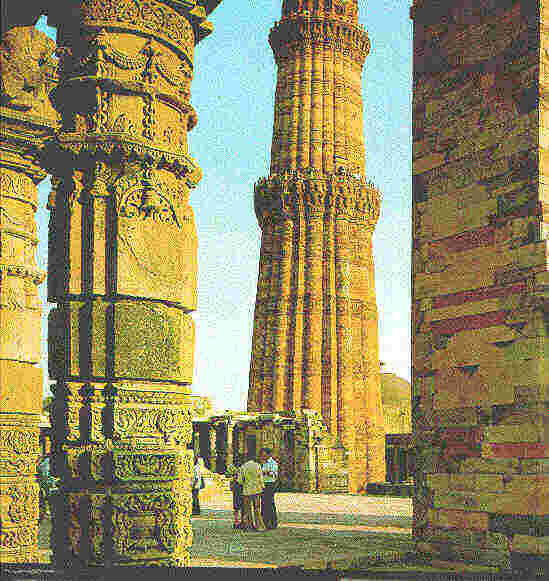
The Kutub Minar - A symbol in granite of the change of India's political fortunes Kutub-ud-Din Aibak built the Kutub Minar as a symbol of his victory. He used the columns from destroyed Hindu and Jain temples from the Pithoragarh complex to build the Minar. Pithoragarh was the capital of Prithviraj Chauhan - the last Hindu ruler of Delhi. The damaged motifs on the pillars surrounding the Kutub Minar show clear Hindu origins. A testimony to the vandalism of the Muslim Aggressors. Kutub-ud-Din Aibak, asserted his independence soon after Mahmud Ghori's death in Afghanistan and formed his own dynasty - the Slave Dynasty or the Gulam Saltanat. The word Gulam occurs frequently among Muslims both as a first name and a family name. This indicates that many of them descended from slaves captured from the subjugated people. The Rajput Resistance to Muslim Rule - Man Singh Tomar In spite of the establishment of Muslim rule in Delhi and UP (Uttar Pradesh) in the former kindoms of Prithiviraj Chauhan and Jaichand Rathod, the Muslim invaders could never overrun the entire country. The Rajput dynasties like the Tomaras of Gwaliar and the Ranas of Mewad still continued to rule central India. One such Rajput ruler was Man Singh Tomar the king of Gawaliar. Man Singh put up a stout resistance to the Lodis and he succeeded in halting the Muslim ruler Sikandar Lodi's southward march at Gwaliar. While the Tomaras of Gwaliar held back the Muslims from advancing into Malwa, the Ranas of Mewad held up the banner of Indian independence from Mewad in those trying times of Muslim aggression in India. In South Rajasthan especially, the Rajputs had defiantly preserved their writ by resisting the Delhi Sultans. The center of this Rajput resistance was the kingdom at Chittor. The Story of Rani Padmini In the 12th and 13th centuries, the Sultanate of Delhi - the kingdom set up by the invaders was nevertheless growing in power. The Sultans made repeated attack on Mewad on one pretext or the other. Here we may recollect the story of Rani Padmani who was the pretext for Allah-ud-din Khilji's attack on Chittod. In those days Chittod was under the Rule of King Ratansen, a brave and noble warrior-king. Apart, from being a loving husband and a just ruler, Ratansen was also a patron of the arts. In his court were many talented People one of whom was a musician named Raghav Chetan. But unknown to anybody, Raghav Chetan was also a sorcerer. He used his evil talents to run down his rivals and unfortunately for him was caught red-handed in his dirty act of arousing evil spirits. On hearing this King Ratansen was furious and he banished Raghav Chetan from his kingdom after blackening his face with face and making him ride a donkey. This harsh Punishment earned king Ratansen an uncompromising enemy. Sulking after his humiliation, Raghav Chetan made his way towards Delhi with -the aim of trying to incite the Sultan of Delhi Ala-ud-din Khilji to attack Chittor. On approaching Delhi, Raghav Chetan settled down in one of the forests nearby Delhi which the Sultan used to frequent for hunting deer. One day on hearing the Sultan's hunt party entering the forest, Raghav-Chetan started playing a melodious tone on his flute. When the alluring notes of Raghav-Chetan flute reached the Sultan's party they were surprised as to who could be playing a flute in such a masterly way in a forlorn forest. The Sultan despatched his soldiers to fetch the person and when Raghav-Chetan was brought before him, the Sultan Ala-ud-din Khilji asked him to come to his court at Delhi. The cunning Raghav-Chetan asked the king as to why he wants to have a ordinary musician like himself when there were many other beautiful objects to be had. Wondering what Raghav-Chetan meant, Ala-ud-din asked him to clarify. Upon being told of Rani Padmini's beauty, Ala-ud-din's lust was aroused and immediately on returning to his capital he gave orders to his army to march on Chittor.
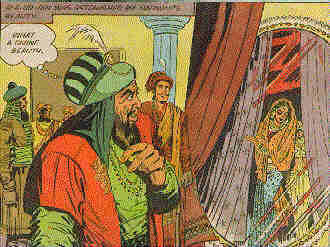
On being persuaded by her husband Rana Ratansen, Rani Padmini consented to allow Ala-ud-din to see her only in a mirror. On the word being sent to Ala-ud-din that Padmini would see him he came to the fort with his selected his best warriors who secretly made a careful examination of the fort's defences on their way to the Palace. But to his dismay, on reaching Chittor, Ala-ud-din found the fort to be heavily defended. Desperate to have a look at the legendary beauty of Padmini, he sent word to King Ratansen that he looked upon Padmini as his sister and wanted to meet her. On hearing this, the unsuspecting Ratansen asked Padmini to see the 'brother'. But Padmini was more wordly-wise and she refused to meet the lustful Sultan personally. But on being persuaded she consented to allow Ala-ud-din to see her only in a mirror. On the word being sent to Ala-ud-din that Padmini would see him he came to the fort with his selected his best warriors who secretly made a careful examination of the fort's defences on their way to the Palace. On seeing Padmini, the lustful 'brother' decided that he should secure Padmini for himself. While returning to his camp, Ala-ud-din was accompanied for some way by King Ratansen. Taking this opportunity, the wily Sultan treacherously kidnapped Ratansen and took him as a prisoner into his camp. Ala--ud-din showed his true colours and demanded , that Padmini be given to him and in return Ratnanen was to get his liberty. Word was sent into the palace about the Sultan's demand.
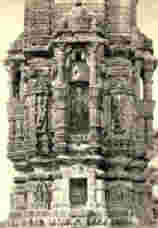
A Section of the Kirti Stambha (Victory Pillar) at Chittodgad The Rajput generals decided to beast the Sultan at his own game and sent back a word that Padmini would be given to Ala-ud-din the next morning. On the following dat at the crack of dawn, one hundred and fifty palaquins (covered cases in which royal ladies were carried in medieveal times) left the fort and made their way towards Ala-ud-din's camps The palanquins stopped before the tent where king Ratnasen was being held prisoner. Seeing that the palanquins had come from Chittor; and thinking that they had brought alongwith them his queen, king Ratansen was mortified. But to his surprise from the palanquins came out, not his queen and her women servants but fully armed soilders, who quickly freed ; Ratansen and galloped away towards Chittor on horses grabbed from Ala-ud-din's stables. On hearing that his designs had been frustrated, the lustful Sultan was furious and ordered his army to storm Chittor. But hard as they tried the Sultans army could not break into the fort. Then Ala-ud-din decided to lay seige to the fort. The seige was a long drawn one and gradually supplied within the fort were depleted. Finally King Ratnasen gave orders that the Rajputs would open the gates and fight to finish with the besieging troops. On hearing of this decision, Padmini decided that with their men-folk going into the unequal struggle with the Sultan's army in which they were sure to perish, the women of Chittor had either to commit suicides or face dishonour at the hands of the victorious enemy. The choice was in favour of suicide through Jauhar. A huge pyre was lit and followed by their queen, all the women of Chittor jumped into the flames and deceived the lustful enemy waiting outside. With their womenfolk dead, the men of Chittor had nothing to live for. Their charged out of the fort and fought on furiously with the vastly Powerful array of the Sultan, till all of them perished. After this phyrrhic victory the Sultan's troops entered the fort only to be confronted with ashes and burnt bones of the women whose honour they were going to violate to satisfy their lust. These women who committed Jawhar had to perish but their memory has been kept alive till today by bards and songs which glorify their act which was right in those days and circumstances. Thus a halo of honour is given to their supreme sacrifice.
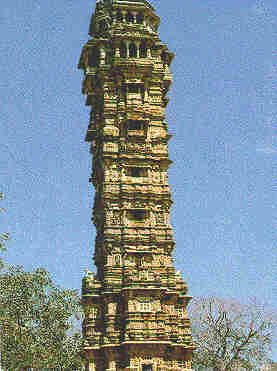
The Kirti Stambha (Victory Pillar) at Chittogad. The Rana's of Mewad had their capital at Chittor or Chittodgad. They included Rana Ratansen (Rani Padmini's Husband), Rana Sanga, Udai Singh and the tallest of them all - Maharana Pratap. It was these 'Lions of Mewad' who defiantly upheld the banner of Indian Independence during the darkest days of Muslim Tyranny. Rana Kumbha Rana Kumbha who ruled from Kumbhalgad also put up a stout resistence to Muslim incursions into Rajputana in the 14th century. His capital Kumbhalgad which is a formidable fortress in densely forested Aravalli Ranges facilitated his resistance to the Muslims. This was one of the few times when the Rajputs used guerrilla tactics against the Muslims. The Resistance of Rana Sangram Singh (Rana Sanga) The next chapter of Rajput resistance to Muslim aggression was in the year 1527 when the Timurid ruler babar invaded India. Babar first struck at the ruler of Delhi who at that time was Ibrahim Lodi. At a battle fought at Panipat, Babar defeated and killed Ibrahim Lodi and captured Delhi. Babar next turned his attention to the most powerful Hindu Kingdom in North India. This was the kingdom of Chittod ruled by Rana Sangram Singh. The clash of the Rajput and Muslim armies took place at Sikri. The Rajputs fought bravely and many perished in the cannon fire which Babar was using. The battle of Sikri gave Babar his second victory in India and saw the establishment of the Mughal Dynasty (the last Muslim dynasty to rule India). Rana Udai Singh Despite the defeat of Rana Sangram Singh in the battle of Sikri, the resistance of the Ranas of Mewad to Muslim rule continued for the next 100 years. Rana Sangram Singh's son, Udai Singh was an infant when his father died after the battle of Sikri. His uncle tired to kill the child and crown prince Udai Singh. But the supreme sacrifice of his nurse Panna Dai who misled the uncle by offerring her own son for being killed, saved Udai Singh. Udai Singh was brought up secretly till he attained youth. He subsequently defeated his uncle and assumed the throne of Chittod. He continued his father's legacy of preserving the independence of Chittod from the Muslim invaders. The city of Udaipur in Mewad bears his name.
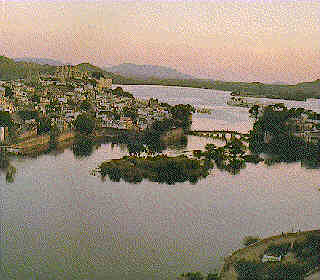
A panoramic veiw of the city of Udaipur. This city and the forts that dotted the hills surrounding it were the heartland of the Rajput resistance to the Muslims. Here Muslim Rule could never be established for any length of time all through the 700 years when the Muslims occupied different parts of India. Maharana Pratap Udai Singh's son was Maharana Pratap who lead the Rajputs against Akbar's armies and preserved Rajput rule in Mewad. Rana Pratap was faced with the formidable challenge of renegade Rajput princes like Raja Todar Mal and Raja Man Singh who had joined forces with the Muslim rulers. The Battle of Haldighati In the Battle of Haldighati fought between Maharana Pratap and the Mughals; the Rajputs were not able to overcome the combined strength of the Mughals and the renegade Rajput princes who had played the role of traitors. But Maharana Pratap who was badly hurt in the battle, was saved by his wise horse Chetak, who took him in an unconscious state away from the battle scene. Although Maharana Pratap was not able to thwart the Muslims successfully, the saga of Rajput resistance to Muslim rule continued till the 17th century when the baton of the struggle for Indian Independence from Muslim tyranny was taken up by the upcoming power of the Marathas, who brought about an end to Muslim domination of India. Now we move on to examine the period of
753 years from 1194 to 1857 which marks the intervention of Muslim
Occupation of India.
"Sudheer,
Lavlesh
and the Hindu History team would be happy to receive your valued feedback
on this site.We invite you to Sign
and Read our
Guest book. We also invite you to use our Message
Board on Hinduism and Hindu History to start a discussion on any relevant
topic".For comments on site mail to [email protected]
|
|||||||||||||||||||||||||||||
 |
 |
 |
|||||||||||||||||||||||||||

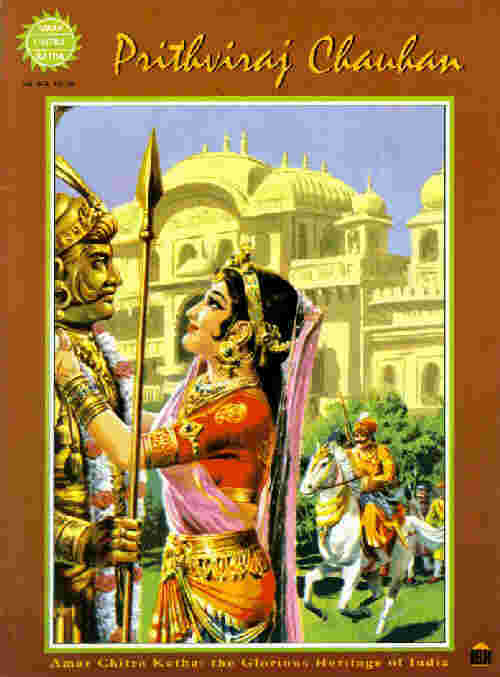 The
refusal of the two Rajput Kingdoms of the Chauhans and the Rathods (Gahadwalas)
to unite in face of the Muslim invasion led to the Fall of Delhi and Kannauj
to the Muslims and led to the establishment of Muslim Rule in India.
The
refusal of the two Rajput Kingdoms of the Chauhans and the Rathods (Gahadwalas)
to unite in face of the Muslim invasion led to the Fall of Delhi and Kannauj
to the Muslims and led to the establishment of Muslim Rule in India.