|
||||||||||||||||||||
CONTENTS
The Post-Maurya Dynasties at Pataliputra - The Shungas and the Kanvas. The period from the fall of the Maurya empire in the 2nd century B.C.E. upto rise of the Guptas in the 3rd century C.E. saw a string of smaller dynasties rule from Patliputra. The Maurya Empire itself had started shrinking after the passing away of Samrat Ashoka Maurya. The last Maurya Emperor was Brihadratha, the grandson of Samrat Ashoka. Brihadratha was assasinated by his general Pushyamitra Shunga who started the Shunga dynasty. This dynasty ruled for a few decades and was displaced by another dynasty, that of the Kanvas. But neither dynasty could recreate the splendour of the Mauryas.Meanwhile in the north-west of the country a procession of invaders came into India.Assorted Invaders/Settlers of North India in Pre-Gupta times - The Kushanas The first were the Kushanas (Ku-Shan) who were a sub-set of the Yuei-Chi from today's Sinkiang area of Eastern China. They came as invaders but settled down in India and were absorbed into Indian society. They embraced Buddhism and patronised it. The most illustrious ruler of this line was Emperor Kanishka who built the magnificent Boddhisattavas at Bamiyan in Afghanistan. The Kushana empire which is dated around the 1st century B.C.E. to the 1st century C.E. stretched from Smara-Kansa (modern Samarkand) upto Mathura in North India. It did not include the Ganges valley. The capital of the Kushanas was at Sakala (modern Sialkot). The Satavahanas The Satvahanas were contemporaries of the Kushanas and they ruled the country from Vengi in Andhra up to Pataliputra (Patna). During the rule of the Kushanas and the Satavahanas the economy remained basically feudal. The most famous ruler of the Satavahanas was Gotamiputra Satakarni. The Satvahanas (or Salivahanas) were Hindus and built many temples and gave grants to many temples-endowments. Their architectural style is called Hemadpanthi style. The Shakas - Scythians The Shakas
came into India as invaders from South-Western Iran. They seem to have
ruled a large part of India including Gujarat and Sindh apart from Baluchistan
(in today's Pakistan) and Siestan (in today's Iran). The Shakas seem to
have patronised Hinduism although they might have originally been Zoroastrian
by faith. The most illustrious ruler of this line was Rudradaman who patronised
and composed Sanskrit poetry.
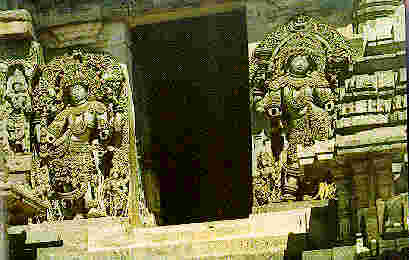
The panels of the temple complex at Belur shows the finesse that the artisans were able to reach 1000 years ago. The Golden Age of the Guptas The age of the Guptas in the 3rd and the 4th centuries C.E. is considered to be the golden age of ancient India. The Gupta empire was founded by Chandragupta the first (not to be confused with Chandragupta Maurya who founded the Maurya empire in the 3rd century B.C.E.). It is a coincidence that the names of the founders of both the major Hindu empires of ancient India was "Chandragupta". The king who really extended the Gupta
Empire was Samudragupta who has inscribed the story of his conquests on
the rust-proof Askoka pillar which today stands in the Pithoragarh (where
the Kutub Minar was also built later by the Muslim invader Kutub-ud-din
Aibak). Samudragupta has said that he uprooted 17 kings from the Ganges
valley to lay the foundations of a pan-Indian empire. But the most
illustrous emperor of the Gupta line was Vikramaditya who succeeded Samudragupta.
He shifted the capital from Pataliputra to Ujjaini (Modern Ujjain in Central
India). It was in Vikramaditya's court that he had the Navaratnas (Nine
Jewels) who included the playwright Kalidas and the astronomer Varaha-mihira.
His rule can be said to epitomize the zenith of ancient Hindu civilization. The Huna Invaders The weakening of the Gupta rule saw the fresh intake of invaders like those of the Hunas or Sweta Hunas (White Huns) who invaded Iran and then India in the 5th century C.E. The Huns who were very war-like and destructive were led by successful chieftains like Toramana and Mihirakula. A Gupta Emperor by the name Narendragupta is said to have checked the initial Hun invasions led by Toramana, but the later Hun invasions seem to have had their toll in weakening and finally subsuming the empire of the Guptas. The Last Pan-Indian Kingdom of Emperor
Harsha Vardhana The last pan-Indian Hindu Kingdom was that of Emperor
Harsha Vardhana. He successfully defeated the Huns and established a large
kingdom over most of North India. But he could not bring the entire country
under his rule.
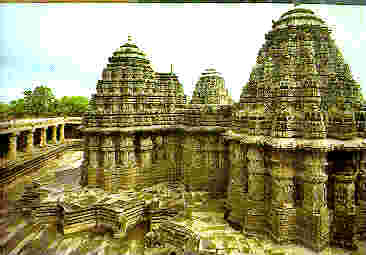
The Hoysalas have built temples on a star shaped foundation. This was due to Vastu Shastra (Hindu Architectural Principles). It also gives the temple complex a unique aesthetic value. According to Principles of Vastu architecture, round shapes and curves are to be avoided, hence the Hoysalas seem to have used star shapes in place of round-shaped foundations for the temples. In his days, Central India was under the
rule of the Chalukya ruler Pulikeshin who checked Harsha's advance south
of the Narmada and who in turn was checked by the Pallavas from extending
his rule to the deep south. Thus the picture of India after the Guptas
in the 5th century C.E. is that of political fragmentation, of which the
The first Muslim Aggression in Sindh
When
Harsha's rule ended with his death in 641 C.E., an event had taken place
in far away Arabia which was to have a deep impact on India and its subsequent
history. Needless to state that this was the rise of Islam and the beginning
of the Jehad which was to bring Muslim invaders and rule to India from
1194.
The actual reason for this invasion was that Raja Dabir was aiding the Iranian (Zoroastrian) princes in trying to overthrow the Arab Rule in Persia. This seems to be a fact as many Sassanian nobles from Iran had taken refuge in Sindh and were plotting for the liberation of their country from the Arab yoke. But the pretext given by Arab historians for the Arab invasion of Sindh is that Raja Dabir's navy had detained an Arab merchant ship. To avenge this detention of a merchant ship, the Arabs overran the entire kingdom of Raja Dabir as also the neighbouring kingdom of Mulasthana (Multan). They even unsuccessfully tried to attack Malwa (Malibah in Arab records)! After this invasion which was limited to
Sindh, for a period of 300 years all further Muslim attacks were thwarted
by
It is not well known that in the period
750 to 850 C.E., the Arabs based in Sindh, had attacked Malwa (called Malibah
by the Arabs), but were repulsed by Raja Bhoja and his successors. The
later Arabs attacks were repulsed first by the Gurjara rulers and later
on the Rajputs who play an important role in Indian history from the 9th
century C.E. till the coming of the Muslims in the 12th century.
But before we go to the Rajputs, let's look at the scene in Afghanistan in the period 950 C.E. The Arabs had 300 years before that age,
i.e. around 650 C.E., overthrown the Zoroastrian Sassanian rulers of Persia
and had managed to wipe off Zoroastrianism as a religion in Iran and Western
Afghanistan by converting the population to Islam. It was now the turn
of the then frontier provinces of India to face the sword of the
Islamic Jehad. In those days, Western Afghanistan comprising the provinces
of Heart (whose name is derived from Hari-Rud which is said to be a derivation
from the older term Hari-Rudra - two Hindu dieties), Kandahar (the ancient
Gandhara of the Mahabharata) was ruled by Sabuktagin a Muslim ruler from
a town named Ghazni. He was facing Raja Jaya Pala who ruled from Kubha
(modern Kabul) in Eastern Afghanistan. His kingdom comprised the provinces
of Kapisa on the western side of the Hindu Kush Ranges and Punjab on the
Eastern side. (Incidentally, his kingdom was like that of Ambhi who ruled
approximately the same provinces, when Alexander the Great had invaded
the area in 330 B.C.E.)
Raja Jaya Pal Shahi, Ruler of Punjab bore the brunt of the Islamic Onslaught The year 980C.E. marks the beginning of the Muslim invasion into India proper when Sabuktagin attacked Raja Jaya Pal in Afghanistan. Afghanistan is today a Muslim country separated from India by another Muslim country Pakistan. But in 980 C.E. Afghanistan was also a place where the people were Hindus and Buddhists. The name "Afghanistan" comes from "Upa-Gana-stan" which means in Sanskrit "The place inhabited by allied tribes". This was the place from where Gandhari of the Mahabharat came from Gandhar whose king was Shakuni. The Pakthoons are descendants of the Paktha tribe mentioned in Vedic literature. Till the year 980 C.E., this area was a Hindu majority area, till Sabuktagin from Ghazni invaded it and displaced the ruling Hindu king - Jaya Pal Shahi. The place where Kabul's main mosque stands today was the site of an ancient Hindu temple and the story of its capture is kept alive in Islamic Afghan legend which describes the Islamic hero Sabuktagin who fought with a sword in every hand to defeat the Hindus and destroy their temple to put up a Mosque in its place. (This is not being mentioned here to reclaim the place as a temple. But to record a long forgotten fact that today's Islamic battlefield of the Taliban was once inhabited by Hindus.) The victory of Sabuktagin pushed the frontiers of the Hindu kingdom of the Shahis from Kabul to behind the Hindu Kush mountains (Hindu Kush is literally "killer of Hindus" - a name given by Mahmud Ghazni to describe the number of Hindus who died on their way into Afghanistan to a life of captivity) . After this setback, the Shahis shifted their capital from Kubha (Kabul) to Udbhandapura (modern Und in NWFP). Sabuktagin's son Mahmud Ghazni, kept up the attacks on the Shahis and captured Und. Subsequently, the Shahis moved their capital to Lahore and later to Kangra in Himachal. Tirlochan Pal Shahi - the Last Hindu Ruler of Punjab Three generation of Shahi kings laid down their lives and their kingdom in battling the invaders. Raja Jaya Pal Shahi was followed by his son Anand Pal Shahi who fought a battle with Mahmud near Lahore, but lost as his elephant is said to have run amok within his own army. His son Tirlochan Pal Shahi continued his struggle with the Muslims from Kangra but he too went down fighting when he was treacherously killed when away from the battlefield. The defeat of the Shahis opened up the Gangetic plains to the Muslims and Mahmud Ghazni repeatedly attacked the main Hindu kingdoms ruled by the Gurjara-Pratiharas and sacked Hindu temples. The main ruler in those days was Rajyapala Pratihara who resisted Mahmud Ghazni's raids, partly successfully. In his last attack on Somnath, Mahmud Ghazni successfully sacked the temple at Prabhasa Patan in Gujarat, but on his way back he was roundly defeated by the Gujar rulers of North Gujarat. Mahmud never came back to India after that. (Refer to the Glory that was Gujar Desha by K.M. Munshi) But these first Muslim raids into India proper had given an ominous indication of what was to come a couple of centuries later in the year 1194 C.E.
But for now, the Muslim rule of the Ghaznivids was established in Kabul, Paktoonistan and in the land of the five rivers - Punjab. Thus after Sindh in 715; Kabul Paktoonistan and Punjab became the next Indian provinces which went under Muslim domination in the period 980 C.E. to 1020 C.E. Tirlochan Pal Shahi was the last Hindu ruler of Punjab and only after an intermission of 700 years of Muslim rule could the next Hindu ruler - Maharaja Ranjit Singh consolidate Hindu Sikh rule after the Moghul rule in Punjab had been weakened by the first blow given to it by the Marathas in 1756 C.E. Now we move on to examine that critical
period of 400 years in Indian history from the 12th century up to the 16th
century when we see the stiff resistance put up by the Rajputs
to the Muslim invaders.
"Sudheer, Lavlesh and the Hindu History team would be happy to receive your valued feedback on this site.We invite you to Sign and Read our Guest book. We also invite you to use our Message Board on Hinduism and Hindu History to start a discussion on any relevant topic".For comments on site mail to [email protected]
|
||||||||||||||||||||
 |
 |
 |
||||||||||||||||||

 The
Post-Maurya Dynasties at Pataliputra - The Shungas and the Kanvas The period
from the fall of the Maurya empire in the 2nd century B.C.E. upto rise
of the Guptas in the 3rd century C.E. saw a string of smaller dynasties
rule from Patliputra. The Maurya Empire itself had started shrinking after
the passing away of Samrat Ashoka Maurya.
The
Post-Maurya Dynasties at Pataliputra - The Shungas and the Kanvas The period
from the fall of the Maurya empire in the 2nd century B.C.E. upto rise
of the Guptas in the 3rd century C.E. saw a string of smaller dynasties
rule from Patliputra. The Maurya Empire itself had started shrinking after
the passing away of Samrat Ashoka Maurya.