|
||||||||||||||||||||||||
CONTENTS
The Rise of the Self-Sufficient Village Economy : The individual producers who resulted from this falling mode of production, settled in the scattered villages throughout the countryside. In the absence of good means of communications. The village now began to get the characteristic of being itself self-sufficient closed economic unit which produced all its required commodities internally. Without any exchange or trade. While trade did exist it was a much smaller and irregular scale than it was in the Mauryan times. Thus while in Europe the coming of feudal relations in the middle ages saw the rise of craftsmen-guilds, in India the rise of feudal relations was marked by the disintegration of the Shreni guilds. Rise of a Class of Hereditary Revenue
Collectors - the Feudal Lords : This shifting of economic activity
was accompanied by the shifting of political power to the rising class
of village feudatory revenue collectors who stood one above the other in
a hierarchy in place of the salaried bureaucrats who collected revenue
for the Mauryan State. In the changed circumstances the practice that was
gaining ground was of appointing revenue collectors who would not be paid
a salary by the king but who would be entitled to a share in the revenue
collected by him. Thus the position of a revenue
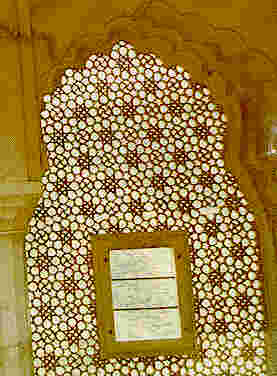
The Caste System with its hereditary occupational structure led to superb specialization.Craftsmanship in the making of jewellery from jade and other semi-precious stones reached unparalleled heights in Medieval India. Role of Temples in Revenue Collection
: When such revenue collectors were to be appointed for the first time,
Brahmadeya, Devadana and Agrahara Land
Grants :These land grants were to religious institutions were called
Brahmadeya, (i.e. donated to Brahmins) Devadana (donated to Gods) and Agrahara
(Settlement - of priests)
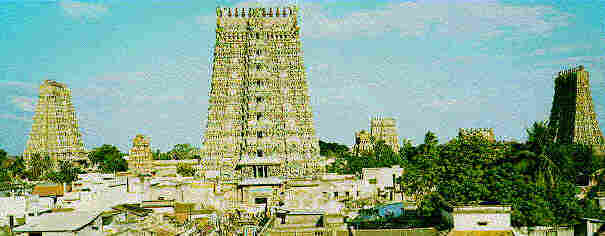
The Madurai Temple Complex is one of the most awesome of Medieval Hindu temples.The Raj Gopurams (temple spires) soar to a height above 180 feet. This unpaid labour, became an important
method of enrichment of the intermediary revenue collectors, which the
temples were, apart from having the rights of revenue collection. Right
to carry arms for the Nobility 'Samants' But the physical muscle of
this method of revenue collection through intermediaries, was the right
to bear arms which was given to the feudal lords and the petty local chieftains.
These armed feudal lords could be called upon by the king to render military
service to quell a rebellion to defend the kingdom from attack or to launch
an attack on neighbouring kingdoms.
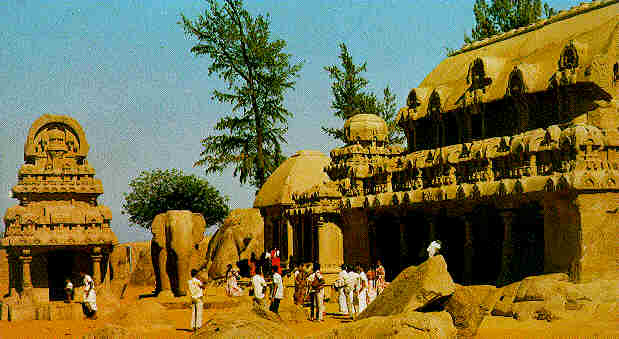
A frieze from the rock-cut temples at Mahabalipuram
near Chennai.These temples were created by the Pallava Kings in the 8th
century. The armed retinue of every feudal revenue collector-administrator
was maintained out of the revenue
The King was at the mercy of his Noblemen
Alongwith these oligarchies in the hills, there existed on the plains within the kingdoms of Koshala and Magadha, large landed estates owned by absentee landlords. These were the second type of large land-holdings. Such absentee landlords are mentioned in the Pali text of Buddha's time. These absentee landlords had landholdings relatively near the monarchical states of the Ganges valley. As these landlords came under the sovereignty of the kings of Koshala and Magadha their landholdings came to be integrated with the prospering mercantile economy of these kingdoms. In the Pali texts we find mention of landlord-merchants like Anathapindaka and Kossiyagotta. The state in whose territory these landlord-merchants lived also gained in the form of increasing collection of taxes and the general prosperity. In these monarchical states, the landlord-merchants played the role of intermediaries between the state and the actual tillers of the soil. Thus a nexus was established between the state and the landed aristocracy.The corollary of these large estates of the absentee landlords were classes like the ardha-sitika share croppers. This indicates the existence of a society sharply polarised into two classes. Extensive landed estates in the Ganges Valley which were under private ownership were tilled by the labour of classes like the ardha-sitikas . Indepedent small peasantry seems to be largely absent in the civilized belt of the Ganges valley in that period. The 2nd Stage : The imperialism of the Mauryas marked the second stage which led to the extinction of the big landowners and also of the urban merchants. The object of this was to eliminate centres of potential opposition to the state, through the almost complete elimination of this intermediate class between the state and the peasantry. The Mauryan state itself assumed the role of this class which it had successfully eliminated. But after the departure of the Mauryas and alongwith them of the highly centralised multifunctional administrative apparatus, a void was left between the state power and society (of peasant cultivators).
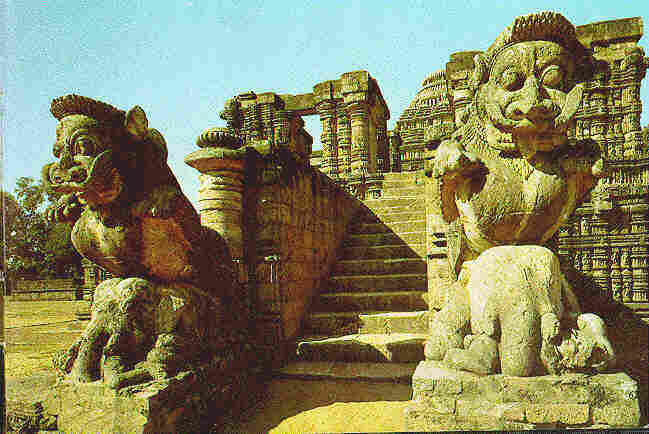
The Konark Sun Temple in Orissa.This temple was erected by Narasimha Deva the ruler of Orissa in the 13th century to commemorate his victory over Tugan Khan the Muslim Governor of Bengal. The 3rd Stage :The filling up of this void marks the beginning of the third stage. This void was filled up by the policy of giving land grant; followed by the emperors in the post-Maurya period and continued by the Gupta and Post-Gupta Kings. The titles assumed by the Gupta kings also indicate that they ruled their large empire by proxy. The Gupta kings did not call themselves Samrat as Ashok Maurya and Chandragupta Maurya were called. The titles of the Gupta kings like Samudragupta and Vikramaditya included Param-Eshwara (The Greatest - God), Param-Bhattaraka (The Greatest - Protector of the Brahmins), Maharaj-Dhi-Raj (King of Kings). All this indicates that the Gupta kings recognised themselves not as undisputed absolute monarchs, but as Chieftains of many other lower (and defeated) chieftains who paid tribute to the Guptas.
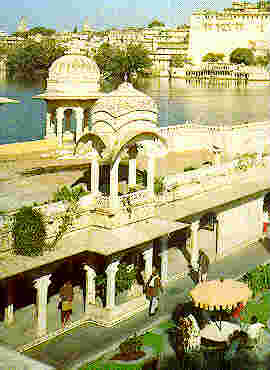
These Chattris (Marble Cenotaphs)at Udaipur represent an unique style of architecture in Medieval India But now the social relationships were of
a qualitatively different nature than those prevailing in the pre-Maurya
period. During the Maurya period too land was granted to farmer cultivators.
But what was granted was not the right of revenue collection, but the right
to cultivate and pay a part of the produce to the Mauryan state in the
form of tax. The land grantees of the Gupta age were not owners of the
lands and the villages granted to them. They were not interested in actual
cultivation of the land themselves. They were only invested with the rights
of revenue collection and exacting of forced labour, etc. A part of this
revenue collected they gave to their overlord - the Gupta Emperor. In this
respect they were neither land-owning aristocrats, nor were they absentee
landlords, they were feudal intermediaries between the state and the peasantry.
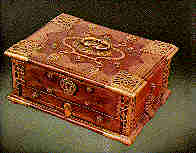
Craftsmanship in the making of jewellery boxes from beaten metal and teakwood reached unparalleled heights in Medieval India.
Craftsmanship in the making of jewellery boxes from beaten metal and teakwood reached unparalleled heights in Medieval India.It can thus roughly be summed up that in the pre-Mauryan period the landholding class in the tribal oligarchies comprised mostly the Kshatriyas. This must have been so as the passage from a tribal to a settled agrarian society the social class that could have established, through muscle power, its ownership over property (mainly land in an agrarian society) would have been that which wielded arms.(But in the kingdoms they seem to have been mainly Vaishyas like Kossiyagotta and Anathapindika).In the later periods i.e. in the Gupta and Post-Gupta Periods, the grantees must have been largely, though not necessarily individual Brahmins and temples as they constituted the class which commanded royal patronage and had a lesser tendency to rebel against the king, unlike the nobility which had a martial attitude. The temples also exercised religious influence and hence were most acceptable as revenue collectors to the God-fearing peasantry. These land grants along with the rights of revenue collection and the free forced-labour services of nearby villagers and the generous offerings of devotees had made Hindu. temples into conglomorates of vast collections of wealth in terms of gold, silver, gems, artifacts apart from acres of land and the rights of revenue collection.
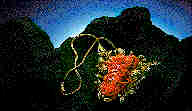
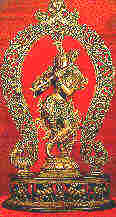
Art in the middle ages was religious in expression Krishna - the God of Music is shown with his flute (Bansuri) Krishna represented as a playful and romantic personality is a favourite God among the Hindus. Now we move on to examine India's
Raj Namavali This term stands for the political happenings that shaped
the above process of economic and social development of India in the Post-Maurya
times. It also gives the list of dynasties that followed one another from
the Post-Maurya times till the coming of the Muslims.
"Sudheer, Lavlesh and the Hindu History team would be happy to receive your valued feedback on this site.We invite you to Sign and Read our Guest book. We also invite you to use our Message Board on Hinduism and Hindu History to start a discussion on any relevant topic".For comments on site mail to [email protected]
|
||||||||||||||||||||||||
 |
 |
 |
||||||||||||||||||||||

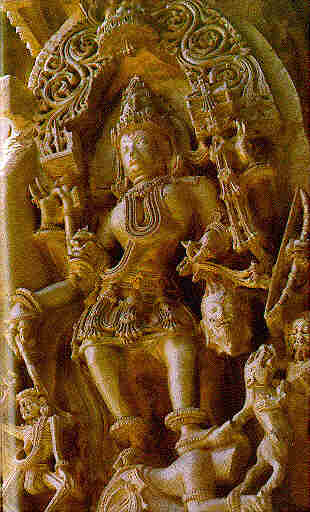 In
the mediaeval ages many kings and feudal lords made generous donations
to temples and temple construction. This is the reason for the rich opulent
temples in the middle ages. Seen here is a statue of Shiva-Maheshwara at
the Hoysaleshwara temple complex at Halebid in Karnataka. These temples
date back to the 12th century C.E.As long as the centralised apparatus
of the
In
the mediaeval ages many kings and feudal lords made generous donations
to temples and temple construction. This is the reason for the rich opulent
temples in the middle ages. Seen here is a statue of Shiva-Maheshwara at
the Hoysaleshwara temple complex at Halebid in Karnataka. These temples
date back to the 12th century C.E.As long as the centralised apparatus
of the 
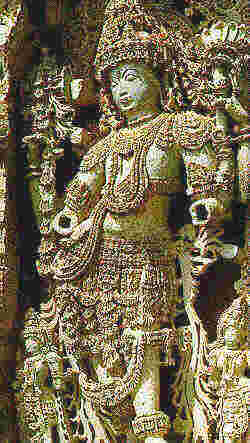 The
Opulence of Mediaeval Architecture. Seen here is a representation of Nandikesava
- the bodyguard of Shiva-Maheshwara as depicted at the Hoysaleshwara
Temple complex at Halebid. The only way to satisfy the village demand was
for the producer-artisans to move out of the centralized Shreni guilds
and spread out into the countryside. With the strengthening of this tendency,
the urban based centralised production units of the Mauryan period began
to disintegrate . So also did the till now cohesive Shreni guilds.
The
Opulence of Mediaeval Architecture. Seen here is a representation of Nandikesava
- the bodyguard of Shiva-Maheshwara as depicted at the Hoysaleshwara
Temple complex at Halebid. The only way to satisfy the village demand was
for the producer-artisans to move out of the centralized Shreni guilds
and spread out into the countryside. With the strengthening of this tendency,
the urban based centralised production units of the Mauryan period began
to disintegrate . So also did the till now cohesive Shreni guilds.