The Maurya Empire Unites
India as One Political Entity
The nearest authoritative source which
can give us an idea of the Mauryan State apparatus is the Arthashastra
- a Sanskrit classic on the principles of politico-economic organisation
authored by Chanakya who was the principal adviser to the first Mauryan
Emperor, Chandragupta. Guided by the Arthashastra, the Mauryan state became
the central land clearing agency with the objective of extending
settled agriculture and breaking up the disintegrating remenants of the
frontier hill tribes whose members could serve as a useful source of providing
labourer-cultivators on these newly cleared forest lands.
Mauryan agriculture had two type of landholdings,
one were the Rashtra type of holdings which were the direct descendants
of the holdings of the former tribal oligarchies who had been subjugated
in pre-Mauryan times. The Rashtra landholdings were to a large extent independent
of the state machinery in their internal functioning and administration.
Their only obligation was the regular payment of the Rashtra taxes to the
state.
An
elaborately carved torana (panel) from the Sanchi Stupa. This represents
a typical Mauryan Village scene
The second major type of landholdings were
of the type. These Sita landholdings were formed by clearing forest lands
with the help of the tribesmen whose tribal way of 1ife had been systematically
and annihilated by the Mauryan statecraft. It would be interesting to recollect
here the episode about the birth and passing away of Rama' s wife
Sita whose name these landholdings bear or perhaps vice versa.
The Story of Sita Janaka the king
of Mithila was childless since many years. He prayed to Lord Vishnu and
asked for a child. Vishnu blessed him and said that his wish would soon
be fulfilled by the mother earth. But days passed and there was no sign
of a new arrival ln the royal family. Janaka's longing for a child increased
but he had faith in Vishnu's word. Then one day came the festival of sowing
when the king of the land initiated the year's sowing by himself ploughing
a field. When Janaka started the ceremonial ploughing, much to his chagrin
the plough got stuck in the soil and refused to budge. After much pulling
and pushing, the earth around the plough was dug up to set it free.
To the surprise of Janaka and others gathered
there, they found that a bejewelled casket was the reason why the plough
had got stuck. Their surprise turned into a pleasant shock when they
saw that the casket contained a baby girl .King Janaka guessed that Lord
Vishnu's boon had been fulfilled. He gratefully took the baby girl home
and named her Sita to commemorate the fact that she was the daughter of
the eafth. (Incidentally in Sanskrit the word 'Sita' is also used to mean
'land').The girl Sita, grew up aa janak's daughter and was eventually married
to Rama with whom she spent 14 years in exile during which she was kidnapped
by the demon-king Ravana and was rescued by Rama after a fierce battle
was fought at Lanka. After this Sita gave birth to two to two sons Luv
and Kush. But unfortunately she had to bring her children up at an hermitage
as she was forsaken by Rama due to her chastity begin under a cloud for
some residents of Ayodhya.. But the family reunion took place eventually
when Luv and Kush unknowingly captured Lord Rama's, Ashvamedha horse and
gave battle to his army. But now after the family reunion the question
remained of Sita's return to Ayodhya.
When Rama asked her to return, she refuse;
and prayed to her mother earth to take her back. In response to her prayer
the mother earth, we are told, opened up and accepted her. As Sita disappeared
into the earth, Rama rushed; to stop her but he could only clutch her hair
which remained above the ground as the breach in the earth closed to engulf
Sita. Thus, Sita who was born out of earth also returned to the earth for
her eternal sleep.
The
famous Didarganj Yakshi (from the Patna Museum). Yakshis were nymphs in
Indian Mythology. This statue also represents a sculpture typical of the
Mauryan times.
The corollary in the name Sita for Rama's
queen and also for a type of landholding illustrates the fact that the
Sita type of holding must have been a very common type of holding in ancient
India such that the word Sita was given to a mythological character who
was supposed to have been a daughter of the earth. But this story also
illustrates that the Sita type of holdings could have come into being as
a new type of landholding which was evolved out of an earlier one
(perhaps the Rashtra holding or some other holding) .
This was the possible reason why the daughter
of the earth, who sprang from the earth was called Sita .Mauryan Imperialism
to Enforce Revenue Collection However, it was during Maurya rule that the
word Sita seems to have come into wide usage and the Sita holdings were
a result of clearing up of forest lands mainly with the labour of displaced
tribesmen. This clearing up of forests opened contacts with still farther
tribes within whom the process of disintegration was then planted by the
Mauryan State. Thus was extended the margin of the monarchical revenue
system and of settled agriculture as well .
The state maintained a close control over
the -state owned Sita lands. These lands were not made the property of
the cultivator. They were leased to him for his lifetime and he could hold
the lease on condition that he cultivated the land and paid taxes. The
penalty for non-cultivation was confiscation of the leased land. The reason
why the Mauryan State insisted on intensive cultivation with maximum results
suggests that taxes in Mauryan times bore a close proportionate relationship
with the size of the crop. Hence it was in the interest of augmenting the
state's revenue collection, to insist on maximum results.
Mauryan Prohibition on Sale of Land
In
Mauryan times, the Sita lands could not be sold or transferred without
special permissions Their cultivation too was strictly on a family
basis. No form of communal or any other type of work that could arouse
common tribal solidarity, was allowed. Even religious associations were
restricted. Thus by prohibiting
the establishment of any public platform
the Mauryan state totally eliminated all possibilities of any popular resistance
from the peasant masses. The right to movement was also restricted
for the fear of cultivators shifting from the Sita
lands to those outside the pale of fiscal
jurisdiction.
A representation of a merchant from Maurya Times (reproduced from the original
at the National Museum Delhi).
Regimentation of Rural Life : No
peasant could even become a monk without making prior provision for his
dependants. The Mauryan state took no burden of unproductive citizens upon
itself. This explains the barring of entry
of Buddhist and Jaina Bhikshus, before
Ashoka in these Sita lands.This was aimed at preventing the conversion
of peasants into unproductive monks. Agricultural production was not even
to be disturbed by non-agricultural pursuits. According to the Arthashastra,
there shall be no buildings, in villages, which could be used for sports
and recreational activities. Nor shall actors, dancers, singers, drummers,
baffons (Vagjivana) and bards (Kushilava) make any disturbance in the work
of the villagers. These extreme provisions were enforced by establishing
guarded frontiers for each of the isolated and disjointed agricultural
villages called Janapadas. These internal frontiers served the purpose
of toll and tax collection and exercising control over the movements of
peasants. The state also had a full-fledged network of spies to observe
and maintain up-to-date records of every minister and state official to
check on their loyalty and honesty. Spies disguised as philosopher-hermits
were placed around the residence of every important person. Any sudden
acquisition of wealth or suspicious behaviour on part of any important
official was closely watched and reported. such was thesteel-framed web
of the Mauryan state which enabled preservation of the highly centralized
character of the empire.But the real factor that enabled such centralised
functioning was the limited, but widely scattered Janapadas on which taxes
had to be levied. But the state got its revenue directly from the peasants
with no intermediary in between was in the later feudal ages. The smallness
of the fiscal jurisdiction made possible the consistently followed, policy
of not giving land grants that could permanently deprive the state from
any revenue hence the absence of a hereditary revenue collecting hierarchy
of Jagirdars and Subahdars that became a character of later ages.
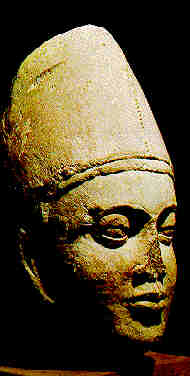
A bust of a
Kushana King from the 1st century C.E. (Reproduced from the original at
the National Museum, Delhi)
Mauryan Socialism - State Ownership
of the Means of Production : The Mauryan State also undertook commodity
production on a large scale. Apart from farmlands it also owned warehouses,
shipyards and mines. In short, the Mauryan economy functioned not only
without intermediary revenue collectors but also largely without individual
owners of
means of production in the heavy and basic
industries of those days. The state was by far the biggest owner of the
means of production and organiser of the normal economic functioning. The
reason for this control of agriculture, industry, trade and the levy of
all varieties of taxes on the population was perhaps that the state was
in dire need of a great amount
of surplus for military considerations.
Before the Mauryas, no other state in ancient India maintained such a huge
standing army as did the Mauryas. But by their policy, the Mauryas introduced
important changes in the face of the rural Economy. New settlements were
established and decaying one's were rehabilitated by drafting surplus settlers
from the
overpopulated area of the Ganges valley.
Generally the lower castes were encouraged to move out of the Ganges valley
and settle in the new agricultural settlements. Land was leased out to
them. In order to make the virgin land cultivable, the state allowed remission
of taxes for a few initial years and other concessions by way of supplies
of cattle, seeds and agricultural instruments which they were required
to repay later. But no land could be sold off by these cultivators, they
were supposed to cultivate it and churn
out revenue for the state.
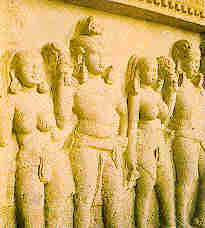
One of the panels
at Ajanta Caves in Maharashtra in Western India.
The Mauryan Revenue Collectors were
Employees of the State : This feature of centralism that characterized
the Mauryan state was made possible due to the limited expanse in which
the fiscal machinery had to function. Though the agricultural settlement
were scattered throughout the empire, the sum-total size of the scattered
Janapadas made possible the centralised system of the Mauryas. This centralised
system which was built upon the principle of the Arthashastra, did
not create a corollary of feudal lords
who could occupy the hereditary position of revenue collectors and earn
their own income from retaining a part of the revenue collected. In the
absence of such a class what came into being was a class of revenue collectors
who were the paid officials of the Mauryan State and who resembled the
IAS (Indian Administrative Service) revenue collectors of our times
rather than the Jagirdars of the middle ages.But this high bureaucracy
and the upper citizenry had its opposite in the form of a proletariat who
worked on the Sita state owned farms without a claim to the land they tilled.
These tillers of the Sita lands were termed the ardha-sitikas or half share-croppers
as they were entitled to only a portion of the crop they reaped, with the
rest going to the state as revenue.These relations were basically feudal
in nature. This was the reason why these relations were preserved by the
various dynasties that followed the Mauryas.
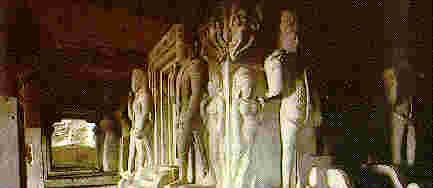
Similar to the Ajanta
temple are the Kanheri Caves near Mumbai. Seen here is one of the panels
from Kanheri.
During the Post-Maurya and the Gupta periods,
the state revenue collectors were absent and their place was taken by the
donees of Brahmadeya, Devadana and Agrahara lands, but the position of
the share-croppers remained almost unchanged as they had to pass on a share
of the crop to the donees in the place of the revenue collectors of the
Mauryan State. The donees were feudal intermediaries who passed on a part
of the revenue they collected to the king.
Later in place of these donees came the
Jagirdars, Subahdars and Inamdars during Muslim rule, but the sharecropping
system was almost unchanged. It was then known as the Biradari or the Bhaiya-chara
system in the middle ages but it was
fundamentally similar to the ardha-sitika
system of the Mauryan days. The Zamindari system of revenue collection
introduced by the British was an adaptation of the Jagirdari and Inamdari
systems of the Muslim rulers. Only that the Zamindars did not have wide
administrative powers which the Jagirdars and Inamdars had. But the
various forms of land tenure that were reared under the Zamindari system
were also basically similar to the ardha-sitika share-cropping system of
ancient India. Only after independence and the abolition of Zamindari was
an attempt made to make the tiller, the owner of the land and for the state
to collect revenue directly from him without any intermediary. But to return
to the Mauryas, we have to consider another institution that made its appearance
in ancient times i.e. the craftsman guilds.
The Shreni Craftsmen Guilds of the Mauryan
Economy : These guilds were called Shreni. Craftsman guilds which were
a feature of Europe in the middle ages, made their appearance in India
in ancient times but were conspicuous by
their absence during the middle ages.
This institution of the Shreni was between the tribe and caste in its organisation.
Though the historical reasons why these guilds appeared at that particular
stage of development are not yet established, it can be inferred with fair
accuracy that at the stage when productive forces had advanced upto a limit
where specialised occupations could emerge alongwith a division of labour
making it possible for individual tribes to specialise in particular occupations,
the Shreni guilds made their appearance. These guilds were an adaptation
of the tribal set-up when the tribes started specialising in a particular
occupation.
Such lustrous glass beads
have been recorded by Roman chroniclers to have been made in ancient India.
But in spite of taking on some artisan
occupation, these Shreni guilds retained the umbilical cord that tethered
them to the
tribal organisation. This was perhaps
due to a late contact with the hierarchical societies. But in the course
of time these Shreni guilds were pulled into the caste hierarchy and the
fact that they did obtain a place in this hierarchy, while retaining features
of their original tribal organisation (like the right to bear arms), is
indicated by the word Shreni itself which means level or grade., The Shreni
guilds played an important role in the productive apparatus of the period
which saw the flowering of the monarchical states of Koshala and Magadha
when the institution of occupational castes had not yet ossified into their
classic form. But the Shreni guilds did not survive during the post-Mauryan
times, when the economy was based on self-sufficient villages. Even the
centralised land revenue collection system with state-employed salaried
revenue collectors, gave way to one based on donees who received no salary
from the state but who retained for their own use, a part of the revenue
they collected. Thus a change in the nature of revenue collection was necessitated
by economic factors like the spreading of farmlands making it difficult
to collect revenue through a centralised apparatus, the absence of a well
knit empire after the fall of the Mauryan empire and hence the absence
of good communication links. All this led to the evolution of locally based,
hereditary revenue collectors who were petty administrators, of the chieftains
and kings themselves depending on the powers they wielded-whether they
were independent or were the vassals of some other king.
Constitutional Checks on the Rights
of a King : Another significant development during Mauryan times which
indirectly influenced the rise of Feudalism was the victory of Emperor
Ashoka over Kumar - the King of Kalinga (Orissa). The battle was a
very fierce and bloody one and the heaps of dead bodies turned Emperor
Ashoka very remorseful. It was at this juncture that he embraced Buddhism
in an attempt to conquer himself before setting out
to conquer others.
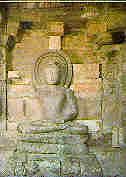
A statue of
the Buddha at the Sanchi Stupa in Madhya Pradesh.
He sent out Buddhist Missionaries to Sri
Lanka, China, Korea, Central Asia and spread the Buddhist message of universal
love and brotherhood far and wide. In addition to this, in a marked retraction
from the Chanakyan policies of statecraft (as laid down in the Arthashatra),
Emperor Ashoka formulated the code of conduct to be followed by an Emperor,
the Emperor's duties and obligations towards his subjects. This act of
his provided for constitutional checks to regal authority for the first
time in recorded history. By this act of his, he also pre-dated the Magna
Carta by 1500 years. This codification of a king's duty and
obligations are also reflected in later Dharmashastra (Political Administration)
literature of the Gupta and post-Gupta times in India. By this act, Ashoka
also undermined the steel-framed web that Chanakyan statecraft had created.
The undermining of this structure and also of the related state-apparatus
for commodity production, tax collection, espionage, etc., gradually let
loose decentralizing tendencies which weakened the Maurya Empire and led
to its downfall. Not only did it result in this, but more importantly,
after this downfall, it created a vacuum between the state (king) and the
lay people, both for the purpose of revenue collection as also for dispensing
justice and maintaining law and order. This also made necessary the creation
of intermediaries to fill this vacuum. This is an important point, which
influences the course of later history of revenue collection and political
administration in India. The spread of farmland far and wide to proportions
unimaginable in pre-Maurayn times also made the emergence of such a class
of intermediary revenue collectors - the Feudal Lords viz. Samants, later
called Jagirdars, Subahdars, Mansabdars, indispensable.
The Chaitya
- Buddhist Prayer Hall at the Ajanta temple complex.
Now we move on to examine the change which
followed the decline of India's first Pan-Indian empire of the Mauryas
and the consequent Fall Towards Feudalism
that
characterized the middle ages. Between the king and the common population
there was now a class of middlemen who were the intermediate revenue collectors.
They were variously known as Samants and Saranjamdars (called Thakurs,
Chaudharys, Patils, Patels, Deshmukhs, etc) and in later times Subhadars,
Jagirdars and Mansabdars.
"Sudheer,
Lavlesh
and the Hindu History team would be happy to receive your valued feedback
on this site.We invite you to Sign
and Read our
Guest book. We also invite you to use our Message
Board on Hinduism and Hindu History to start a discussion on any relevant
topic".For comments on site mail to [email protected]



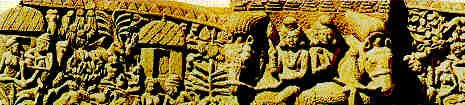 An
elaborately carved torana (panel) from the Sanchi Stupa. This represents
a typical Mauryan Village scene
An
elaborately carved torana (panel) from the Sanchi Stupa. This represents
a typical Mauryan Village scene

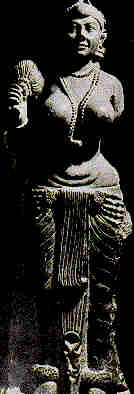 The
famous Didarganj Yakshi (from the Patna Museum). Yakshis were nymphs in
Indian Mythology. This statue also represents a sculpture typical of the
Mauryan times.
The
famous Didarganj Yakshi (from the Patna Museum). Yakshis were nymphs in
Indian Mythology. This statue also represents a sculpture typical of the
Mauryan times.