|
|||||||||||||||||||||||
CONTENTSThe Intervention of Alien Rule in India from 1194 C.E. up to 1947 C.E.
After this invasion which was limited to
Sindh, for a period of 300 years all further Muslim attacks were thwarted
by
The second surge of the Muslim aggression began in 980 C.E. and lasted till 1020 C.E. This was the time when the Shahi Kings of Punjab grappled with the invaders. By the year 1020 C.E. Muslim rule had been established in Afghanistan, Paktoonistan (NWFP) and West Punjab. These Muslim invasions were led by Mahmud of Ghazni. The Rajputs ruling North India resisted further Muslim aggression. The third wave of a successful Muslim invasion led by Mahmud Shabuddin Ghori (or Ghauri) took place between 1191 C.E. and 1255 C.E. This was the time the Muslims extended their occupation to Delhi. The lead role in resisting this invasion was played by Prithviraj Chouhan. This Muslim surge brought East Punjab, the Ganges Valley (Uttar Pradesh and Bihar) and Bengal under Muslim Occupation. This invasion reached up to Bengal where the last Hindu kingdom ruled by Laxman Sena was overurn by the Muslims. But the Muslims were checked and repelled when they tried to invade Orissa, where the Hindu King Narasimha Deva defeated Tugan Khan who invaded Orissa from Bengal. To commemorate this victory, Narasimha Deva erected the Sun Temple at Konark. The next surge of the Muslim Invasion was launched from Delhi by Allah-ud-din Khilji in the year 1310 and was led by his general Malik Kafur. This invasion trampled the Hindu Kingdoms of the Yadavas of Devgiri in Maharashtra, the Kakatiyas of Warangal in Andhra Pradesh, the Hoysala of Belur-Halebid in Karnataka and the Pandyas of Madurai in Tamil Nadu. This invasion lasted till the year 1328 and with this invasion, except Orissa and Assam, the whole of India passed under Muslim Occupation. The Hindu Struggle for Independence against Muslim Tyranny Thus the struggle of the Hindus to resist the Muslim aggression into India was spread over a period of 600 years from 715 C.E. up to 1328 C.E. This contrasts with the the swift Muslim victories in Persia (Iran) over the Zoroastrian Sassanians and in Mesopotemia, Egypt and North Africa over the Romans (Byzantines). The Muslims could not subjgate India with ease. And even after subjugating different parts of the country, they were never able to rule it enitrely. The next 400 years from 1328 up to 1720 was marked by a valiant and ceaseless struggle for independence by Hindus to deliver India from Muslim tyranny. This struggle was first led in North India by the Rajputs and then by the Jats, Marathas and Sikhs. In the South this struggle was embodied in the Vijayanagar Empire. This struggle for independence culminated when the Marathas began to bring an end to the Muslim domination of India. The Gurkhas came in later in the 18th century, but their activities also played a role in weakening the Muslim power in North India which was on its last legs in the 18th century. The Gurkha struggle was more with the British East India Company. But more of this later. The Muslim rulers built on the same Feudal Base* of the Hindu Period…But the successful aggression of the Muslim invaders did not change the Base of the earlier pre-Muslim society. Base* defined as the land ownership system and the system of making land grants to middlemen (feudal lords) who collected taxes for the higher authority - the king (Sultans of Delhi in the context of the middle ages). The very first act of the Muslim invaders was to pillage the well endowed Hindu temples at Somnath, Thanesar, Mathura, Kannauj; and other places. By this, with one stroke, the riches concentrated in the hands of these temples through many centuries of grants from Hindu rulers, fell into the hands of the Muslim invaders from Ghazni and Ghori. But the Muslims Aimed at Totally Destroying the Superstructure** Associated with the Hindu Period : The Muslims aimed to totally destroy the Superstructure associated with the Hindu period. The term Superstructure** which the Muslims aimed at destroying included a wide spectrum of aspects of social life including Indian religions (Hinduism, Buddhism, Jainism), language (Sanskrit and its various vernaculars), universities (like Nalanda), traditions of learning (ashramas, gurukulas), architectural symbols (temples, Chaityas, Viharas, Stupas), etc. The policy during the 700 years of Muslim occupation of India was to totally replace the superstructure of the Hindu period with a typical Muslim one. Towards this end the Muslim invaders undertook the desecration of places of worship, destruction of universities like Nalanda, the wholesale slaughter of the monks and priests to wipe out the intellectual bedrock of the people they overran. Such tyrannical polices which the Muslim rulers folllowed since their rule was established in 1194 C.E. they left a trail of bitterness in the regions which passed under their domination. Hindu tradition survived only in remote corners of the country like in Orissa, Assam and parts of South India. Contrasts between non-Muslim Invasions and the Muslim Aggression of India Though the new rulers built upon the same feudal economic foundations of the Hindu period, they aimed at total destruction of the super-structure as it then existed. In the early days of their reign the Muslim rulers unleashed a reign of terror the kind of which India had never experienced before in its history. Before, the Muslims, India had been invaded
by the Greeks
(Yavanas) , Huns (Hunas), Shakas and Kushanas, but what contrasted
their invasions from that of the Muslims was that, after their initial
collision with Indian society, the previous invaders were completely absorbed
into the existing Indian society. Even the memory of their ever having
been foreign
But the barrack-like lifestyle of the Muslims
along with an attitude of contempt for everything associated with this
Eclipse of Buddhism and Trying Times
for Hinduism The near total eclipse of Buddhism following the
destruction of monasteries and the slaughter of monks by the Muslims in
their headlong rush down the Ganges, establishes both - the fanatical
ferocity of these intolerant invaders as also the changed character of
Buddhism which had by then long lost its mass base. The religion had become
highly centralised comprising mainly the monks at Nalanda and other universities.
The eclipse of Buddhism stands in sharp contrast to the survival of Hinduism
through 750 years of intolerance and persecution. This was so as Hinduism
with all its superstitions and rituals was still anchored in the
mass and had not become limited to being solely an intellectual tradition
as had Buddhism.
The Hindu-Muslim Conflict was Economic, Social, Cultural, Military and Religious But the fierce conflict that featured the early days of the Muslim occupation of India, was in its hidden essence a conflict for domination, of which religion was only one aspect. This struggle was primarily between the Muslim nobility (Amirs) led by the Muslim Monarch (Sultan) on one side with the Hindu nobility and general Hindu population on the other. To quote D.D. Kosambi , a contemporary historian, "The monarch's regulations were so strictly carried out that the Khuts, Mukaddims or Chaudhuris (Hindu noblemen and village headmen) were not able to ride on horse-back, they were not allowed to carry weapons or even to indulge in betel. These classes were brought to such a state of obedience that one revenue officer would string twenty Khuts, Mukaddims or Chaudhuris together by the neck and enforce payment by blows. (D.D. Kosambi Introduction to the
Study of Indian History)
The exploited classes of the former Hindu social structure did not experience any change in their economic position, but they now bore the additional burden of repression on religious grounds, the payment of Jazia (penal tax which the Hindus had to pay for refusing to convert to Islam), the waves of forced conversions, where they, like their more fortunate noblemen and upper caste fellow countrymen, were made to submit to 'Islam' at the point of the Sword, the destruction of their places of worship, and the arbitrary humiliation of the honour of their womenfolk, in addition to the discrimination in legal matters and a general status of being second class citizens. It was for these tyrannical policies that the Muslims were looked upon by all Indians as Mlechha (commonly pronounced as Mlench) - which in Sanskrit means "barbarian". But in all frankness, it should be said that despite Muslim tyranny, the lower castes of the Vaishyas and Shudras continued to be a tillers of the land with an obligation to part with a share of the crop to the state - whether Hindu or Muslim. Under Muslim rule their economic position did not change, but their social position became worse. In addition to being economically exploited, as they were earlier during the Hindu period, they were now also socially tyrannized along with the rest of their countrymen, by their new intolerant rulers - the Muslims The Brief Revival of Slavery under Muslim
Rule Even the brief revival of slavery that took place under the Delhi
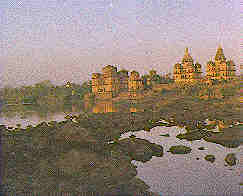
The setting sun casts its glow on the Orchha temples across the river that flows past the complex.In the dark days of Muslim Rule the Bundela rulers not only tried to preserve their independence but also preserve a hoary tradition of temple building in an age when the Muslim aggressors spared no opportunity to vandalize any non-Muslim structure that could lay their hand on. This showed the low importance given to
both human life and to the practice of slavery in the productive process.
Had
Dynasties set up by the Muslim Aggressors
in India from 1194 C.E. up to 1857 C.E. After Mahumd
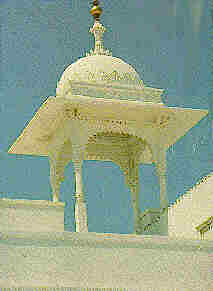
A Marble Chattri at Udaipur.Udaipur means City of the Rising Sun.Like the Bundela rulers of Orchha, the Ranas of Udaipur defianly held aloft the banner of Indian independence in the darkest days of Muslim rule in India. The Moghul Badshahs Babar came from
Ferghana in Central Asia and he belonged to the Timurid line. Incidentally
Babar decended from Tamerlane (Timur the Lane) who had invaded and devasted
Delhi a hundred years before Babar's invasion. Babar established the Mughal
dynasty which ruled from Delhi (and later from Agra) Between 1527 C.E.
and 1690 C.E., the Mughals gradually expanded their hold over almost the
whole of India. They ruled from 1527 upto 1857.
But the fact to be noted here is that
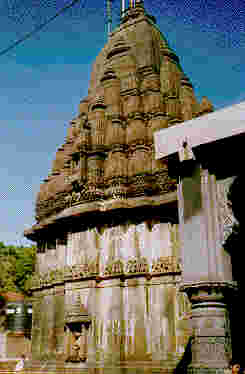
Hidden fron the covetous eyes of the Muslim iconoclasts, the temple at Bhimashankar in Maharashtra was constructed in thick forests deep in a valley during the middle ages Rapproachment between the Rajput Nobility and the Moghal Rulers As we saw the policy of confrontation between
the Mohammedan monarchy and the Hindu landed nobility did not last forever.
The later Muslim rulers (the Mughals from Akbar to Shah Jahan) were shrewd
enough to realise the long
Feudal Relations Remained Unchanged
Irrespective of the Rulers being Hindu or Muslim Thus whether in the
Sultanate of Delhi or in the Mughal rule, or in the petty Muslim Kingdoms
of the Deccan, or in the Vijaynagar empire or in that of the Marathas
at a later stage, the feudal mode of production with its hierarchical apparatus
remained
In spite of this compromise of the Hindu nobility with its Muslim counterpart, all through the Mohammedan rule an under-current of the state policy was the aim of converting people to Islam. How the Hindu Ruling Class - faced the
Muslim Challenge in Various Ways The conflict of interests between
the two ruling classes of the Hindu landed nobility and the Muslim monarchy
was partly mitigated by the continuing opposition to the Muslim power,
as happened in the case of the Rajputs especially in Mewad (the line of
Rana Sanga and Maharana Pratap of Udaipur/Chittor).
The Rajputs were brave as well as proud. They lived a luxurious lifestyle built magnificent palaces rode caprisoned elephants fought one another bitterly and at critical junctures in Indian history their internecine rivalry cost the nation its sovereignty which passed into the hands of the invading Muslims But in the Gangetic valley the Hindu landed
nobility in most cases went over to the side of the Muslim Sultan, by getting
themselves converted to the religion of the new rulers and thus retaining
their position as the landed nobility alongwith the rights of revenue collection.
The surnames Khatri, Chaudhary, Shah, Chohan, Patel, etc., still linger
on in many
The Marathas in the south also followed another "honourable" compromise with the victorious Muslims by offering to be mercenaries under the service of the Muslim rulers (Shahji Bhosale for example). It was only when a national revival took place under the leadership and vision of Chattrapati Shivaji Maharaj that the Marathas came into their own.. The Vijayanagar Empire In around
1350, two brave Hindu youths named Harihara and Bukka set up the last major
Hindu Kingdom of the south - Vijaynagar. We are told that these two youths
had been captured in their early teens by Malik Kafur when he invaded South
India. They had been brought up as Muslims at Delhi and had been sent to
the south to govern the rebellious provinces. But these two enterprising
youths had different ideas. They had not forgotten who they originally
were. They repudiated Islam and returned to their original faith. With
the help of a sage named Madhavacharya, they established a powerful Hindu
Kingdom at Hampi (called Vijaynagar).
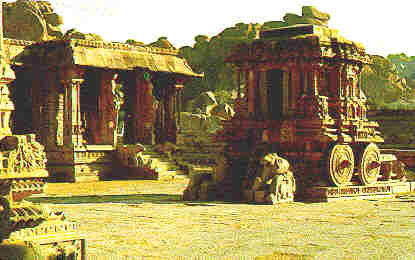
Hampi the destroyed capital city of the Vijayanagar Empire.
However for all this glory, the Kings of Jaipur/Amber could preserve their throne during the Muslim rule giving away their daughters to the Mughal Rulers and serving as the paid servants in the Mughal armies against their fellow countrymen. Mirza Raja Jai Singh came on behalf of Aurangzeb to fight against Shivaji. Udai Bhan the renegade Rajput Mughal commandant of Sinhagad, fighting with whom Tanaji laid down his life, was one such renegade Rajput. Not to say that there were no renegade Marathas - there were many Suryaji Pisal and Chandrarao More to name two. On the other hand there were stout-hearted nationalist Rajputs like Maharana Pratap, Rana Sanga, Prithviraj Chouhan and many others. But it was the dark sheep who, to save their throne and skin, brought defeat and dishonour to the nation. Now we move on to examine the period which
marks the national revival under the Marathas
that also marked the end of Muslim Rule in India.
"Sudheer, Lavlesh and the Hindu History team would be happy to receive your valued feedback on this site.We invite you to Sign and Read our Guest book. We also invite you to use our Message Board on Hinduism and Hindu History to start a discussion on any relevant topic".For comments on site mail to [email protected]
|
|||||||||||||||||||||||
 |
 |
 |
|||||||||||||||||||||

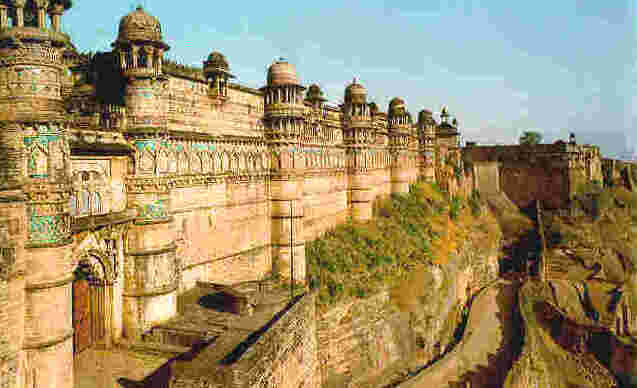 The
fort of Gwalior.-This fort dates back to the 11th
century and was originally built by the Tomara rulers whose adopted heir
was Prithiviraj Chouhan - the last Hindu ruler of Delhi. The Gwalior Fort
witnessed the chapters of the stout Indian resistance to the Muslims and
later the British. Important rulers of this fort were Prithviraj Chouhan
(circa 1190 C.E.), Man Singh Tomar (circa 1490 C.E.), Mahadji Shinde (circa
1761 C.E.) and Rani Laxmibai of Jhansi (circa 1857 C.E.)
The
fort of Gwalior.-This fort dates back to the 11th
century and was originally built by the Tomara rulers whose adopted heir
was Prithiviraj Chouhan - the last Hindu ruler of Delhi. The Gwalior Fort
witnessed the chapters of the stout Indian resistance to the Muslims and
later the British. Important rulers of this fort were Prithviraj Chouhan
(circa 1190 C.E.), Man Singh Tomar (circa 1490 C.E.), Mahadji Shinde (circa
1761 C.E.) and Rani Laxmibai of Jhansi (circa 1857 C.E.)