

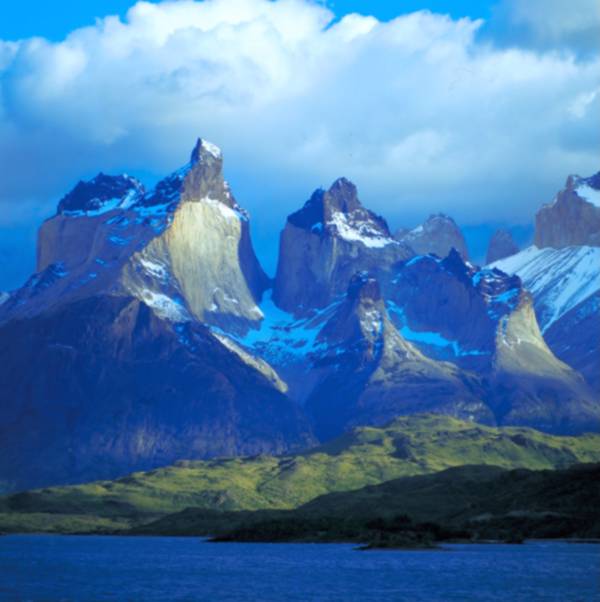
TORRES DEL PAINE NATIONAL PARK IN CHILE.
GIGANTESCO INCENDIO DA�A MILES DE HECTAREAS EN
PARQUE NACIONAL TORRES DEL PAINE EN LA PATAGONIA CHILENA.
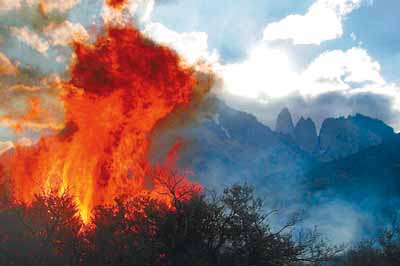
Campers still don't understand why he didn't stop the fire immediately, since a camping cooking stove is really small as well as are the flames. In such cases you can usually stop the fire with your boots, rocks, soil, other larger pieces of wood, water, etc. So, other campers say this irresponsible tourist didn't do anything to extinguish the fire. The only reasonable explanaition is that he was making a big fire or cooking in the middle of the bushes and grass at the peak of the dry season. If this is the case, he should had been more severely judged.
Torres del Paine National Park is one of the highlights of every visit to the Patagonia. It is included among the list of places considered to be a Reserve of the Biosphere. It is visited actually by 100.000 people every year from throughout the world. It seems as though that thousands and thousands of visitors trough the years respected the rules and knew how to feed themselves without causing damamge. Actually many campers don't cook as a method of fire prevention, carrying easy to eat food in their backpacks. Others do carrry small units to cook, but don't build big fires with pieces of wood unless it is done within authorized camping sites.
The park has an extension of 181.0000 hectares or the equivalent to 1.810 square kilometers. The area affected thus far for the fire is near to the 8 % of the park. On the Patagonia winds normally blow at 90 - 100 kilometers an hour, making it very difficult to control the fire and it is very risky for the firefighters, since a sudden wind can trough the flames into the firemen. There are 700 men working to control the fire. Only rain could help. As it happened a night ago. But Magallanes tundra in some spots will keep the fire underground, so the watch must be kept.
FAUNA AFFECTED BY FIRE
Animals have run away from the fire, as guanacos (Lama guanicoe), �and�es or rhea a flightless 4 feet tall bird; huemul (Hippocamelus bisulcus ), foxes (Canis culpaeus), puma (Felis concolor), chingues , rabbits and rodents.
The park is plenty of bids among which we can mention Andean Condor (Vultur gryphus), Black-chested Buzzard Eagle (Geranoaetus melanoleucus), Black-necked Swan (Cygnus melanocoryphus), Chilean Flamingo (Phoenicopterus chilensis), Spectacled Duck (Anas specularis), Magellanic Woodpecker (Campephilus magellanicus), Ringed Kingfisher (Ceryle torquata), Patagonian Sierra-Finch (Phrygilus patagonicus), Common Diuca-Finch (Diuca diuca) and Rufous-collared Sparrow (Zonotrichia capensis).
However, eggs and nesting of new birds, insects and all sort of biodiversity is being damaged. Besides animals and birds running away will compete for food and room in the other areas of the park.
VISITORS
Visitors can still visit the northern areas of the park not affected by the fire. Probably you will see more animals as they concentrated in the safe section of the park. The Glaciers and the peaks are not affected at all. So you still can enjoy the striking views offered by the park
PENALTIES FOR FIRE AND THE FORESTRY SERVICE
Chilean legislation is too old to punish fires. Mr. Jiri Smitak paid only US$ 200 while he is causing millions of dollars in losses, plus invaluable biodiversity loss. I hope visitors and other organizations can contribute to recover the park.
However, while private companies have millions of dollars in fire prevention and extinction to care for their plantations, the state of Chile doesn't has the same system to protect its wildlife. Many environmentalist think this due to the mixed missions of Conaf, which stands for Corporacion Nacional Forestal, the National Forestry Agency. Among it duties are:
1. Forestry department in charge of Chilean Wildlife.
2. Forestry department authorizing cutting permits in native forest.
3. Forestry department in charge of industrial plantations
Then for one side is protecting the Chilean Vegetation and Wildlife, and for the other side has to authorize its exploitation. Conaf get paid by authorizing cutting permits and receives a lot of funding and incentives to replant with industrial plantations. So, even it got funds for fire prevention, most of these resources are usually allocated where the industrial plantations are located, in the central area of Chile. So, even Conaf has 14 million of hectares of national parks and reserves under its direct supervision, the number of resources allocated for fire protection to this sole purpose is minimum compared to the protection of private plantations. The situation is worst, since forest fire resources of Conaf are used whenever there is a forest fire in Chile, either in private land or in national parks. So, they can extinguish their resources most of the time in private land fires. But private resources owned by large forestry companies for fire extinction are never employed in national parks fires.
In the case of National Park Torres del Paine, is by far the most visited park by foreigners in Chile. So it receives a lot of funding trough tickets, but none it seems reinvested properly in prevention. Without any doubt the members of Conaf in charge of forest fires near Torres del Paine, probably were not more than 5 men. Probably this is a large estimate. Which is not sufficient to control 181.000 hectares. If enough resources for fire extinction would had been located near the park, the damage would had been less. Besides, it is located geographically so distant from the central areas of Chile, that while forest fire teams arrive to the site, the flames have gone too far. Probably this is the sad lesson from this fire. Magallanes region and Torres del Paine need a strong and self sufficient fire fighting team locally rooted.
More information about Conaf see, http://www.conaf.cl/
PROPOSAL N� 1 : ESTABLISHING A NEW INDEPENDENT PUBLIC ORGANIZATION TO SUSTAIN WILDLIFE IN CHILE
So, even the origin of the fire was a human irresponsible action, there is another irresponsibility in the State of Chile, for not creating a specific organization in charge of the Chilean Biodiversity. It is impossible for the professionals working in Conaf to split their soul between conflicting goals. For the same window they have to control and organize their national park system to protect wildlife, and for the same window they have to authorize cutting permits, industrial plantations and activities that hazard the environment. You are asking too much to same people. You can not ask the police force to capture the criminals and at the same time to be psychiatrist to understand them. These functions are everywhere in different organizations. The same should happen with the wildlife. These multiple conflicting objectives of the Agency in charge of Wildlife in Chile, are similar to those in other countries. So, there should be an international trend to split those functions.
Besides the Forestry department in Chile, Conaf is a private corporation receiving funds from the state. But most of the budget and people working on it goes clearly to activities related to industrial plantations. For instance just watching their chart of functions you can realize that the area of Patrimonio Silvestre or Wildlife Treasure is just a unit under the Operational Unit. Instead the area of Forestry Development, which is industrial plantations basically, is a above the ladder in the organizational chart as top department. Another weird situation is due to the fact that the legality of Conaf as private organization but owned by the state, has lead it to the necessity of creating a foundation, Fundacion Raices, to channel funds to protect the native forest. So most of the people working to protect the state assets are not hired by the state, but for a foundation. This strange legal agreements must be finished and begin a new approach to protect the state resources.
If a truly Wildlife Agency should be related to "production" , this "production" should be ecotourism, trough national park management. This orientation to servicing persons requires different professional competencies in the team and also at the top of the management. Clearly different competencies than thinking on how many cubic meters are produced by hectare as industrial exploitation does.
Moreover another of the "production" actions to be carry on by the Wildlife system is research of knowledge and issuing it to the community. This is another SERVICE. Environmental education on site is key for the future and it should be another mission of this Agency.
Classification of the biota and keeping control of the endemic assets are fundamental tasks. Protecting and studying the hazards endemic species face from exotic plantations or exotic species are also mandatory goals, among others.
In addition, suggesting sustainable ways of services or production to be obtained from native species in hands of private owners, it is another objective. Like medicinal plants, essences, furniture, etc. Advise to HARVEST the native forest and in general the wildlife instead of destroying it or replacing it by exotic plantations.
This agency should raise within the citizen and politicians strong support for advocacy and awareness to pass new legislation protecting the wildlife. Not like today, where environmental organizations or individuals without proper funding, are using their time and resources like Don Quixote, to carry the flag of keeping the biodiversity. The state has the intention but the agency on charge has its soul divided. A bad example of this situation is the Law for Protection of the Native Forest, which has been dormant in the Congress DURING TWELVE YEARS. One of the great reasons is that the large logging companies see on this law a restriction to continue their plantations. Then they have done all sort of lobby to the Congress and the Government successfully thus far. Unfortunately one of their allies is the same Conaf, due to its duties in favor of industrial plantations.
So, this new Agency for the Conservation of our Wildlife must be created as soon as possible. Passing the law for protecting the native forest, and still keeping Conaf in charge, has proven to be like the cat put on charge of taking care of the meat. It has proven impossible. It simply will not work.
Another example. There are incentives offered by the state to offset some of the cost for replanting degraded soils, which could be done with native or exotic species. The government trough Conaf, Indap and other agencies is putting millions of dollars every year to plant exotic species. Instead, minimum resources are being allocated to native plantations. Then Conaf is not interested on developing a long term achievement with private owners of land and campesins, planting and harvesting native plants. So Conaf is leading the way to change radically the landscape of Chile in private hands, as we can see today in large extensions of the Central Region tied to the coast, full of radiata pine tree as eucalyptus. Also this trend is coming vigorously toward the District of Lakes, as industrial plantations are growing near Puerto Montt. This pattern is going steady toward the Patagonia.
The Kyoto Protocol is opening the door to ambitious businessmen favoring plantations to be exchanged by Carbon Bonds in industrialized nations. Japan is seriously interested in using the Patagonia for this purpose, so their industries can keep contaminating the Biosphere. If Chile were wise enough we could use the greedy of these industries to replant with slow growth species or those in danger of extinction or existing in minor numbers. So we could widen our strength to maintain our biodiversity.
But, as Conaf is a second party interested in industrial plantations has not developed any proposal of this kind.
Anyway, it must be acknowledged that the Chilean Forestry Service has one of the best teams in fire fighting in Latin America, if not the best, due to the significance of the forestry activity in Chile. Hope these resources can really be available to the wildlife protection as well. Unfortunately the resources of the state are the same for extinguishing a fire either on industrial plantations, general private lands, and protected wildlife areas. Many suspect that the government is more focused in preventing fires on industrial private plantations since most of the budget of Conaf is dedicated to exotic plantations incentives and control. This dilemma and doubts on the Governmental action, can only can be eliminated creating this new agency for Wildlife protection.
PATAGONIA GROWING UNPROTECTED
Chile has 14 million hectares of protected areas. In the Patagonia, understanding for it the province of Palena, and the regions of Aysen and Magallanes, there are 12 MILLION HECTARES of those wildlife reserves. It means 120.000 square kilometers distributed throughout an incredible geography, from Puerto Montt by the north to Cape Horn at the extreme southern tip of America. Chile is doing an extraordinary effort in keeping these area from commercial exploitation. Recently, at the end of year 2004, Presidente Ricardo Lagos incorporated another area of Palena into the protection, creating National Park Corcovado, with around 200.000 hectares. So the Patagonia reserved for the future keeps growing. .
However, another big fire in year 1985 affected 15.000 hectares of Torres del Paine National Park. Also in years 1997-98 a fire in Reserva Las Guaitecas, in the Aysen Region, damaged 18.000 hectares of forest and land. Nothing was done to stop this last fire. Difficult access, although as the entire Patagonia does. So, it shouldn�t be an argument for not protecting it. We must be prepared to keep safe this wild and rough geography.
PROPOSAL N� 2. PATAGONIA WILDLIFE AGENCY ESTABLISHED IN PUERTO MONTT
Then, Chile needs an agency only dedicated to wild life protection in the Patagonia, having its main office not in Santiago, but in Puerto Montt, on the gateway to Patagonia. And two main offices in Coihaique and Punta Arenas. One of the reasons for not reacting promptly to these fires, is due to the simple reason that all the decision makers are located in Santiago, as far as 2.000 kilometers away from Torres del Paine. Fighting a fire in central Chile with nice and steady good weather conditions, predictable seasons, good roads and airports, has nothing to do with the ever challenging conditions of the Patagonia. Then higher officers in charge of protecting the wildlife must be professionals living in the same area where the assets are located. Chile can not leave any more the responsibility of caring for these huge universe of wilderness to strongly committed ground workers, and park guards, but not entitled at all to take decisions. Their bosses have to be right there, close to them, if Chile wants to have a Patagonia safe and protected toward the future.
The Republic of Chile has more than the 85 % of its protected areas in the Patagonia, but there is none of top decisions makers living in the area. This is non sense for a private company, because top management and decision makers would be right there where the facility is located. Actually Douglas Tompkins, a United States citizen creating private parks in the Patagonia, owning near to 400.000 hectares or more of land, is living in Puerto Montt or within his parks. In addition, Sebastian Pi�era, a wealthy politician of Chile has bought in year 2004, nearly 150.000 hectares in Chilo� Island to convert them into a private park. Then, only in year 2004, the southern region of Chile gained more than 350.000 hectares for protection. There is none of these efforts being done either by the state or private individuals in other areas of Chile, not at this large extent.
Then the state pursuing its own interest plus the interest of individuals acting in protection, must put resources to protect and maintain this wonderful biodiversity. Policy makers can not be seated in Santiago. The Head for the Patagonia protection and the District of Lakes must be in Puerto Montt. Planes, helicopters, ships, barges, boats, etc, must be located to keep the safety of these more than 12.500.000 hectares. There is a huge capital in land resources, but almost ZERO dedicated to take care of it. Or what is available is simple not enough. If you just value in US$ 500 and 1.000 dollar each hectare of land, then there are between US$ 6.250 and 12.500 MILLION DOLLARS ( 6.25 to 12.5 BILLION as US citizen like to say) in properties not protected and well managed.
But if you add to it other real estate in the District of Lake and Patagonia in private hands, in many farms of different sizes, closer to access with added value and development, these figures grow much still.
If the state of Chile has added several parks on the last 15 years to the national treasure, plus private protected areas have grown also at the same time, then Chile has to invest in protecting these assets. So, the Chilean and international efforts must be concentrated presently in the protection of what we have.
So, requesting the creation of a sole entity for taking care of these land is MUST. For instance, private corporations like Copec-Arauco owning near a million hectares of industrial plantations, in the central area of Chile, has a large plan for fire protection and administration of risks. Besides normally the state resources are highly concentrated on these area, leaving unprotected the District of Lakes and the Patagonia. This is the reason fires begun by tourists can have large consequences. Private enterprises are being called by the state to invest in the Patagonia, either in private land or state owned land. But those investment must be backed up for a New Agency in charge of the logistic to protect these assets.
Another Agency for Central Chile Wildlife Protection should be established in Santiago or nearby. And a third agency should be in charge of the Dessert Lands and North of Chile, probably located in Antofagasta. Following the strict administrative division of the country is not enough since the environment doesn't follow border lines. But the Patagonia Agency should include the three last regions of Chile: 10, 11 and 12. The tenth region has large parks in its northern area, as Puyehue, Vicente Perez Rosales and Alerce Andino. So, establishing the Head in Puerto Montt serves all purposes.
INTERNATIONAL COOPERATION
You can read on the late 2005 budget issued by Conaf there has been a significant cooperation of Germany of approximately US$ 1.400.000 . While Conaf may keep its actual goal of promoting the industrial plantations, foreign government cooperation should be designed in another way, so to avoid subsiding their industrial plantations activities. I mean if funding is coming for a sustainable program, when they buy a vehicle with those funds, then it can be used also for industrial plantations. When money is given to pay professionals for these programs, they should be only to pay their time on this activity and not a general wage or honorary for belonging to Conaf. When funds are given for general overhead, then international cooperation is paying mostly industrial plantation actions, because most of Conaf tasks are related to this field.
So I suggest international cooperation should be given in a different way. Here I suggest a few ideas.
EXTERNAL AUDITORS AND EXTERNAL CONTROLS WHEN DONATING TO THE STATE
Hire external scientist auditors to revise the field work. But also hire an auditing company acting as controller BEFORE the funds are allocated. Without those two signatures funds shouldn't be allocated. Comply with this procedure every month. In many situations around the world cooperation is given for many reasons to the states, but from time to time you hear stories of improper use of funds. Most of the time some of the funds are miss allocated. The reasons can be as simple as the goals of the organization of the state using the funds may have conflicting objectives, as Conaf in Chile does. I don't know why international cooperation to nations is not given with external auditors and controls. I am sure the success and good use of those funds will really improve around the world under more strict regulations. It doesn't help enough if auditing comes afterwards. It must be an ongoing process. It has to be a controller service month to month before the funds are paid. Like any private company does.
It is unclear to me why this has not been done. When you handle a small organization you have a lot of controls, but when giving international cooperation for millions of dollars to governments, everyone assumes honesty is magically achieved. Maybe it does, but not necessarily used properly for the goals it was given as proven many times afterwards. So along auditing periodically, the CONTROLLING authority must be put into place as a cost of the project, which at the end will save a lot of money.
Another option is the donor pays directly for the services provided by private companies, NGO or individuals. For instance if new plantations of native forest are going to be done to recover an area, plants could be bought directly to a private organization. Also the service for planting them. The outcome is given to the state or to a foundation. This approach may be more complicated for the government giving the donation. However, if dealt properly it should work out.
PROPOSAL N� 3: AUDITORS AND CONTROLLERS FOR SUSTAINABLE DEVELOPMENT AND INTERNATIONAL COOPERATION
We need this type of professionals and organizations more than ever. It is not just controlling the buck or the penny being backed up by a bill or a receipt, which is normally being done by international auditing companies. Financing Sustainable projects or assistance to reach sustainability, or using the funds properly on an humanitarian disaster requires professionals and organizations that may balance the fast answer to the needed, along meeting a responsibility criteria.
Professionals dedicated to this service should have a very clear personal profile oriented toward sustainability as a mandatory requirement. So to be able to see beyond the receipts. These professionals should understand the goals to be financed clearly. We don't need to replace the state bureaucrat by another desk counter.
If these external controllers were assigned to every international cooperation effort, there is no doubt the goals could be better achieved. United Nations or any country assisting financially another nation in sustainability and humanitarian help should designate an external steering committee to control the proper use of the funds. Receiving nations shouldn't complaint for such controls. It must be accepted. The transparency and honesty of receiving nations most likely be rewarded with additional help.
RESERVE OF BIOSPHERE
Torres del Paine is recognized as a Reserve of the Biosphere. Such condition is given by United Nations, trough UNESCO , its educational, scientific and cultural branch. See it in :
http://www2.unesco.org/mab/br/brdir/directory/biores.asp?code=CHI+03&mode=all
But, it should be more than a symbolic title. When this rank is given to an area, it is due to its importance for the world. So, United Nations and other countries should carry a follow up set of rules to make sure these places are not threaten by human activity.
When this category is given, then at minimum fire fighting squads should be right there and disaster relief teams nearby. Modern satellite system of communication in case of disaster must be in place. Educational speeches and warnings given mandatory to all tourist arriving to these places. Strong fines compulsory internationally to punish who brakes these rules. The same for those taking plants and flowers, animals, etc. in a non authorized manner.
Governments asking for these recognition for a given park or location, should be liable of having a set of protection measures higher than the rest of their national parks. These rules must be enforced, so they can apply and obtain international resources for this purpose. There should be an effective international agency in charge of monitoring the reserves of Biosphere of mankind, because future humanities are going to need them badly. We have to act today, otherwise human population growth and irresponsible actions, are going to damage an invaluable and non replaceable treasure.
PROPOSAL N� 4 : WATCH SECURITY ON RESERVES OF BIOSPHERE
Torres del Paine National Park must be the first Reserve of Biosphere, to be taken seriously by United Nations and the Chilean government. Maybe we can take this site to set an exemplary set of rules compromising the cooperation of all, Chileans and foreigners, for maintaining a Reserve of Biosphere. There are nearly 500 sites in the world with this classification, but probably most of them are not receiving the care they should, compared to the other parks within a given country. Then the nearly 500 Reserves around the world of unique interest for mankind could be damaged for lacking of protection and maintenance. Torres del Paine could then be used to develop this strategy for protecting the Reserves of Biosphere. There are standards set for the industry as ISO norms. Why there isn�t any of the same kind for managing and maintaining something crucial for mankind as these Reserves of Biosphere ?
Observing the site description at the MAB (Man and Biosphere) Directory of Reserves, under the Research and Monitoring feature of the site mentioned, we don�t see anything of significance. But beyond that, UNESCO should include there a WATCH SECURITY feature, including the maintenance and security alerts actions. So every visitor of these reserves could be the monitoring agent controlling those key variables on site, beyond governmental reporting. If there isn�t a good security program, all of these reserves, in particular those located in underdeveloped countries will not last too long.
This open article is a challenging proposal to the Chilean Government and to UNESCO MAB executive committee to build this WATCH SECURITY ON RESERVES OF BIOSPHERE. Chile has SEVEN of these Reserves. Parks Fray Jorge, Juan Fern�ndez, Laguna San Rafael, Lauca, Conguill�o-Los Paraguas, La Campana-Pe�uelas and Torres del Paine. An extraordinary treasure to the world, but that may suffer identical ecological disaster if the FOUR PROPOSALS suggested here are not put into place rapidly by the international community. I am afraid a quick search around the world on the so called Reserves of the Biosphere, in the southern hemisphere may prove there are not enough resources on the site to protect them. So, if the world can not protect all the national parks, it must concentrate in protecting these sites. It is wonderful to add more parks to the human heritage, but if we don't provide each country with a strong Wildlife and Biodiversity Service dedicated only to this sole purpose, and the resources to protect these areas, then the light and blossom of our reserves is going to fade.
All the educated citizens of the world should get engaged on these proposals, so or future generations, like ourselves can enjoy the beauty and diversity of these reserves. Discuss this page, send it to your government where they may face similar risks of an accident on a Reserve of the Biosphere. Sent it to UNESCO, in particular to MAB Executive Committee. Check for your own country member on such Committee. If you have visited Torres del Paine, you are obligated to help on these efforts. Lets take TORRES DEL PAINE, and THE PATAGONIA as the first goal.
Teofilo Martinez
Economist
[email protected]