Welcome to Landabore
Game Concepts
Introduction
Our goal is to create an RPG entirely from our own imaginitive energies and through the process of developing and playing then compose an epic story from our adventures. Through this we hope to both create something unique but also be able to draw from this process new material and stimulating ideas.
The form we see this taking place in is that of a small group of players being formed, building a forum through which diverse ideas can be exchanged and developed. This group of players will each take turns in the number of game playing roles involved to allow this flow from one to the next. Each player will also have a say in how logistics of the game are dealt with as well as questions of fairness of play.
Creation of the Game
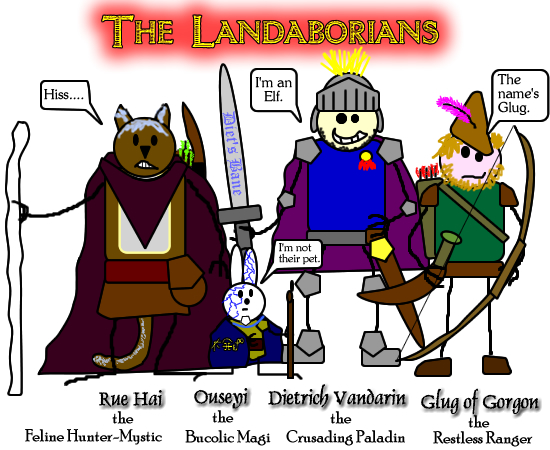
The first step in the creation of the game is done through each player thoroughly developing their character such as:
personality, skills, attributes, lifestory, history of the character's civilization/race, religion, magic, etc.
Whatever the player wishes to use in the game needs to be developed into the character and fully explained. (note: up to the character's knowledge - see below for more details on this) Such as how different spells work, what their religious beliefs are and how they affect/where they come from: could include Pantheon of Gods, symbols, etc. This also means assigning numerical values of some kind as to damage, range, etc. at least on a basic level so as to lend to playability. Once the characters' concepts are solidified the players then can decide on the parameters for the meeting of their characters.
The second step in this process is bringing the characters together into the world, where the adventure will be begin. The biggest dilemma with attempting to bring these characters together is that their characters' backgrounds, religious systems, magic systems, etc. will not match up, or even more so, might conflict. This is where the uniqueness of each idea and how they blend will come into play. The players will first need to decide what it is that will unite them and bring them together from these totally disjointed planes. This unifying principle is pivotal to keeping the players together, but also serves as the basis for the beginning of the epic journey. We recommend the characters meeting in a place that none of them know and so in that way they are all equal. This also allows for the creative process to extend beyond the initial creation because the world can become anything the Game Master and the characters make it. We also recommend that the unifying principle been unknown (the characters suddenly appear in a place having no idea why or how they got there) and at first will be something they must figure out for themselves as play goes on, which also could possibly change several times. As the game comes to a close maybe it will finaly all come together, but also possibly not.
As for the irregularities between the characters' backgrounds, if it is something that is perceived to be severe enough to not be able to be resolved then possibly something needs to be changed before game play starts, but it is generally encouraged that we let the discrepancies work themselves out through the adventure. Overall one thing is known: that these characters are coming together from entirely different places, which could overlap too, but more than anything else they are together and don't know where they are.
Logistics
Game Session
Some general game sessions logistics that we are concentrating on are:
1) Game Mastering is rotated from player to player each session. The player who is GMing will also play their character that session but must make an effort to play both the GM and their character independently. We could possibly implement some kind of restriction for that character when the player is GMing, like not being able to see things first, not gaining as much as experience as the others, possibly even having the other players mutually decide what experience benefits the GM's character gets.
2) Writing will be an intregal portion of this process, taking our experiences and turning them into a story. After each session one of the players will write the journal of what occured. This will then rotate from player to player to have varied perspectives in the telling of the story. Each player can decide which perspective they wish to narrate the events in, from their character, omnipresent, etc. Another variation would be for every player to write about each session and then try to compile them all together.
3) Sessions could be once a month for a couple of hours, less or more, as we wish. Because of physical locations on the globe they have to be conducted over the internet. I've looked into ways of doing this, there is a program downloadable for free from www.webrpg.com that has a nice format for playing. The problem with this is they now charge for connecting to their service. We've talked of using ICQ as the mode of communication and then each having our characters on our computers somehow ie. using that program, excel, whatever. ICQ would be a little more difficult, but would probably be the best way to start. Also we've talked about using minis and maps, etc. I personally think it might be better for game play and for our imaginations if we did not use them, but as we wish.
Character Creation
To create a character there definitely does need to be some kind of medium that we can use to keep track of the basics of the characters such attributes, skills, HP, etc. I recommend we use the Palladium model as the one we are all most famialar with. Also in melee round battles I suggest we use Palladium's system. This will give a base to work off when interacting within a session. If someone wants to make a variation on this I think its fine, but it just needs to be adequately explained.
Using the Palladium system will at least give us some where to start. There is another large issue that we have run into in our conversations about creating characters and GMing. You, the player, should develop your character's skills, magic, religion, only to the point of the actual character's knowledge. Because each player is creating their own universe per se for the character, it is tempting to design it completely knowing what exactly each step is and where it leads, such as with magic - developing every spell your character can discover, knowing every magic item, etc. This kind of development will lead to conflicts in game play as the GM takes your character somewhere you hadn't planned to go, such as suddenly you don't find that spell you planned on finding or it does something entirely different. This instead should be a joint product of both the player's development of the character and how the GM fits it into his sessions, the world he/she is creating. To resolve this the player should limit his development, but also the GM should be thoroughly knowledgable of the character's background and systems. The player can develop a direction the system could go such as possible results that the GM could work with but ultimately it's the GM's discretion as to what the character discovers and how he/she develops.
This is another integral part of the game: each player must have a thorough knowledge of their character as well as the other players. This will allow the creation process to go more smoothly as everyone can combine the pieces together. (one more side note: your character only knows so much too, he/she does not neccessarily know the history of the other characters, though you might)
Experience
Another way in which we would like to stray from more traditional RPGs is how experience points are given. The usual system of allocating points until a certain threshold is reached and then rewarding a new level is an unrealistic portrayal of reality, though it is easier to use.
We suggest instead using a system where the GM distributes experience more sporadically as the play progresses. This could take several forms such as character finding a new spell or god etc. in the middle of gameplay thus increasing their repertoire. Also after the character uses a skill many times he/she learns how to do it better. Another case would be in battle the character learns how to strike or parry better, thus gaining increases. This would reflect reality better as well as make more interesting gameplay as the players actively develop in the continuing game. The highs and lows will be more extreme.
On the drop side of this issue, it will much more difficult to use this system because it puts that much more pressure on the GM to keep the players moving. One way that this might be helped is for the players to scetch general structures of skill levels so that the GM knows generally how much to raise the characters abilities as they go along. It might help to keep things moving when its tough to know how much experience to distribute.
General Details
It would be helpful to us all if as we develop our characters to post the sketches to this webpage thus allowing us easy access to familiarize ourselves with each others characters as well as points of disagreement. We could then all meet online sometime and discuss ways we can improve them.
To maintain the balance in play we should all review each others characters before starting to both solidify the workings of the characters as well as lessen in-session disputes.
Any ideas please post here so we can all view. Thanks.
Write Suggestion View Suggestions
