

LaGremlin at the Harvard Museum of Natural History
Trilobites in Quincy?!
I must start with an observation that has been bothering me recently, but that has absolutely nothing to do with the main article. Here goes:
I am probably alone here, but I think a better and more accurate title for “Honey, I Shrunk The Kids!” would be “You Will Never Eat Cheerios Again.”
The sequel would have to be, “Well, You Will. But Only If Your Other Option Is, Like, Plain Oatmeal. And Even Then, You Will Be Severely Creeped Out In A Way That Is Very Hard To Verbalize.” OK kids, did you finish breakfast? Then let’s go to Harvard!
By far, the museums at Harvard University are the most underrated tourist attractions in the Boston area. They are just lovely. This article came about when I had to make a quick trip to Harvard Square (teacher-in-training stuff) and I decided, for the heck of it, to visit the Harvard Museum of Natural History.

Of all the Harvard museums, this one might be the most famous. There are hundreds and hundreds of things to see in here. For now, we are going to tour the Natural History Museum itself. (It’s unclear as to whether the Peabody Museum is part of the HMNH or not. I consider it one of the art museums. Next trip.) First, here is a photograph that I was probably not supposed to be taking of one of the famous Glass Flowers:
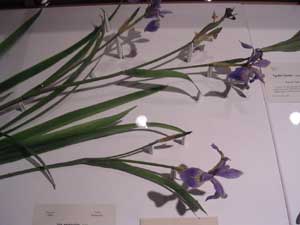
These pieces are unbelievable. This is a painstakingly accurate scientific model of an Iris made out of glass. They had a small display of how the artisans created these models and it must have taken a $#!^-load of time to do and an amount of patience that is totally alien to me.
I start with the Glass Flowers because they encapsulate something downright poignant about this museum: It is OLD. Some of the exhibits date back almost a hundred years or more. Several of the *models* on display are a hundred years old. Most of the animal displays use taxidermy, and it’s sad to see that some of the mounts are falling apart (check the stitches on their Rhino). And, inevitably, you see things like this:
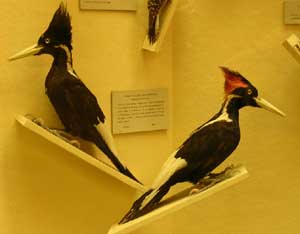
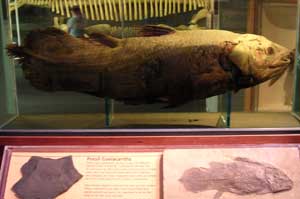
Yeah. Several exhibits have, inadvertently, become requiems for creatures that are now severely endangered or extinct. Needless to say, you have to keep the historical context of these exhibits in mind when you go. Just when I was starting to get bummed out, I saw this:
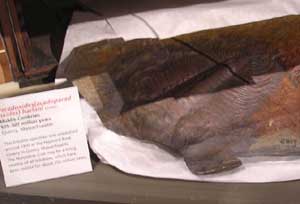
The card is a little hard to read in this photo, but it turns out that there were Trilobites in Quincy!!!
This little fellow is Paradoxides harlani. Similar to the Horseshoe Crabs that scurry about in our salt-marshes today, these creatures lived about 505,000,000 years ago towards the end of the Cambrian period. Back then, Quincy (which looked a lot more like Bikini Bottom at the time) was inhabited by a bunch of invertebrate sea creatures that looked like they might have been dreamt up by Dr. Seuss after severe head trauma. Indeed, from a geological perspective, Quincy spent much of history either underwater, under glaciers, or being recycled through a volcano. This is where we got our granite. And our friend here was found in a granite quarry. Trilobites survived for a very, very long time. Sadly, they became extinct around 300,000,000 years ago, right around the same time land vertebrates first evolved (coincidence?) There. Now you know more about these prehistoric sea creatures than you ever needed or wanted to. You’re welcome. Now let’s talk about some fossil animals you have actually heard of.
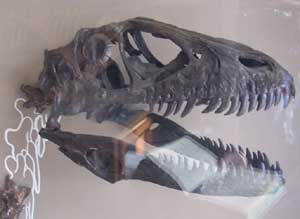
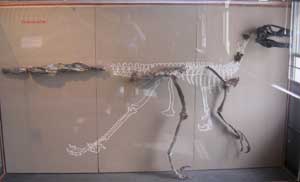
Throw up your talons if you [heart] Maniraptors. Meet specimen “MCZ 4371”, a Deinonychus antirrhopus. And if I’m not mistaken, this is one of the ’raptors who was described by Professor John Ostrom in the late 60’s, and who inspired him to say, “Woah… this here’s one KICK-ASS animal.” Before he wrote his report on 4371, people didn’t realize just how KICK-ASS Maniraptors were. It’s very likely because the only ’raptors found thus far back then were small animals and fossils whose hind talons were badly preserved. Imagine the only ’raptor you know about is cute lil’ Archaeopteryx lithographica… and then you find this. It’s also fairly obvious, when you stand next to this animal, that this is the “Jurassic Park” raptor. It’s still unclear whether Deinonycus was a larger “robust” subspecies of Velociraptor (which were generally much smaller and slimmer) or if these were two separate genre of animals. Like most of the exhibits, unfortunately there isn’t much information to confirm or deny the “famous” status of a specimen. That’s too bad. Don’t they understand that dinosaurs have fans too?
Now that we have reminded ourselves of just how totally sweet Maniraptors are, let us turn around, try to photograph around the other visitors and their reflections, and…
…It’s funny how I started this article by invoking the utterly unspeakable horror of the idea that someone could eat you without having to chew, isn’t it?
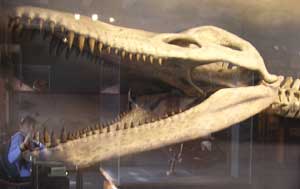
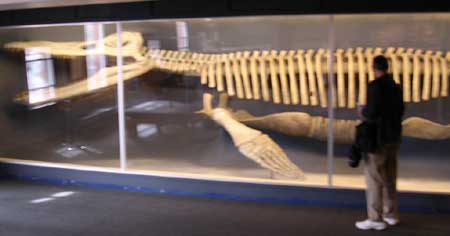
*whimper*
No, that’s it, just *whimper*
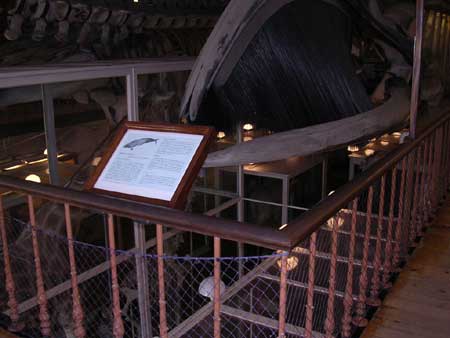
But the Kronosaur is typical of the scale that you’re dealing with here in the Museum of Comparative Zoology, as you can hardly see in this crappy picture. This is the main collection of animal specimens from all over the world, and although the hall is HUGE, it’s… dense. There is just enough space to walk around among the specimens. That picture was taken from the top of the scary balcony section (note the fishnet). I think it’s enough to document the fact that they fit three Whales in here and still found space for a Giraffe fully four times as tall as me.
Things I Learned At the Museum Today
* - Maniraptors: The more you think about them, the more they KICK ASS!
* - Pelycosaurs (primitive mammal-like-reptiles like Dimetrodon) were strange creatures.
* - Some beetles look like exquisite jewels.
* - There is something unsettling about stuffed apes.
* - Hummingbirds are just incredible creatures.
* - The pervasive scent of mothballs and industrial strength disinfectant will stop bothering you after about an hour.
* - Mouse Lemurs, the smallest primates of all, really are hardly bigger than mice. People, this is a hand-held monkey!!!
* - I can stay in one museum for almost five hours and still have a hard time leaving.
Related Links and Sources:
Here is the official website for Harvard Museum of Natural History, which includes quite a lot of information if you want to visit.
I got my Maniraptor information from Gregory S. Paul’s Predatory Dinosaurs of the World, which is simply one of the most beautifully illustrated animal books around… and which has inexplicably been long out of print. Until the publisher grows a brain and puts it back on the market, the Dinosauricon is a wealth of information for dino-fans and has many fine illustrations. For the wonderful geological history of Quincy, read this page on The Paleontology Portal, a bookmark-worthy resource that has every U.S. state’s geology and lets you search for fossil creatures by type, range, and historical period.
Finally, as if you needed more reasons to love the Internet, Trilobites have a fan-page and Coelacanths have a fan-page.
Special Disclaimer Thingy!
I am solely responsible for any inaccuracies in the preceding. Everything on this page that I did not think of myself is copyrighted to its owners and creators, none of which I am affiliated with, so no endorsement is intended. No libel is intended either, so please don't hurt me.
Yet Another
Reiteration: Any
movies, cartoons, songs and such mentioned herein are © their respective
owners, and no endorsement (or it's opposite for that matter) is intended
by the webmistress; with the possible exception of such cases in which she
says that said material either "Rules" or "Sucks". Even
so, she is NOT getting paid for it. >:P
Home | About
| Writings |
Cyberpets |
Collections
| Links | E-mail