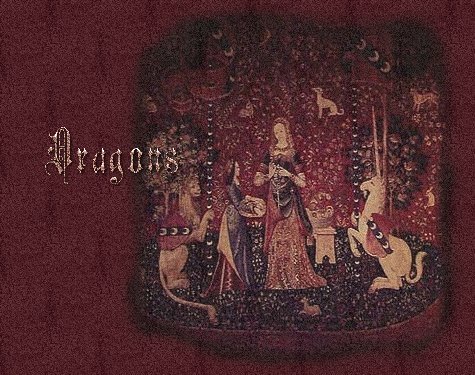
Poeticall Musick
- - English Renaissance music c. 1607
The Dragons Lair Adopted Guardian, "Pen"
Dragons are found in myth world wide.
The Chinese dragon being the most popular and prevelant in art.
Celestial dragons are found in the skies, carrying castles on
their backs. There are sea dragons, subterranean dragons,
and terrestrial ones.
The Chinese emporers even carried clawed dragon emblems on
their state's robes.
In early North America, a picture drawn by William Dennis
depicts a creature four feet high with wings....once painted
by indians, the Piasa Rock. (Piasa, meaning in Illini
language, bird that devours men.) By description, it
resembles a Chinese version of any written kind, of a dragon.
Some have heads of lizards, while others have heads of humans
other animals such as camels, lizards, and more. Horns of a stag, eyes
of a demon, necks resembling the curvature of a snake slithering,
whiskers and scales of a catfish or carp...coarse.
Some have horns, and ears.
The Anglo-Saxon origin, drakan, is probably Greek. Draco, meaning
serpent, snake-like. Perhaps a smiliarity of the verb, derkein,
meaning to see clearly. Or a combination of the three. Also
nicor, meaning beast from the water, or Icelandic word, nyker,
meaning sea goblin.
The dragon also came to be a symbol of many religions. Also
centuries earlier, dragons were a manifestation of terms of
different existences, a dream or fantasy world.
In history, the first known 'existence' of dragons was
as mothers of earth. One that comes to mind is in Denmark.
A bronze work of art, with a woman, and dragon inner-twined.
In India, legend and lore has serpent demons.
Slaying of such demons, dragons if you will, was part of
written cultures. Symbolisms of dragon like creatures can
be found and interpreted among many works. This too could
be picked out in the Bible, the serpent, Adam and Eve. Some
paintings and drawings have the serpent with Eve, with a
woman's face.
One published document, dating back to 1669, was written
about a "
Henham Dragon
". Entitled "The Flying Serpent
or Strange News of Essex". In the pamphlet, the creature is
described as nine feet long, small wings and curious eyes.
Its tail was pointed, and like an arrowhead. A tongue hanging
from its well-fanged mouth.
Dragon slayers? There are legends behind this subject too.
Most are commoners. Some are saints, and saintes. And, all were set out
to redeem themselves in one way or another. Others were
'hired' out to save a village from an evil beast. In either
case, epic stories evolved. Woman dragon slayers are few also.
St. Martha, and St. Margaret. Lest we not forget in earth.....
on earth, dragons being earth's energies. Slaying or taming
of such a beast may be a rekindling of sorts of mother earth.
Which now brings me to King Arthur and the legends of the
knights of the round table and their slayings of the beasts, dragons.
In lore, King Arthur's father is written as Uther Pendragon. The
surname, Pendragon, means head of a dragon. Tho one account
from Wales has Arthur depicted as a barbaric pig thief, the legend
and dragon lore from this era is fascinating.
A red dragon, a symbol of Somerset, Camelot.
And last, but not least, dragons and or serpents are symbolic
of the study, alchemy.
This text is a compilation of reading from
the book,
Dragons, Their History and Symbolism
by
J. Hoult �1978
Amad�n, in Irish, means April Fool
also note: resized to fit within the frame
*****FOR FURTHER READING & RESEARCH*****
Dragonsearch
Dragons Tempest
***BACK TO LADY IRENE'S WEBSITE***
Warrior Maiden's Pathway
Camelot Tour