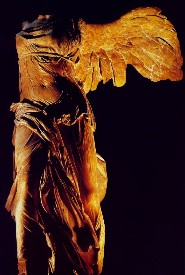
| The Nike of Samothrace |
 |
 |
 |
 |
 |
| Sculptures I |
| Home About me Art Sculptures Nike Articles Beauty Books Career Clubbing Fashion Fitness & health Food Magazine Music Language Photography Poetry Quiz't Contact |
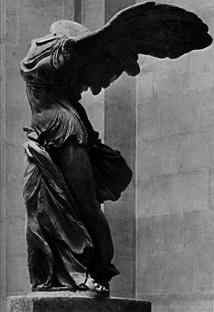
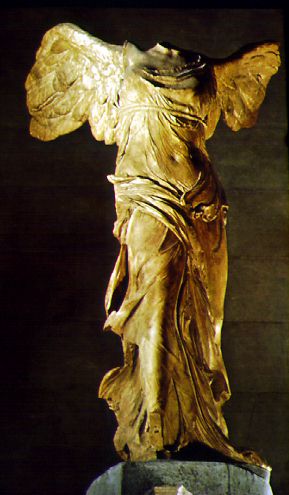
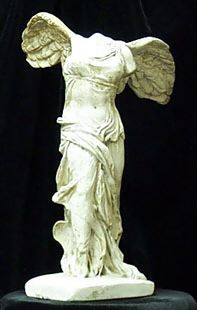
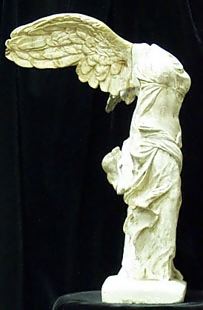
| Information about the sculpture: The famous Nike (Victory) of Samothrace. The Winged Victory, considered the finest extant Hellenistic Greek sculpture, portrays the goddess of victory alighting on a ship's prow, with her wings spread and her clinging garments rippling in the wind. The large 8 ft high marble figure, created by a Rhodian sculptor between 220 and 190 B.C., was discovered on the Aegean island of Samothrace in 1863 and immediately sent to the Louvre Museum in Paris, where it is displayed on the landing of the Daru Staircase. The statue's head and arms are missing. Nike is the goddess of victory in Greek Mythology. She is the daughter of the giant Pallas and the river Styx in Hesiod and she is sent to fight on the side of Zeus against the Titans. Athens did not appear to have a separate cult for Nike. At first she was inseparably connected and confounded with Pallas Athena, the dispenser of victory, but she is gradually separated from her. Both Athena and Zeus can be seen carrying small figures of Nike indicating that she is an attribute of both of them. Nike with Athena is always wingless while Nike as a separate goddess is always winged. Nike appears carrying a palm branch, wreath, or a caduceus of Hermes in works of art. She is also seen erecting a trophy or recording a victory on a shield. Frequently she is seen hovering with outspread wings over the victor in a competition. Nike gradually came to be recognized as a sort of mediator of success between gods and men not only in war but all sorts of human undertakings. Life was early associated with air because the need for air is so immediate. The birds flew in the air and were often associated with the spirit of life. Since a winged flight is associated with a victory over death it was easily associated with victory. Hense victory is associated with the winged goddess Nike. Nike is an aspect of Athena and is essentially an Athena with wings. Nike is not a subject of literature while she is a fairly common art subject. The most famous is the Nike of Samothrace in the Louvre. Some of the other images are as follows: � Flying Nike � Athens, Temple of Athena Nike � Nike holding phiale and oinochoe � Nike with oinochoe � Winged Nike � Flying Nike � Snub-nosed Nike � Nike, thymiaterion � Nike of Paionios Hesiod wrote this about Nike: "(ll. 383-403) And Styx the daughter of Ocean was joined to Pallas and bare Zelus (Emulation) and trim-ankled Nike (Victory) in the house. Also she brought forth Cratos (Strength) and Bia (Force), wonderful children. These have no house apart from Zeus, nor any dwelling nor path except that wherein God leads them, but they dwell always with Zeus the loud-thunderer. For so did Styx the deathless daughter of Ocean plan on that day when the Olympian Lightener called all the deathless gods to great Olympus, and said that whosoever of the gods would fight with him against the Titans, he would not cast him out from his rights, but each should have the office which he had before amongst the deathless gods. And he declared that he who was without office and rights as is just. So deathless Styx came first to Olympus with her children through the wit of her dear father. And Zeus honoured her, and gave her very great gifts, for her he appointed to be the great oath of the gods, and her children to live with him always. And as he promised, so he performed fully unto them all." Nike was a common visual art subject, but absent from the literary arts. Nike could be considered an aspect of Athena. She is represented in art as winged and as carrying a wreath and a palm branch. The Louvre in Paris has 2 images of Nike. The Acropolis Museum in Athens has an image of a young Nike, with wings outstreached, bending and adjusting her sandal. This work called 'The Relief parapet from the Nike Temple.' |
| About Nike, the godess of victory: |
| Nike mainly celebrated victory. Her most important victory celebration was the victory of the Greeks over the Persians in 480 BC. NIKE sat on top of Mt. Olympus with Zeus.This means that Nike was a goddess. All the gods and goddesses do this. Nike's daily chores include bathing in a mountain spring with a waterfall probably came first. Dressing came next. Imperishable gowns woven by Athena and washed by Nymphs at play would be layed out. She had handmaids (nymphs) to arrange her hair. She spent her morning studying the possibility of victories by men and women. Her big meal was abrunch which consisted of ambrosia and nectar and any other delicacies that the nymphs could devise. Her afternoon was spent celebrating the victories of the world. She would flit from victory to victory with her wreaths and vases in hand. Another meal of ambrosia, nectar, fruits and nuts would end her day. Often she would eat with some of the other deities. She would then put on her nightgown. The nymphs would pull her gossamer curtains around her and she would sink into dreamland on a bed laid with down pillowsThe most interesting aspects of Nike's life were the celebrations she organized to celebrate the great military victories of the Ancient Greeks. The most famous was the battle of Salamis because the coalition of Greek city-states had done the incredible. They had defended their homeland and their independence from the strongest power in the world. They had decided to unite in their defense even though the Persians had made generous promises. They knew they had a big challenge so they went to the Delphic oracle who had declared that they defend themselves behind walls of wood. ince Athens was a fortified city with stone walls, this set the people to thinking. They abandoned their city and left the fighting to the wooden ships of the Athenian navy. In spite of being greatly outnumbered the Athenians were victorious and Nike was estatic. Myths about Nike: When someone prepares an altar for her with a bright flame, she will fly down and pour a libation upon it. This is a sign of an upcoming victory. Sometimes she carries proper equipment right to the site of victory so the gods can be properly celebrated for one should not be so proud as to forget the contribution of the gods in any victory. Nike wanted to encourage the proper humility. Hera was a goddess which Nike felt was worthy of respect. She also felt that dancing was a suitable activity to celebrate a victory. She often carried insense to the site of the victory so the victor could be purified. When there was a victory she was particularly interested in announcing it to youths who might be inspired to future deeds. Even personal beauty might be a victory if achieved. Nike was a virgin goddess born of Pallas and Styx. Many artistssculpted images of Nike including Phidias. The Nike of Paionios is 1.98 meter high. A goddess normally stood a head higher than a mortal. All deities were limited by right and fate and they were limited to their own unique realm, which in the case of Nike was the celebration of victory. Her interests were in her realm, the celebration of victory. All goddesses were interested in their appearance, also. Victory was sacred to her. A number of temples were built for her. She was born in the normal way from her mother's womb and nursed by her mother Styx in the palace of Zeus. Both her mother and father oversaw her education. Every goddess had a special realm in which they operated and hers was the celebration of victory. The ancient Greeks believed she was a real goddess. Nike often appears headless, however she was not decapitated in ancient Greek times. During the Roman period many new religions swept through Greece, including Christianity. Some of the religions, such as Christianity did not respect the old religion and the statues of the ancient Greek deities were pulled down and dumped in a rubbish heap. Often statues lost their heads and arms with this rough treatment. Other statues were damaged by the excesses of invading armies. Nike was a favorite of many of the deities who often invited her to their festive events. All the Greek deities are related. For the Greeks, the goddess of Victory (Nike) was abeautiful young woman endowed with wings. This exceptional monument, raised upon the isle of Samothrace, set in a niche overlooking the sanctuary of the Great Gods, celebrates success at sea. The goddess stands on the prow of a galley, resisting the gusty storm, her right arm undoubtedly held high. It was an ex-voto of the Rhodians for a victory won at the beginning of the 2nd century BC: the attitude and the animated draping prefigure the reliefs for the altar of Pergamum." < the Louvre, Paris, France> Nike was a lesser goddess, but she had higher status than many. Some of the lesser goddesses had to serve the higher ones. Nike served no one, but she had goddesses that served her. Each goddess had a special realm. Nike's realm was the celebration of Victory. No other goddess could do this. All goddesses are immortal and have the gift of prophesy. They also can move through the air and change their shape. The typical goddess stood a full head higher than the average Greek warrior. Nike was worshipped from about 800 BCE to about 125 AD in Greece. There were many famous things that happened during this period, but the most famous thing was the defeat of Persia by the Greeks against overwhelming odds. Eventually Alexander conquered all of Persia and an enormous part of the rest of the world. Nike is an immortal and will never die. Hesiod, The Theogany,(ll. 383-403) And Styx the daughter of Ocean was joined to Pallas and bare Zelus (Emulation) and trim-ankled Nike (Victory) in the house. Also she brought forth Cratos (Strength) and Bia (Force), wonderful children. These have no house apart from Zeus, nor any dwelling nor path except that wherein God leads them, but they dwell always with Zeus the loud-thunderer. For so did Styx the deathless daughter of Ocean plan on that day when the Olympian Lightener called all the deathless gods to great Olympus, and said that whosoever of the gods would fight with him against the Titans, he would not cast him out from his rights, but each should have the office which he had before amongst the deathless gods. And he declared that he who was without office and rights as is just. So deathless Styx came first to Olympus with her children through the wit of her dear father. And Zeus honoured her, and gave her very great gifts, for her he appointed to be the great oath of the gods, and her children to live with him always. And as he promised, so he performed fully unto them all. This quote lists the siblings of Nike. Cousins would be too numerous to mention because Ocean had over 3000 daughters. All Greek goddesses can move through the air and have the ability to change their shape if they want. If they want to appear with wings they can. But some goddesses are more inclined to appear with wings because at one time they were associated with birds. This is expecially true of Athena who, in the time before history, was a bird goddess. In some of the images of Athena her aegis looks like a wing. Also in the time before history Nike and Athena were regarded as one goddess. Except for the fact that Athena is a virgin goddess, Nike would be the daughter of Athena. The fact that Athena was once a bird goddess allowed Nike to have wings when she separated from Athena. Poetically this works because victory is often compared to a soaring flight. Nike is an immortal goddess who was born after the creation of the earth and is still alive today. Some major events in her life: � Battle of the Titans. � The Trojan War (1194-1183? BCE). � Defeat of the Persians by the Greeks(490 BCE) � Second Defeat of the Persians by the Greeks (479 BCE) � The First Peloponnesian War (460 - 446 BCE) � The Ascension of Alexander the Great(336 BCE). Her victory wreath is a branch of olive leaves bent into a circle. The musical instruments Nike plays are a lyre or a reeded flute. |