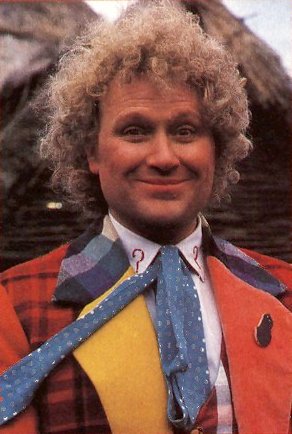
The 44 episodes that constituted the TV era of the 6th Doctor (46 if you include the last episode of The Caves of Androzani and the faked regeneration sequence in the first episode of Time and The Rani) were effectively only a brief taste of a well conceived and executed character. The 6th Doctor was formulated to take the show back to its roots in that The Doctor was to once more be the irritable, partly inaccessible Time Lord with a heart of gold that William Hartnell had first established so well. The last three TV Doctors had the unenviable task of trying to overcome the problems caused by Tom Baker's tenure. Tom Baker's seven year stint did irreparable damage to the show and his own career as he was to remain fixed as the Doctor and only as the Doctor forever more. The range of Target novelisations eventually had to feature Tom's face on every cover in order to sell, resulting in the anomaly of the 4th Doctor's face for example gracing the cover of Doctor Who and The Zarbi - actually based on The Web Planet which was a 1st Doctor adventure! Tom's interpretation was brilliant (particularly in the first four seasons when he was still acting and not just playing himself) but went on for far too long. He wasn't an impossible act to follow, its just that while the public grew tired of him, they still refused to let him go. Tom's era also just happened to coincide with the greatest production era (namely Hinchcliffe/Holmes) that produced some of the best stories. Perhaps if Tom had only himself stayed in the part for three years, and started his run with such a mediocre story as Robot, then been given a season stinkers consisting of The Invisible Enemy, Underworld, The Invasion of Time, Destiny of the Daleks, Nightmare of Eden and The Horns of Rimon to work with and then had a splendid season such as number 13 cancelled (so we had never seen The Pyramids of Mars and the like!) only to return to do a very short, low-budget, interlinked season that always fatigues the viewers which might have included the stories The Ark in Space (okay), The Sontaran Experiment (shocking), Genesis of The Daleks (okay) and Revenge of The Cybermen (bloody shocking), and I think we probably would have all pretty much forgotten about Tom Baker by now!
Certainly the most unappreciated performance has been that of Colin Baker. I would argue that of the last three TV Doctors, Colin provided the best interpretation of the character on many levels. When Colin entered the role the production team of Nathan-Turner/Saward was in full swing. Following the awful Williams/Reid or Adams years, Nathan-Turner pulled the show screaming and kicking into the 80's. From the very start of Tom Baker's final year everything improved. Davison's Doctor was charming but restrained. Colin Baker's Doctor was like a breath of fresh air and for a year or so it seemed that Nathan-Turner was enjoying a creative second wind. The spoofs of the time (i.e.. those featured on Victoria Wood and Lenny Henry's shows) began to imply a growing awareness that the 6th Doctor was a more recognizable, tangible target for satire than his predecessor both in relation to his behavior and costume. There was a lot of substance there for a comic to get their teeth into when it came to the new Doctor! This was to stall after the hiatus (as seen in French and Saunders' abandoned Who sketch in the eighties - the popular imagination had been jolted back to the more simplistic and predictable safety of Tom Baker's enduring image). Season 22 was by far the best season, creatively, since number 18.
Throughout the broadcast of Season 22 however, there had been complaints about a perceived increase in the level of violence in the show. This was used by the BBC as the official excuse to cancel it. It was also argued at the time that while creatively it needed a rest, the ratings were disappointing and the BBC also needed to save money. While obviously not enjoying the level of popularity experienced during Tom Baker's peak (about 10 million viewers a week), the ratings for Colin's season 22 had been very respectable, hovering around 7.12 million. During Tom Baker's last season the ratings for the show were only around 5 million on average. The show had therefore actually been enjoying a resurgence in popularity - something often overlooked by the historical revisionists. At the very least, the last point concerning money was clearly a fallacy, as the show made much more than it cost to make; so it would be more accurate to say that it was cancelled to divert money away to other mostly forgotten rubbish like Eastenders. The only criticism that seems to have stuck has been that of the show becoming overtly violent. I have watched Season 22 many times and the only truly inappropriate scene I can find is when the character Lyton's hands are crushed to a bloody pulp in episode 2 of Attack of the Cybermen. That was an oversight on the part of the production team but no worse than the infamous drowning scene in The Deadly Assassin under Hinchcliffe or the scissors scene in Edge of Destruction under the great Verity Lambert. The acid bath scene in Vengeance on Varos has become a sort of urban myth - easy to debunk but annoyingly enduring! It is almost as if people actually believe the show was glorifying violence! Even as a 12 year old watching it I could understand that it had an anti-video nasty theme. I'm afraid the moral minority had never liked Doctor Who full stop. Mary Whitehouse and her like despised any form of entertainment that dared to be thoughtful. Doctor Who was never a children's show it was a FAMILY show! There is a difference. A family show can be taken on many different levels, just like the American series Star Trek. But while Star Trek and its imitators explored more universal themes the focus of Who was more personal dealing more with ethics and the empowerment of the exploited and such issues - subjects any ruling elite finds irresistible to target. I find it interesting that probably the best WHO producers of all Hinchcliffe and Nathan-Turner were constant victims of this kind of attempted censorship and thought control.
But was there something more sinister to the cancellation? It is interesting to note that on the day the show was cancelled, it was revealed that the BBC had paid 500,000 pounds for Kane and Abel an American mini-series it hadn't viewed and on which the new BBC1 Controller Michael Grade had a credit as executive producer! Doctor Who clearly had its enemies in the BBC hierarchy:
I'm sure that Jonathan Powell (then Head of Series and Serials) hated the show. He was always very hostile to us at playbacks. Very indifferent, whether the show was good or bad. It seemed he'd really decided that he didn't like us. I think it was entirely his decision. I don't think that Michael Grade (then BBC1 Controller) cared one way or the other. - Eric Saward (quoted in The Handbook: The Sixth Doctor by Howe-Stammers-Walker, 1993, p. 205).
But it seems that Grade and not Powell might have been the true villain of the moment. A recent interview with former Production Assistant Gary Downie published in Doctor Who Magazine, has revealed that there was a history of animosity between Grade and Baker. It seems Michael Grade had a personal vendetta against Colin Baker:
There's a history between Michael Grade and Colin. (Actress) Liza Goddard was Colin's wife. And she was Michael Grade's best friend. The divorce was acrimonious and she moved into Michael Grade's house while she was getting over the divorce. And I'll say no more. Michael Grade was determined. He did not want Colin working for the BBC. - Gary Downie (quoted in Doctor Who Magazine #338, January 7 2004, Marvel Comics, p.15).
But there was also another ruthless and arbitrary aspect to Grade's agenda. Downie describes Grade as an arrogant man and accuses him of playing politics with Doctor Who. Placing the show against Coronation Street following Colin's departure eventually killed it in a ratings sense. Why did he do it? Downie explains:
He had fallen out with ITV and was determined to hit their viewing figures hard. And Doctor Who did that. Their viewing figures took a dive. Michael Grade used Doctor Who to get back at ITV... The reason he picks on Doctor Who is that it gives him 'street cred'. It gets him in the news, it's controversial - Gary Downie (Same Source, p.16).
It is clear that there was more to the cancellation than just violence, ratings and money!
The damage having been done for whatever reason, and an 18 month hiatus endured, the show returned, albeit with a much reduced episode rate and budget. It only returned to due to the massive national and international back lash:
Originally it was the axe, it was coming off! Grade back-tracked very swiftly when he found out the reaction was as strong as it was, and it turned into a suspension, which was the only way he could get it back without losing too much face, I suppose. - Colin Baker, (quoted in The Handbook: The Sixth Doctor by Howe-Stammers-Walker, 1993, pp. 204-205).
One can almost sense the broken spirit as the revamped theme for the Trial series begins. The music like the show itself had been watered down! Colin Baker to his credit never allowed it to affect his performance. Very few instructions were issued to John Nathan-Turner in a short interview with his superiors, instructing him to minimize the violence and inject more humor. A task that hardly warranted an 18 month break! Sadly it has been Colin Baker who has carried the blame for the problems with the series at the time. First impressions count and he was originally seen as a violent, raving lunatic in The Twin Dilemma. Colin had to contend with a lingering distrust of his portrayal - the image of him throttling Nicola Bryant having imprinted itself on the national and international consciousness. This had been a rather brave production decision and therefore out of his control. All kinds of rubbish has been bandied from claims that he couldn't act to the extreme of blaming him for the actual cancellation of the series.
To someone who's not even slightly interested in Doctor Who, it reads: "Colin Baker's taken over the post. Oh, yeah, now they've taken it off..." The two things are linked together subconsciously in people's minds, and I don't like to be associated with that kind of failure! - Colin Baker (Same Source, p. 40).
The BBC showed some confidence in Colin as he made another whole season of Doctor Who before being unceremoniously fired! The real reason of course was ratings. But as Colin Baker later stated it increasingly became impossible to maintain, let alone increase, the popularity of the show for some very simple reasons: its format was changed arguably for the worse for his first full season, the scheduling was often less than kind, after the hiatus it returned with a much reduced number of episodes which meant it was still out of the public eye more often than not and even the format of season 23 was almost tailor made to fatigue even the die-hard fans. It is now recognized that ratings figures were actually grossly inaccurate during the mid-eighties as the new practice of video taping favorite shows - particularly on Saturdays - were not taken into consideration. It is very likely the ratings for both seasons 22 and 23 were really much higher than what was recorded. But Colin Baker was told he was to leave in order to give the show a "lift" and he was also told that three years was considered to be the optimum period in the role (despite the fact they'd only been shooting for half that time!). Please note that Sylvester McCoy seemed set to play the Doctor for a fourth season before the entire show was slyly shelved once and for all... oh, I mean rested...
While Sylvester McCoy was a talented successor, his 42 episode era was to prove that the true problem with the show in its last three years on television was that Nathan-Turner had creatively grown stale and needed to be replaced. It seems ridiculous that Colin wanted to stay and was fired while John wanted to leave and was made to stay. In some ways I'm glad Colin Baker did not make such turkeys as Time and The Rani (yawn) or Paradise Towers (yuk!), although if he had been granted his wish to play the Doctor for another season Dragonfire by promising Ian Briggs (who later wrote The Curse of Fenric) might not have been such a bad finale. Often when I'm watching episodes from the McCoy era I wonder if at times the production team was not trying to make it as bad as possible. The public backlash over the initial cancellation may have given the BBC no choice but to run the program into the ground to get rid of it. The only way to kill it may have been to make it unwatchable as I eventually found it to be myself in my late teens. However there are the odd sparks of brilliance and to assert such conspiracy theories may be more than a little unfair. When you consider that a whole season of Who during this time was made with less money than it took to record a single later episode of Red Dwarf, many things come into perspective.
Historical revisionism took full advantage of the prevailing 'blame the victim mentality' in society and Colin Baker's era has been almost universally vilified from every angle since his dismissal. Colin was even vilified for not returning to film a regeneration sequence! Colin Baker explained in The Colin Baker Years that it was both financially and professionally impossible to hold on for 6 months just to film a ten minute regeneration sequence. The BBC's version of events is that they offered him the first four episodes of Season 24 to explain his regeneration. Both cannot be correct and I suspect that this is just one example of the Beeb putting a spin on the whole issue in order to down-play their mistreatment of Colin. However in the very recent past with the end of the 7th Doctor's era and the advent of the 8th Doctor's era, a more truthful atmosphere has evolved. Many who were critical of the 6th Doctor have recently admitted to reevaluating their judgment. Colin has been the most successful who actor in the Big Finish audio series, claiming himself that its the same Doctor with better scripts! Perhaps it points to the fact that the character of the 6th Doctor was ahead of its time in many respects and had the show not been cancelled in 1985, we might now be looking back on season 22 and others that sadly never were, with a more universal sense of nostalgia... makes one think... doesn't it...?