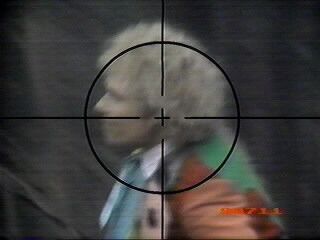
If there is one word that captures the essence of the character of the 6th Doctor it is controversial. Follow this link to The Doctor Who Ratings Guide and take note of how many reviews there are of Colin Baker's interpretation as opposed to the others and how much they vary! Like all the Doctors he made the journey from an extreme caricature of himself to that of a more settled, mellow version over the course of his tenure. He was proud, verbose, abrupt, eccentric and at times callous but he was also heroic, noble and a born iconoclast.
The Doctor we meet at the beginning of The Twin Dilemma is not the same Doctor we know by the end of the story. It has long been recognised that it was a mistake to introduce the 6th Doctor as a deranged maniac as many were unable to let go of the image of him attempting to strangle his companion. While he remained at times unpleasant, the Doctor's morality could not be questioned. His chastisement of The Rani in The Mark of The Rani attests to this as he debunks her grim philosophy of being. His speech to Drathro in The Mysterious Planet, explaining why organic life is important indicates the consistency of this morality. As he explains to Peri in the same story, he can't allow innocent people to die if he can save them. Still the initial impression continues to linger as epitomised by the recent story Trapped! by Joseph Lidster in the Short Trips: Monsters anthology (2004) wherein the 6th Doctor actually decapitates someone and fears he is turning into a monster.
If the 6th Doctor has a central failing (aside from his rather lacklustre interpersonal skills and dress sense - actually I always thought his costume was great but then again I'm colour blind!) it is his callous (i.e. alien) reaction to the death of his adversaries. As Colin Baker insists in the audio commentary of Vengeance on Varos, that was a conscious production decision in keeping with his more alien persona. He turns to the dissolving guards in the acid bath and declares: "Forgive me if I don't join you". In The Two Doctors after killing Shockeye with cyanide (not ignoring the fact he had recently killed and eaten an old woman, had just been in the process of dissecting Jamie alive and at the very least intended to kill the Doctor with his sword) the Doctor remarks: "Your just desserts!" However in the same story he openly mourns Oscar's death - quoting Shakespeare in a very sensitive way. It's just clear he doesn't have a lot of pity for murders and psychopaths. After Orcini blasts Davros' hand off, the Doctor playfully offers his own in a fake gesture and comments: "No arm done!" This aspect had all but vanished by The Trial of a Time Lord and after being forced to wipe out the Vervoids in order to save humanity, the Doctor looks remorseful. But perhaps it is because he knows that the Vervoids have just been following their instincts and are not truly evil in the pure sense of the word, although their actions appear that way to us. There is certainly no admission such as The 5th Doctor made at the end of Warriors of the Deep: "There should have been another way!" The 6th Doctor just isn't the type to openly wear his heart on his admittedly gaudy sleeve!
Many voices raised against the character of the 6th Doctor point to differences between him and the other Doctors. How fair is that? It seems clear to me that he was continually acting by virtue of a strong moral impulse [rather than continuously playing god with time or forcing his companion to face her darkest fears (ie. Ghost Light) like The 7th Doctor]. It has been suggested that in Vengeance on Varos during the scene where Peri is being converted into a bird, the Doctor displays a fascination with the process and at first does not attempt to stop it (The Handbook: The Sixth Doctor, Howe-Stammers-Walker, 1993, pp. 496-497). In reality his first reaction is to shout "What!" His voice betrays his concern. He prevents Jondar from throwing away his life in a useless gesture of resistance. Quillam declares the experiment has gone too far. When he is viewing the experiment it is with deep concentration as he is trying to think of a way to save Peri and Etta. He demands the machine be turned off. Then he provides the distraction needed for Jondar to seize a weapon. The Doctor then uncomfortably attempts to force Quillam to cooperate at gunpoint (no worse than The 5th Doctor holding a gun to protect himself and his friends from a loose Kaled mutant in Resurrection of the Daleks - and unlike the Doctor in that story who had finally decided that Davros needed to be 'put down', the 6th Doctor had no real intention of using the weapon to kill). He doesn't shoot him but the machine instead. Shortly later he prevents Jondor from killing a guard, saving yet another life. In fact he's continuously saving lives throughout the entire adventure just like any other Doctor. The Doctor actually refuses to even take a gun in The Mark of The Rani joking he has given them up as they can seriously damage your health! So much for Doctor Wholigan!
Lets look back at the behaviour of one of the earlier Doctors then and place him on trial for a moment. Paul Shaw (Data Extract 162 July/August 2002, p. 8) clearly lists some of his more questionable behaviour: he calmly causes the death of Styre in The Sontaran Experiment, blows up the Zygons in their ship in Terror of the Zygons, uses cyanide on Solon in The Brain of Morbius, snaps a neck in The Seeds of Doom, brings about the molecular disintegration of Greel in The Talons of Weng-Chiang, deliberately masterminds the death of Taren Capel by altering his voice in The Robots of Death. All were acts of premeditated murder but given the circumstances and the nature of the victims, perfectly understandable. The Doctor Wholigan tag often applied to the 6th Doctor and coined I believe by Antony Howe, seems a mite unfair when placed in proper context. Of The early 4th Doctor, Paul Shaw concludes: "...he snaps and snarls, beats up people in The Seeds of Doom, lays into Goth with a big stick (The Deadly Assassin), coldly flicks a flesh eating Horda onto someone's shoulder (The Face of Evil) etc. etc. ... Tom is praised for this, Colin is damned. I've never understood why..." As the 6th Doctor himself professes during his trial he resorts to violence only in self-defence. That can probably be qualified as all the Doctors at times also acted violently in the defence of the defenceless. The 4th Doctor shoots down a Rutan ship at the end of The Horror of Fang Rock and declares: "That'll teach them!" He also claims the universe won't miss the Jagaroth and engineers their final extinction in City of Death. At least the 6th Doctor didn't send off the hand of Omega to obliterate Skaro (i.e.. Remembrance of the Daleks). One would hope that The 7th Doctor knew that is was clear of Thals. But then again, didn't even the 4th Doctor think that Dalek life counted as well in Genesis of the Daleks when given the opportunity to abort their evolution?
Probably the most misunderstood of all Colin Baker's stories was Vengeance on Varos. It seems to epitomise the degree to which the use of violence in the program at that time has been distorted. Antony Howe (A Voyage Through 25 Years of Doctor Who, December 1988) claimed that while it was an attempt at social criticism of video nasties, its over-exploitation of violence turned it into one. Paul Corrigan (Data Extract 161, May/June 2002, pp. 10-11) has more recently maintained that it was the lunatic behaviour of the 6th Doctor that resulted in two deaths in the notorious acid-bath scene and that he deliberately engineers the deaths of four Varosians in a way that equates with premeditated murder.
Closer inspection of the story on DVD reveals that both opinions are flawed. There is no gore in Vengeance on Varos, only the suggestion of it and the traditional fantastical violence involving fictional death rays etc. For example when Jason Connery's character Jondar is being tortured, it is simply a ray of light shinning or super-imposed onto his torso. I don't see how that even compares with the infamous drowning scene in The Deadly Assassin, which is actual physical violence and easily imitated by the impressionable.
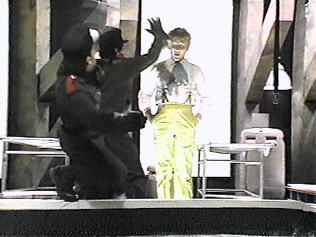
The acid-bath scene is less than a storm in a tea cup and more a sort of black-out in a police box! What actually happens is that the Doctor recovers and then in an inoffensive manner, taps one of the guards on the shoulder. They believed he was dead and perhaps surprise causes one to fall into the pool (into which they were about to tip the body of the Doctor). The remaining guard then tries to force the Doctor into the pool alive and is eventually pulled in by his dying comrade. Look at the picture above... where are the Doctor's hands?
Like all Doctors, when pressed and given no other choice, the 6th Doctor would act to protect innocent and even not-so- innocent lives. People forget that when the Doctor saves the lives of Peri, Jondar, Etta and himself by causing the death of Quillam and his henchmen, Quillam has just told them what he has planned: "I want to hear their screams till I'm deaf with pleasure. See Their limbs twist in excruciating agony. Ultimately their blood will gush and flow along the gutters of Varos. The whole planet will delight in their torture and death." By utilising the vines, the Doctor is merely defending himself and his charges against the worst kind of psychopathic scum.
The other stories from season 22 - which has come to be known as the video nasty season in some circles - have not been devoid of criticism. The most distorted scene in Attack of the Cybermen is the moment the 6th Doctor shoots The Cyber Controller. He was actually trying to rescue Lytton and when discovered, he was attacked. Look at the picture below, The Cyber Controller isn't wandering over to give him a warm bear hug! I've actually read very little about the scene which I believe did cross the line that is where Lytton has his hands crushed to a bloody pulp by the Cybermen. It was actually even included in Timeframe by David J. Howe as one of the selected magic moments of the series! I feel that blood has no place in Doctor Who and all injuries should be internal and caused by fantastical weapons that children will simply imitate with sounds. Ooze running out of corpses and the like was a trademark of the 5th Doctor's era and was actually a very good substitute and retained for the death of Mestor in The Twin Dilemma. Having said this, it must be noted that the 6th Doctor was not present in the aforementioned scene and I feel the scene was an attempt to reinforce the ruthlessness of the Cybermen as a race.
The Mark of The Rani features people being transformed into trees which is more laughable than graphic. It is all done in puffs of smoke of course and there isn't even time for the traditional scream. Despite popular belief, The Two Doctors does not feature any cannibalism at all. Shockeye is an alien. I think some people need to look up the definition of cannibalism in the dictionary, you definitely have to belong to the same species as your meal for it to qualify as such. In Timelash the Doctor merely reflects The Borad's beam back onto him, causing his clone as it turned out, to age to death. At the end of the story the Doctor felt his exile to 12th Century Scotland was a just punishment - not death! Cannibalism on a mass scale is referred to in Revelation of the Daleks, much to the disgust of the Doctor and Orcini. Davros has in fact been financing his experiments into producing Dalek/human hybrids by selling the remains of those interred on Necros in the form of a concentrated protein to starving human colonies. Its a disgusting thought but its meant to be: Davros is evil. Evil people do a lot more than point their finger and shout boo! He had his own people wiped out in Genesis of the Daleks because it suited his purposes. Its remarkable the difference a large alien in a kilt licking his lips over humanity can make isn't it!
I think there have always been a number of people who have simply disliked Colin's portrayal and have used a few little production mistakes and the political cancellation of the show to slander his interpretation and his stories. Particularly in his first full season, he played the Doctor as a tough hero, just as Tom did during his peak. I feel many of the Tom-devotees felt threatened by this attempt to 'out-Baker Baker' in a sense. Davison was entertaining but safe as his was more a very subtle performance in the vein of Troughton and later McCoy and therefore wasn't an obvious threat to their idol. The more eccentric qualities of the 6th Doctor were in part derived from the 4th Doctor in the same way that the irritable, sometimes selfish and egotistical traits were drawn from the 1st Doctor, and his more physically heroic nature was perhaps derived from the 3rd Doctor and so on. This is one of the reasons why I feel Colin made such a good Doctor as he did blend so many elements of his predecessors but left room enough for him to inject a few unique traits.
In conclusion I must say that the degree of violence during Colin Baker's tenure has been exaggerated. In fact compared to some other seasons, I have found season 22 it to be rather mild. The 6th Doctor will of course continue to be the most controversial Doctor of all, which is sad because I suspect given time his popularity would have eventually rivalled that of Tom Baker. Much of the criticism of the 6th Doctor's era I think has been born out of a resentment of Colin's interpretation of the character which above all needed time to mature and grow on his audience. It is fitting to note that he was recently voted most popular Doctor in a DWM poll - a long overdue endorsement of a character who was certainly the best Doctor of the eighties, if not of all.