
A Penang based taekwon-do body for GTF, ITF and WTF practitioners
HQ Address: 33A Jalan Tembikai, 14000 Bukit Mertajam, Pulau Pinang, Malaysia
Library ; Black Belt Club ; E-Commerce ; Pattern
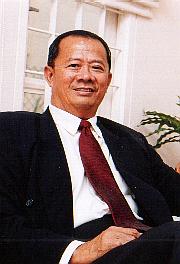
know how taekwon-do developed to its present glory.Should anyone feel that I have erred and
what has been written need to be corrected, I welcome your comments & suggestions.
Master Choong Teck Hong
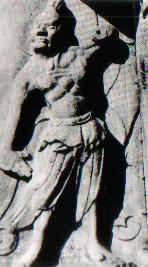
Ancient murals and statues have shown that taekyon, the ancient Korean art of foot-fighting existed as far back as the 1st. century B.C. Historical evidence in the form of pictures and statues showed the existence of a form of fighting in Korea, resembling the legendary taekyon. Mural paintings at Kak-je tomb, during the 10th.king of Koguryo, shows sparring similar to contestants performing the jumping kicks of taekwon-do. Other than statues and murals; there was no documentation to substantiate the existence until the 7th. century when there was evidence of the existence of the division of Korea into 3 kingdoms.
Korean historian Dr. Danjae Shin Chae Ho described the contests of the art of Soo Bak Gi or Taekyon- the ancient art of foot-fighting during the mid autumn festivals in Korea during the Koguryo Dynasty ( A.D. 500 ).
In another study Dr. An Ja San corraborated the study, further stating that the Yoo Sul School of martial arts was known as Soo Bak Gi ( Taekyon ) in his book on ancient Korea.
Historical documents documented that the third king of the Yi Dynasty ( 1401-1408 A.D.) recruited experts in Soo Bak Gi and sirum ( Korean style of wrestling ) in his army.
According to Mr. Song Duk Ki - a veteran of taekyon, by the end of the Yi dynasty ( 1393 - 1910 ), the art of taekyon has developed. After the Yi Dynasty, during the Japanese occupation various martial arts were introduced into Korea from Japan and China , enabaling the merging of taekyon with these arts, thus the emergence of Tang Soo, Kong Soo, Kwon Po and Tae Soo which are fore-runners of modern taekwon-do.
the statue and the; present taekwon-do form.
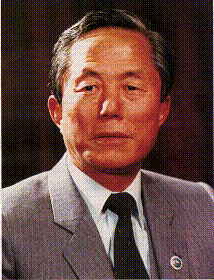
After World War II and the Japanese occupation there was a new resurgence of martial arts in Korea. This saw the emergence of various schools of martial arts or kwans. Styles were varied with each teacher teaching their own versions of martial arts. The major kwans during that time were:
Chung Do Kwan - established by Master Lee Won Kuk. He was teaching Tang Soo Do ( the art of the Tang Dynasty )
Moo Do Kwan - established by Master Hwang Ki . He was also teaching his own version of Tang Soo Do
Yon Moo Kwan - established by Master Chon San Sop. He taught his art called Kong Soo Do
(the art of empty hand). The name was changed to Ji Do Kwan after his disappearance during the
Korean War.
Song Moo Kwan -established by Master Ro Byong Jik, a student of karate who learnt the art with Lee Won Kuk in Japan
Chang Moo Kwan -established by Master Yun Byong In who taught karate with a mixture of Chinese Chin-ah
Oh Do Kwan - established by General Choi Hong Hi.
All the kwans were teaching their own form of martial arts. All the Masters received karate training . Although the masters were training martial arts under different names what they taught had a very strong Japanese and Chinese influence, as can be seen by the names and techniques.The first five schools were established in 1946 except Oh Do Kwan which was established only in 1953 but it was with the establishment of Oh Do Kwan that martial arts in Korea revolutionised.
Oh Do Kwan and General Choi Hong HI
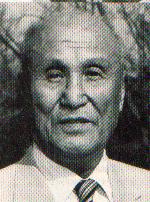
Choi Hong Hi was a 2nd Lieutenant at the 3rd. Battalion of Yong Dae Base. He was an exponent of Taekyon the Korean art of foot-fighting since his childhood days where he trained under his calligraphist tutor and Taekyon expert, Han Il Dong. In 1937 he left for Japan to further his studies and it was there that he intensified his martial arts where he attained his 2nd.dan in Karate. When World War II broke out he was implicated as the leader of the Korean Independence Movement and was imprisoned in the Japanese prison. With the liberation of Korea in August 1945 Choi's 7 year prison sentence was cut short. In January 1946 he was commissioned as a 2nd. lieutenant in the Korean army. His teaching of martial arts began here in Kwang Ju and later in the 2nd infantry regiment in Tae Jon. This spearheaded the spread of taekwondo.In the year 1952 at the height of the Korean War, Korea held a massive show of patriotism. Included in the agenda was the biggest martial arts display when all the Kwans of Korea displayed their skills.Major Nam Tae Hi stole the show when he smashed 13 roof tiles with a forefist punch. Subsequent to the demonstration, President Rhee Seung Man of Korea instructed General Choi Hong Hi to introduce the martial arts to all the Chief Of Staffs and the Korean army. In 1953 the Korean War ended and Choi organised the 29th. Infantry division at Che Ju island. It was here that he established the Oh Do Kwan -Do.; He merged the techniques of taekyon, tang soo do and karate,with the help of Major Nam Tae Hi of Chong Do Kwan - the largest civilian martial arts body in Korea. By the end of 1953 Chong Do Kwan has merged with Oh Do Kwan It was necessary to find a common name acceptable to all kwans of Korea something that has been attempted by others but have failed .
Naming Committee
A naming committee was formed. It comprised Major General Choi Hong Hi; General Lee Hyung Kun-the Joint Chief Of Staff of the Korean Army; Cho Kyung Kyu- the Vice Speaker Of Korean Assembly; Senator Chung Dae Chun; Han Chang Won-the President of the Korean Political Newspaper; Sung Duk Sung - the Director of Chung Do Kwan and Chang Kyung Rok, Hong Soon Ho, Ko Kwang Rae and Hyun Jong Myung - the representatives of the 5 major kwans of Korea.( By the 1950s there were about 40 splinter groups and so it was not possible to include such a vast group in the committee).The Naming Committe sat to propose a name to be submitted to President Rhee Seung Man for approval. The name of TAEKWON-DO was eventually accepted because it was meaningful, Tae means to kick and Kwon means to punch. Moreover taekwon-do sounded like Taekyon, the ancient art of Korean foot-fighting. Names like tang soo do ( art of the Tang Dynasty ) and kong soo do ( the art of empty hand - karate ) which was Chinese and Japanese inclined were dropped.
The name TAEKWON-DO was submitted to President Rhee Seung Man of Korea and it was endorsed by him. Taekwon-do was born - on 11th. April, 1955
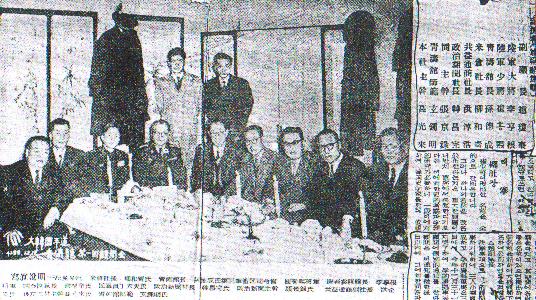
Yoo Hwa Chung, Son Duk Song ( Director Of Chung Do Kwan ), Maj. Gen. Choi Hong Hi, Gen. Lee Hyung Kun ( Joint Chiefs Of Staff ), Cho Kyung Kyu
( Vice Speaker), Senator Chung Dae Chun, Han Chang Won ( President Of Political Press ), Chang Kyung Rok, Hong Son Ho, Ko Kwang Rae,
Hyun Jong Myung


