

HQ address: 33A, JALAN TEMBIKAI, 14000 BUKIT MERTAJAM,
PENANG, MALAYSIA
Correspondence: 53, LORONG DESA PALMA, TAMAN DESA PALMA,
14000 BUKIT MERTAJAM, PENANG, MALAYSIA
Library Black Belt Club E-Commerce
Biomechanical techniques can be used with taekwondo to identify the factors underlying the successful performance. Knowledge and understanding can enhance the learning skills.
Peak velocity can be measured. It is an important component in generating force, illustrated in the equation :
F = MV/t.
The mass of the thigh and lower leg is constant. The force can be increased by maximising velocity and decreasing the duration of impact.
The acceleration of the kicking leg and the resultant impact is determined by the muscle forces and the impact is directly related to the measured strength of the practitioner.
The impact has strong relationship to torque produced by hip-flexion and knee extension.
Method
A good kicker should influence the effectiveness of the kick by changing the muscle tension in the muscles of the ankle.He should also create major forces at impact by reducing the swing time enabling him to create a large change in segment velocity at the knee.
The kicker should also produce extra velocity by rotating the supporting leg and countering with arm rotation in the opposite direction and drawing the torso sharply backward, additionally using muscular elasticity of hip flexors and knee extensions. Correct timing means higher velocity, thus greater impact.
Conclusion
Mastering all the above biomechanical principles of taekwondo shall give much added impetus .
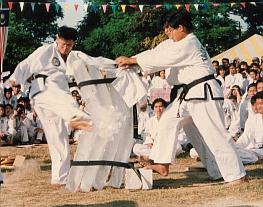
Theory
The front-turning kick is a kick that is relatively easy to learn but difficult to master.It involves rotational movements aimed at producing high velocity through the kinetic chain of body segments.Length of body segments determines the radius of rotational movements, thus influences the linear velocity of the kicking tool.
The role of the arm is to maintain balance and to increase the moment of inertia of the trunk.As the kicking foot contacts the target the arm moves foreward and then across the body to create a reaction force.


