

HQ address: 33A, JALAN TEMBIKAI, 14000 BUKIT MERTAJAM,
PENANG, MALAYSIA
Correspondence: 53, LORONG DESA PALMA, TAMAN DESA PALMA,
14000 BUKIT MERTAJAM, PENANG, MALAYSIA
Library Black Belt Club E-Commerce
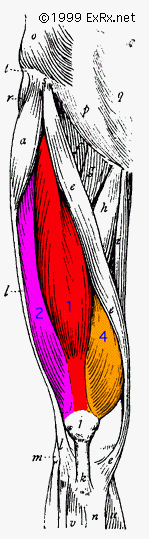
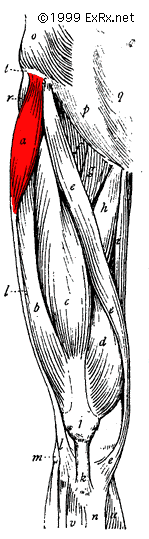
All limb movements are determined by torques at the joints. They are influenced by active muscle torque, gravitational torque and interaction torque created by different segments of the body.
The purpose of this study is to analyse how these torques influence the limb motion and identify the muscles involved and then design a training programme that strengthens the related muscle for high speed kicks.
5 top taekwondo exponents were made to undergo a predesigned training programme.For each session the front kick, side kick, back kick and front turning kick were investigated with the members using a medium L stance as preparatory stance. Muscle activities were recorded by electromyography (EMG).
Results
Results showed that there were differences in the kicking time among the kicks.The front kick and front turning kick to medium height was significantly faster(0.7 s) The step-in side kick was slower than all other kicks ( 1.09 s). The main muscles identified was the vastus lateralis and tensor fasciae latae which showed higher average activity when compared with other groups of muscles.Other parts - sartorius, rectus femoris and vastus medialis come in second. Muscle of the hamstring is less represented.
Subsequently an isokinetic training programme was designed with knee concentric extension & flexion at three sessions weekly to evaluate power performance training, setting the resistance mode at RPM 95 and progressively increasing, to train for fast twitch muscle fibre. These isokinetic concentric knee extension peaking torque at 240 degrees showed sufficient increase for the training group, reading taken after 24 training sessions.
Conclusion
The individual muscle group namely tensor fasciae latae and the vastus laterialis was seen to be the most active. Isolating the muscle groups using isokinetic training at 240 degrees angular velocity increased the muscle peak torque. By the method of variable workload there is significant muscle strengthening which is monitored and evaluated by KWON.


