

HQ address: 33A, JALAN TEMBIKAI, 14000 BUKIT MERTAJAM,
PENANG, MALAYSIA
Correspondence: 53, LORONG DESA PALMA, TAMAN DESA PALMA,
14000 BUKIT MERTAJAM, PENANG, MALAYSIA
Library Black Belt Club E-Commerce
and Mr. Roland Choong Taekwon ( 6th. Degree Blackbelt ). This remains the property of Kwon
Taekwon-do Academy. No part of this material may be reproduced for commercial purposes without the consent of
the owners.
Introduction
The science of biomechanics is concerened with the forces that act on the human body and the
effects these forces produce. It is only logical that serious taekwondoists should turn to
biomechanics to provide a sound scientific basis for the analysis of taekwon-do techniques.
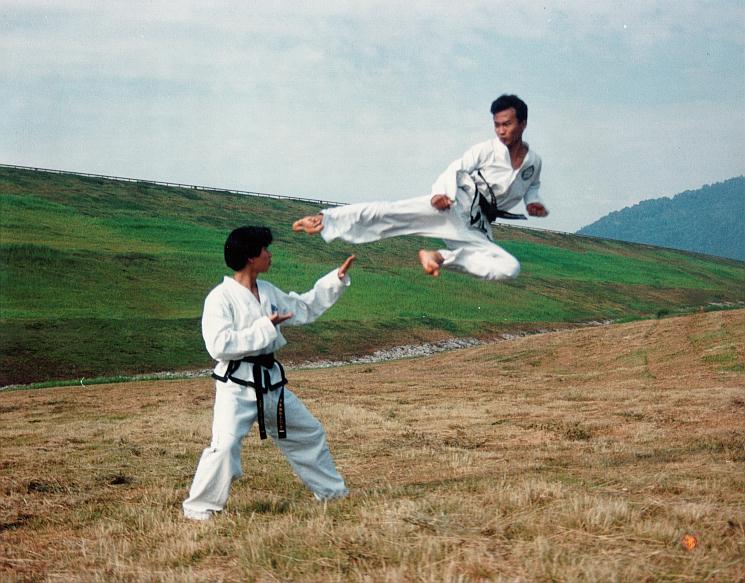
The High Jumping Sidekick
In the high jumping sidekick, the height that a taekwondoist achieves is divided into two parts
1. The height of the taekwondoist's centre of gravity at the take-off position
2. The height that the taekwondoist raises his centre of gravity after he has taken off.
The height of the centre of gravity during the take off depends on the taekwondoist's physique
and his starting position. Long legged taekwondoists have high centre of gravity and as such has
an advantage. The advantage will be more if he has long legs relative to the trunk.
The height that the centre of gravity rises is however governed by his vertical velocity and
the vertical impulse trasnsmitted through his jumping leg during take off.
Vertical velocity means the speed at which the body moves upwards.
In algebraic form:
__ l
s = t
__
where s is average speed, l - the length of path covered and t - time. Thus the vertical
velocity is obtained by dividing the displaced upthrust by the time taken.
__ d
v = t
__
where v is average velocity, d - displacement upward and t - time.
Vertical impulse means the force that the taekwondoist exerts on the ground when the body moves
upwards.
The magnitude of the vertical impulse depends on the forces involved - the arms, the leading leg, the
knee and the ankle joints of his jumping leg. It also depends on factors like the speed with which
the limbs move, the muscles of the jumping leg and the way the movements are coordinated.
Another factor that influences the magnitude of the vertical forces is the rotating of the body to
assume the required position for the jumping side kick and the speed of the extending foreleg.
To execute an ideal kick he must be in a good layout position at the peak of the jump.
It is also found out that the shorter the time of take off, the greater the veretical lift.
TECHNIQUE
The analysis of the techniques in the high jumping side kick are considered under 4 sub-headings-
the run-up, the take-off, the rotation and the landing.


