Blue Camas
from UVic's The Ring
on the Songhees Camas Restoration Project July-August 2005 キ Vol 31 キ No 7
Harvest time
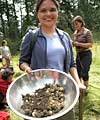
Songhees lands manager Cheryl Bryce holds up a bowl of camas bulbs freshly harvested from a campus meadow near Gordon Head Road. The Songhees (Lekwungen) Nation, supported by UVic's school of environmental studies, hosted a traditional harvest and pit-cook in the meadow on June 22. Various First Nations came to witness and take part in the event. The day included drumming, singing and a discussion on food security and access to traditional foods. UVic is in the heart of Lekwungen traditional territory where camas was an important and plentiful source of carbohydrates and an essential resource for trade.
Read more about camas
from Dr. Nancy Turner's Food Plants of British Columbia Indians: Coastal Peoples
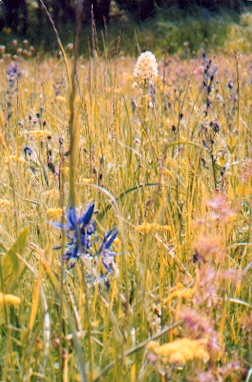 Death camas amongst the blue camas Death camas amongst the blue camas
Camas bulbs were a staple article of diet for many Indian groups of the northwestern United States, and were also widely used in British Columbia in areas where they were obtainable. They were especially important to the Coast Salish Indians of Southern Vancoubver Island, but were eaten to a lesser extent by the Sto:lo, Squamish, Sechelt, Comox, Nuu-chal-nuth, and Southern Kwakiutl. The Nuu-chah-nult often traded for them in the Victoria area, and the Kwakiutl obtained them from the Comox people. Methods of collection and preparation vary according to tradition, but generally the bulbs were dug during or after flowering, between May and August, and steamed in pits. Sometimes they were stored in cat-tail bags, but apparently they did not keep well.
Among the Vancouver Island Coast Salish, aboriginal harvesting and crop maintenance practices for camas can be termed 都emi-agricultural.・Large areas around Victoria, such as the grasslands of Beacon Hill Park and the small offshore islands of the Saanich Peninsula were frequented each year by the Saanich and Songhees peoples. The camas beds were divided into individually owned plots, passed from generation to generation. Each season these were cleared of stones, weeds and brush, often by controlled burning. Harvesting continued over several days, with entire families participating. The soil was systematically lifted out in small sections, the larger bulbs removed, and the sod replaced. Even within the present century, families would collect four to five potato sacks full at a time. Most of these would be used for a communal feast upon returning to the village.
The steaming pits used to cook the bulbs were usually several feet across and at least 2 feet deep. A fire was lit at the bottom and was allowed to burn until the rocks lining the pit were red hot. The ashes were then removed, the bottom leveled, and seaweed, blackberry, and salal branches, fern fronds or grand fir boughs were placed in. The bulbs (as much as 100 pounds at once) were placed over the vegetation. They were sometimes mixed with red alder or arbutus bark to give them a reddish colour. They were covered with more branches and then with soil or sand. Finally old mats or sacking were placed on top. Water was poured in through a hole made with a stick, and the bulbs were allowed to steam for a day and a half.
When cooked, the bulbs were soft, brownish and sweet. They were often used to sweeten other foods such as soapberries in the days before sugar was available.
Contrary to popular belief, the bulbs do not contain starch; instead, they contained stored carbohydrates in the form of complex sugar know as inulin.
Warning: care must be taken never to confuse the bulbs of the blue camas with those of the closely related death camas. The death camas has cream-coloured flowers which are smaller and in a tighter cluster than those of the blue camas.
|