
Friends of Glencoe Cove
|
Background |
Glencoe Cove has great potential as a site location that can be preserved and used as an outdoor centre for teaching the public about the past, for involving local school children in a more direct way of learning about the long history of this region. Glencoe Cove is within the 19th century traditional territory of the people who called themselves the Lekwungen. They became known by an anglicized version of one of their sub-groups, or extended family groups, as the Songhees. The descendants of these people live at present on the Songhees Reserve and the Esquimalt Reserve. At Glencoe Cove, south of the rocky point called Gordon Head are the remains of a prehistoric village. If you were standing on this spot around 1000 years ago just before the Battle of Hastings, you would see huge native houses with large post and lintel construction around the back end of Glencoe Cove. Based on the extent of the buried deposits and what is known of the region in general, we can make a probable estimate that the site dates back to about 1500 years ago. In the past people were sometimes buried in the ground at a village site or buried behind a village in tree burials, canoe burials, rock shelter burials or placed in the ground under a rock pile or burial cairn. Large boulders have been pushed over [ the bank]. These may be field boulders or the remains of other cairns that were once along the open areas back from the shoreline. The Songhees name for Gordon Head point provided to the ethnologist Wilson Duff 40 years ago by Songhees band elders Sophie Misheal and Ned Williams is “Kwatsech.” Unfortunately, much of this site has been destroyed by housing development and no archaeological studies have been undertaken here. The only information about the prehistory of Glencoe Cove lays buried in the ground. It is important that this site be preserved both for future studies of the information it contains and for its aesthetic historic value as a landscape where for hundreds of years human beings interacted with the environment in a way so different from that of us today and from which lessons can be learned.
|
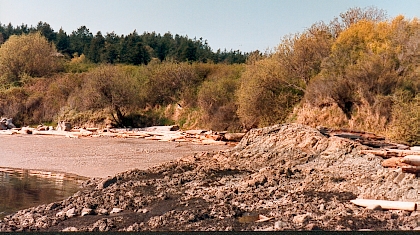 photo by Ann Chiddell